RAF Museum launches new dementia tour

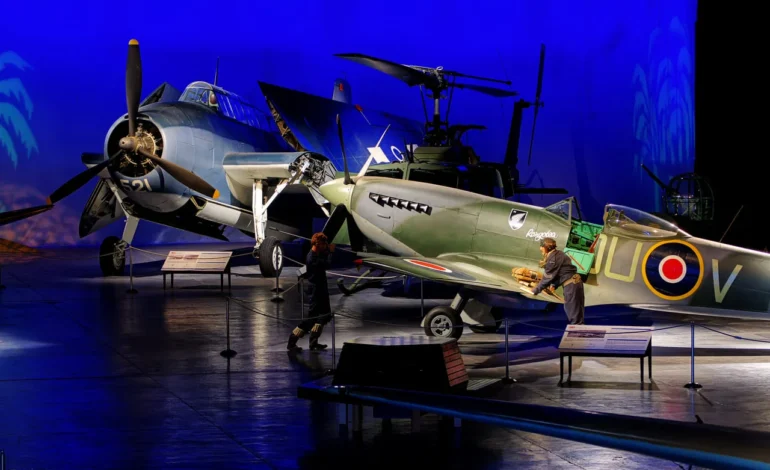
The RAF Museum London has launched a new dementia-friendly tour launching in 2026, replacing the First World War-focused version it has run since gaining accreditation under the capital’s Dementia Friendly Venues Charter. The new version drops the “First World War in the Air” exhibition as its anchor and instead centres on the museum’s Battle of Britain aircraft and collection, introducing participants to pilot Ray Holmes, WAAF Sergeant Joan Mortimer and the engineer Beatrice Shilling through photographs and handling objects during a 45-minute guided session.
The switch is a genuine change of material, not just a rebrand of an existing tour. Ray Holmes was the pilot credited with ramming a German bomber over Buckingham Palace in September 1940 rather than let it reach the target below. Joan Mortimer served as a WAAF sergeant during the same battle. Beatrice Shilling designed the small brass restrictor plate, nicknamed “Miss Shilling’s orifice” by the pilots who relied on it, that stopped Spitfire and Hurricane engines cutting out during steep dives. None of that material existed in the museum’s previous tour, which drew instead on the London Aerodrome’s founder Claude Grahame-White, the early Black pilot Robbie Clark, and the wartime diary of motor transport driver Grace Mary Berry.
What makes this more than an internal exhibition reshuffle is what it says about the raw material museums have to work with when building dementia-friendly programming. Reminiscence therapy, the underlying technique behind nearly all of this work, depends on autobiographical memory staying more intact than short-term recall in people with early-stage dementia. Multiple clinical reviews describe the same basic mechanism: reminiscence uses objects, sounds and photographs from a person’s own past to prompt memories that recent events can no longer reliably surface on their own. For a generation now in their eighties and nineties, the Battle of Britain sits inside living memory in a way the First World War, for all its objects and photographs, increasingly does not. A person who can no longer recall this morning’s breakfast may still remember exactly where they were during an air raid, or a relative who served.
The V&A took the opposite route architecturally, building touch and scent permanently into its redesigned Gilbert Galleries rather than reserving them for a single scheduled tour. Its approach works from decorative art: gold boxes, cowrie-shell graters, a scent station built around nutmeg, objects chosen because their intimacy and their tactile smallness invites a hand to reach out. The RAF Museum’s material does the opposite kind of work. A Spitfire cannot be picked up or passed around a table, so the tour instead relies on photographs and smaller handling items alongside the aircraft, using named individuals and specific wartime episodes rather than sensory intimacy to anchor the encounter. Where the V&A is building an environment, the RAF Museum is building a story with people in it, which is a different mechanism aimed at the same outcome.
The RAF Museum became one of the first venues accredited under London’s Dementia Friendly Venues Charter, a framework the Mayor of London launched with the Alzheimer’s Society in 2021 covering knowledge, inclusivity, accessibility, communication and sustainability. Toni Donston, the museum’s Access and Learning Officer, and Rhiannon Watkinson, its Community Engagement Manager, said at the time of accreditation that becoming a Dementia Friendly Venue was only a starting point rather than a finished project, a description that the shift from First World War to Battle of Britain material now bears out in practice: the accreditation covers the venue’s general commitment, but the specific tour content is clearly something the museum keeps revising rather than treating as fixed.
The tour is free, runs roughly 45 minutes, and is designed for people living with early-stage dementia to attend alongside a carer or companion, with refreshments beforehand and a meeting point at Hangar 1. Booking is essential and numbers are described by the museum as extremely limited for each session.
The RAF Museum has clearly worked out that a Spitfire only helps if it comes with a name attached to it, and EyeOnLondon will be watching to see whether other London collections follow that logic rather than just adding a quiet room and calling it done.
For more London arts and culture, visit EyeOnLondon at eye-on-london.com
Follow us on:



Subscribe to our YouTube channel for the latest videos and updates!

We value your thoughts! Share your feedback and help us make EyeOnLondon even better!