Aigul Akhmetshina Turns Femme Fatale Cliché Into Real Drama on Mujer Fatal, Alongside New Mahler, McCabe and a Forgotten Giordano

This month’s four releases run the full range of forces, from Mujer Fatal, Aigul Akhmetshina’s new Decca recital with Antonio Pappano, to the massed sound of opera and symphony orchestra. Two of them arrive after decades in the wilderness: Giordano’s Marina waited 138 years for its first performance, and John McCabe’s symphonies still await the recognition British music has been slow to give them.

Mujer Fatal
Songs by Montsalvatge, Bizet, Ravel, Satie, Tchaikovsky, Rimsky-Korsakov, Minkov, Gershwin, Bernstein and Weill, plus the world premiere of Roussanova’s Mujer Fatal
Aigul Akhmetshina — Mezzo-soprano
Sir Antonio Pappano — Piano
Decca 4872240
Akhmetshina has one of those full mezzo voices that always sound deeper than it actually is, and she maintains that richness throughout her range, with just a slight tremble to add character. Her recent acceptance as a British citizen means that we can benefit from her intelligent singing for a long time to come, I hope. This recital follows the idea of the woman who is dangerous to know, taking the cue, without including any of the opera, from Carmen. The title Mujer Fatal comes from the opening song by Elena Roussanova (b. 1974), a real discovery. Akhmetshina follows it with a series from the Spanish repertoire before moving into Spanish sounding French songs by Bizet and Ravel, Satie’s boulevard chanson Je Te Veux, then into her native Russian. Of these, Rimsky-Korsakov’s exotic The Nightingale and the Rose and Mark Minkov’s (d. 2012) setting of Lorca, Landscape, from a cycle called The Crying Guitar, are the most engaging. Aside from being a big name conductor, Antonio Pappano has been accompanying singers all his professional life, and his careful touch, always supporting, never intruding, is beautifully judged throughout. His background growing up in America means that his backing in the standards by Gershwin (The Man I Love), Bernstein (Somewhere from West Side Story) and Kurt Weill’s Speak Low from One Touch of Venus catches the idiom naturally. Akhmetshina is just too operatic in this Broadway repertoire. That does leave the majority of the album, though, as high octane pleasure.
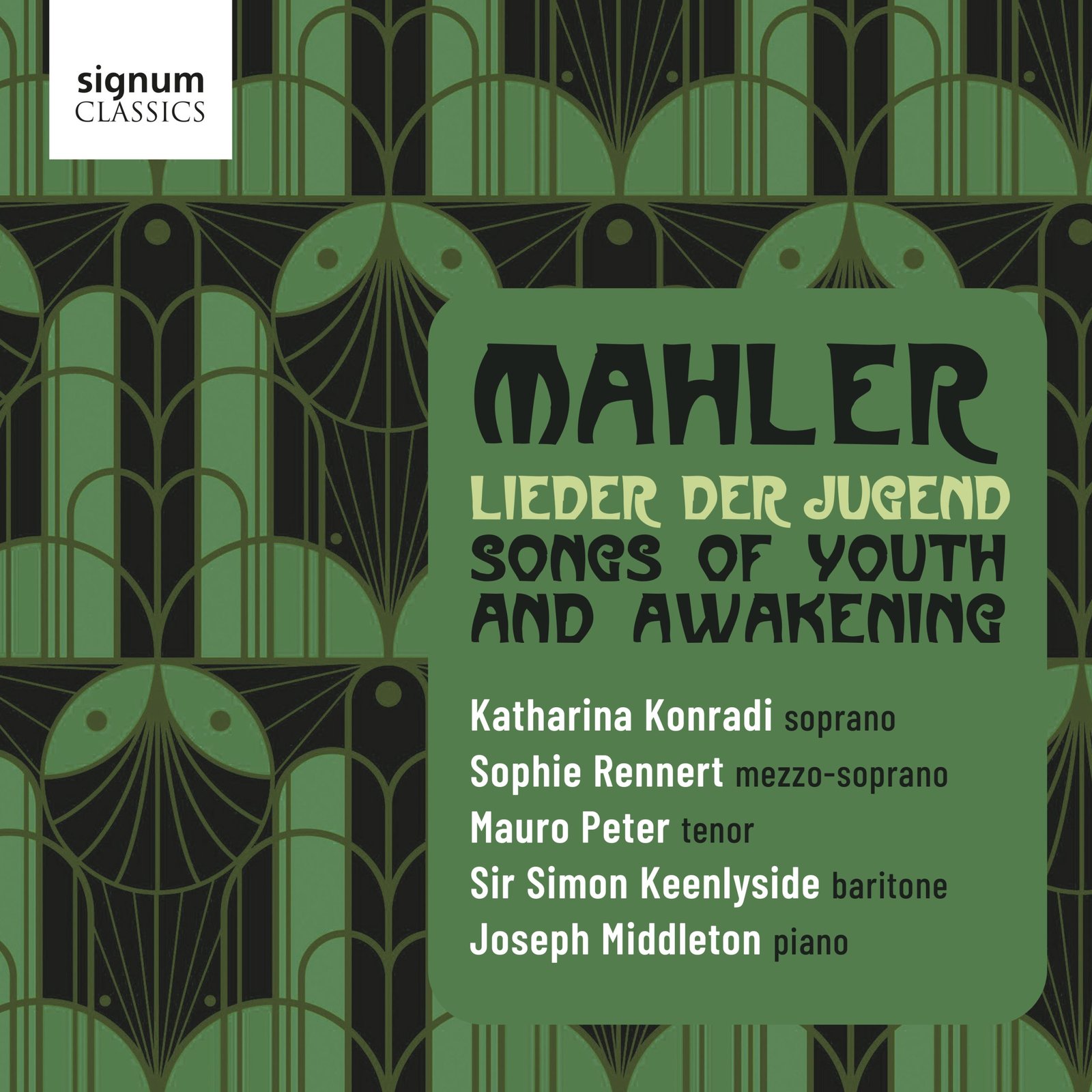
Mahler
Lieder der Jugend, Lieder eines Fahrenden Gesellen
Katharina Konradi — Soprano
Sophie Rennert — Mezzo-soprano
Mauro Peter — Tenor
Sir Simon Keenlyside — Baritone
Joseph Middleton — Piano
Signum Classics SIGCD1006
Mahler gave so many of his songs great orchestral settings, often in his symphonies, that hearing them as songs with just piano is disconcerting. They feel as if they are somehow too big for their clothes and straining to break out. Joseph Middleton argues that this is not anomalous. “The lied evolved as a piano genre precisely because the instrument is uniquely capable of suggesting a wide range of instrumental colours and textures.” That may be true, but Mahler’s music is magical with orchestra, merely good with piano, however subtle Middleton’s playing. There is fury, desperation and emotional energy in the songs that pushes them into a much bigger realm than the drawing room. The four singers here, excellently chosen, underline the sense of scale, though Sophie Rennert also catches the intimacy of I Walked With Joy through a Green Wood in the Songs of Youth. She also catches finely the bittersweet Never to Meet Again, which has pre-echoes of the later Rückert Lieder. These are not a cycle but a collection from his early twenties, the first half of the 1880s. They form the bulk of the album, before Simon Keenlyside concludes with the four Songs of a Wayfarer, which do form a unified set. He is magnificent, but oh, I long for an orchestra to be with him!

Giordano
Marina
Eleonora Buratto — Marina (Soprano)
Freddie De Tommaso — Giorgio Lascari (Tenor)
Mihai Damian — Lambro (Baritone)
Nicholas Mogg — Daniele (Baritone)
Chorus of the Teatro Petruzzelli Foundation
I Pomeriggi Musicali de Milano Orchestra
Vincenzo Milletarì — Conductor
Decca 576 7566
Umberto Giordano (1867 to 1948) is one of those composers who are known these days for only one work, Andrea Chénier, which has remained in the repertoire of most major opera houses. This is unfair, because he was an accomplished contemporary, if a decade younger, than Puccini, and was thought of in his time as on a par with him. Marina is a student work, submitted to a competition in 1888, and never performed until this year. Ironically the story is all too close to us, set in war in the Western Balkans, in this case between Montenegro and Serbia. Marina and her brother are Montenegran, Giorgio a wounded Serb. From then on the brutal chaos accelerates in true operatic style, with Lambro the vengeful killer. As a late Romantic opera it is musically impressive for a twenty-one year old composer, with the tension maintained at a high point all the way through its one act, lasting an hour, but there are some gorgeous moments of lyricism too. Giordano’s score has been languishing in the Koch collection at Yale University since 1986, and it deserves this belated airing from an excellent quartet of soloists and an orchestra and chorus for whom the verismo style is their natural environment. All concerned deserve the thanks of opera lovers, and it would be good if it found a stage elsewhere: Wexford or Savonlinna, which is staging Andrea Chénier next year, perhaps.

McCabe
Symphonies 2 & 3, Cello Concerto
Raphael Wallfisch — Cello
BBC Scottish Symphony Orchestra
Kenneth Woods — Conductor
Signum Classics SIGCD1007
On my desk is a photograph from the 2005 Presteigne Festival. From right to left are the composers Cecilia McDowall and John McCabe, the poet Jo Shapcott, pianist Paul Plummer and, reclining on a tomb in the churchyard, soprano Rachel Nicholls. I stand leaning against the stone beside Rachel. It was taken after the premiere of John and Jo’s song cycle, Gladestry Quatrains, and Cecilia and my Radnor Songs, which Rachel later recorded in an orchestral version. This was ten years before John died at the age of 75. He was part of that generation of modern composers who emerged in Britain in the 1960s, like Peter Maxwell Davies and John Tavener, and, perhaps along with Max, he can be seen now as the most significant symphonist among them. He wrote seven in all, and the pair recorded here were composed in 1971 and ’78 respectively. It feels strange that his work was ever thought difficult. It is far more approachable than the other composers who studied in Manchester at the time, like Max again and Harrison Birtwistle. His orchestration is consistently superb, and his writing follows musical, not mathematical, logic. He also believed in music that combined rhythmic momentum with thoughtful thematic material that almost never became rhetorical. This is illustrated well by his later Cello Concerto, subtitled Songline, from 2007. The middle slow movement, three times as long as the outer movements, is one long meditation by the soloist accompanied by delicate orchestral comments. Wallfisch and Woods are both seasoned champions of good works by undercelebrated British composers. And McCabe’s works will, I am sure, only grow in importance.
Start with Mujer Fatal if you want the sheer voice, but McCabe’s Cello Concerto is the disc that will follow you around. EyeOnLondon says try both.
For more London arts and culture, visit EyeOnLondon at eye-on-london.com.
Further Reading on EyeOnLondon
- April classical CD reviews — an earlier Simon Mundy roundup in the same original-voice format, useful for readers who want more of his multi-album criticism
- Faure Prokofiev and Brahms classical CD reviews — another Mundy roundup building the same cluster of EyeOnLondon’s original classical criticism
Follow us on:



Subscribe to our YouTube channel for the latest videos and updates!

We value your thoughts! Share your feedback and help us make EyeOnLondon even better!