JWST Reveals How Young Planetary Systems Lose the Gas Needed to Build Giant Planets

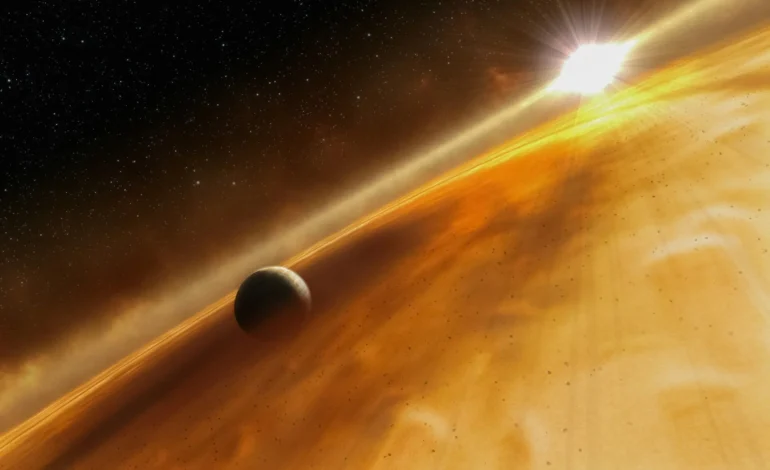
The gas surrounding a young star does not last forever, and new observations from NASA’s James Webb Space Telescope (JWST) are showing astronomers how that disappearing supply changes as planetary systems develop.
A study led by Naman Bajaj of the University of Arizona, with SETI Institute scientist Uma Gorti among its co-authors, examined 72 young stars similar to the Sun and the planet-forming disks surrounding them. Published in The Astronomical Journal, the research provides one of the largest JWST studies yet of how these disks lose their gas.
That process matters because giant planets such as Jupiter and Saturn need large quantities of gas to build their thick atmospheres. If the surrounding disk disappears before those atmospheres can form, a developing planet may be left without enough material to become a gas giant.
Using archival observations from the Mid-Infrared Instrument (MIRI) of the JWST, the researchers traced escaping gas through emissions from molecular hydrogen and ionized neon. They detected extended emissions from one or both tracers in 66 of the 72 systems. Conical molecular hydrogen winds were identified in 46 systems, while fast-moving neon jets appeared in 40.
The observations also reveal a shift in how young systems lose their gas. In the youngest systems, powerful jets and broad winds are associated with magnetic fields within the planet-forming disk. These outflows can carry gas and angular momentum away from the disk while material is still falling towards the young star.
As the systems mature and that inflow declines, the jets become weaker. High-energy radiation from the young star can then penetrate the thinning disk, heating gas until it escapes in a process known as photoevaporation.
The findings suggest that disk dispersal is not controlled by one mechanism throughout a planetary system’s early life. Instead, magnetically driven outflows appear to be particularly important early on, while radiation-driven winds become increasingly significant later.
The researchers now want to establish how much gas these different winds remove and where in the disk the escaping material originates. That could help astronomers determine how the changing gas supply influences the types of planets that ultimately emerge.
For more, visit EyeOnLondon at eye-on-london.com
Follow us on:



Subscribe to our YouTube channel for the latest videos & updates!

We value your thoughts! Share your feedback and help us make EyeOnLondon even better!