Devon farmland gives up Britain’s westernmost Roman mosaic

A flower with eight petals, picked out in thousands of stone cubes no bigger than a fingernail, has spent roughly seventeen hundred years under a Devon field between the villages of Halberton and Sampford Peverell. Archaeologists have now lifted it, piece by piece, and confirmed what they suspected from the moment the first coloured tesserae appeared in the soil: it is understood to be the most westerly example of a polychrome mosaic yet found in the country.
That single geographical fact is the reason this dig matters beyond Devon. Roman Britain had a capital, Londinium, roughly where the City of London stands today, and it had an edge, the point beyond which the empire’s wealth, its building styles and its taste for elaborate flooring simply stopped reaching. This villa sits close to that edge. Understanding what was found there means understanding how far Rome’s version of civilisation actually travelled, and how thin it got by the time it arrived.
Archaeologists have uncovered a rare and intricate polychrome mosaic within the remains of a Roman villa sitting beneath Devon farmland, consisting of thousands of red, white and dark blue or grey cubes, the twelve square metre mosaic likely installed sometime in the fourth century A.D.
Away from the main villa, an elaborate bathhouse with at least two plunge pools and painted plaster walls has also been uncovered, along with Roman artefacts including a beautiful intaglio depicting the goddess Victory.
The combination of these items suggests the villa was occupied by people of wealth and status, living a very Roman lifestyle, and such opulence is rare in this part of the south-west in the Roman period, with only a handful of villas known.
Roman archaeology in Devon has always looked thin compared with the villa-dense counties further east, Gloucestershire, Somerset, Wiltshire, where estates cluster in the hundreds. Research into the wider south-west region has long noted that villas become markedly scarcer once you cross the River Exe heading west, and that the last general survey of Roman Devon is decades old. A site like Halberton, fully excavated and fully published, is rare precisely because so few comparable Devon villas have been.
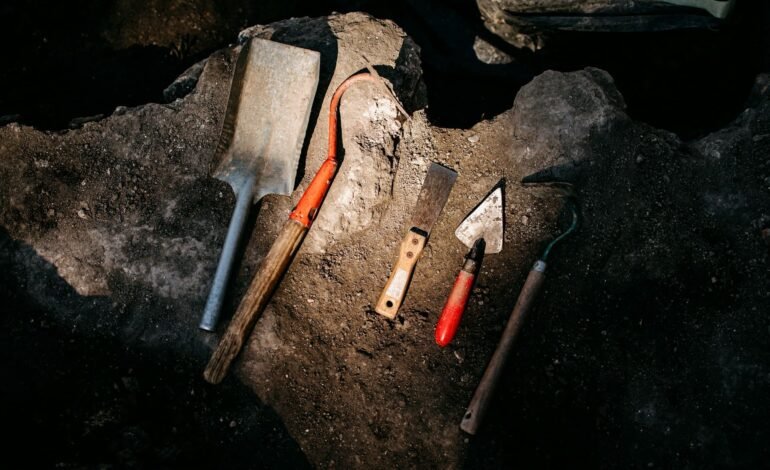
The discoveries followed a two-month dig on the farmland, led by archaeologists at the University of Exeter and Cotswold Archaeology, funded by a grant from The National Lottery Heritage Fund, as part of the SHARE (Saving Halberton’s Ancient Roman Environment) project, a partnership with Devon County Council, Tiverton Archaeology Group, and the Sampford Peverell Society.
The project has attracted scores of community volunteers as well as archaeology students from the University. It is believed to have covered the floor of one of the villa’s rooms, potentially a dining or reception room, and consists of tiny twelve millimetre square stone cubes.
At its heart, the tesserae form a roundel with a stylised flower with eight overlapping teardrop-shaped petals, with interlaced squares and a common Roman pattern of a pair of knotted lines surrounding it, and larger, coarser off-white limestone mosaics around the perimeter to cater for higher traffic areas.
The border pattern, a twisted braid called guilloche, is one of the most recognisable motifs in Roman decorative flooring, and it turns up in mosaics found hundreds of miles away under very different circumstances, which is where London comes in.
In February 2022, archaeologists working near London Bridge, on a site overshadowed by the Shard, found a large and strikingly well-preserved Roman mosaic of their own. That floor, dated to the late second or early third century, featured a square of white tiles enclosing floral and geometric shapes in blue and dark red in the pattern known as guilloche, laid within a large red field.
Archaeologists suspect it came from the dining room of a wealthy Roman house, or possibly a mansio, a resting spot to entertain high ranking travellers.
London already had its own famous example from more than a century earlier. The Bucklersbury Pavement, an exquisite two thousand year old Roman floor mosaic discovered in central London, was a sensation when it was found in 1869 and has remained one of the most important relics from Londinium.
Set the Devon flower against either of these and the pattern language is recognisably the same empire-wide vocabulary, guilloche borders, geometric infill, a room built for reclining and dining. The difference is not craft, it is context: London’s mosaics sat inside a provincial capital of some 3,000 acres built to project Roman authority, while the Halberton floor sat in a working farmhouse near the western frontier of that authority’s reach.
Roman villas are rare in the south-west of Britain, with only a handful confirmed through excavation, which is what makes the discovery at another villa, on the Isle of Wight, of a mysterious eighteen year gap in its coin record such a useful point of comparison for how much a single site can still surprise archaeologists.
The Halberton site’s own history is not confined to the mosaic room.
Scores of community enthusiasts have taken part in the excavation of two large trenches, working alongside sixty-five archaeology students and professional project members, revealing that the villa’s layout is bigger than first thought, extended several times from its original, modest rectangular dimensions.
Additional rooms were added to the north and south ends, and walls and a rainwater gulley have been found to the rear, suggesting a practical area for storage or kitchens, with hints of a timber staircase suggesting part of the villa may have been two storeys.
Two further stone-built structures were also excavated, one containing at least two large water tanks believed to be a plunge bath, built of opus signinum, a waterproof Roman concrete, and the other a large rectangular building that may have been a barn or agricultural space, given the quantities of animal bone and worked antler found nearby.
The smaller finds fill out the picture of who actually lived here.
Among the items recovered are an intaglio, a blue glass ornament originally set within a ring and used to seal wax documents, a delicate copper alloy bangle found sitting on top of the mosaic, and a fine silver-plated spoon unearthed in one of the villa rooms.
There were numerous pieces of pottery too, including an indented beaker used for serving drinks, a piece of Samian ware mortarium with a lion’s spout located near the bathhouse, an enormous storage jar, and a natural piece of flint most likely used as a mixing palette or mortar for paint or cosmetics.
The villa first came to wider attention in 2004, after a local metal detectorist found Roman material in the area, and fieldwalking, metal detecting and geophysical surveys have since revealed several phases of buried archaeology.
Having fully uncovered the mosaic, specialists are now carefully lifting it so that it can be conserved, and later put on display at Tiverton Museum of Mid-Devon Life, along with the other artefacts recovered.
This year’s dig is the first of three annual visits to the site, with future excavations set to concentrate on the wider estate on neighbouring land.
Whatever emerges next will be measured against the same question this year’s find already answers. Rome’s reach into Britain was never uniform. It thinned as it moved west, but the guilloche border on a Devon dining room floor and the one under a London office block are the same pattern, laid by the same imperial culture, at opposite ends of how far that culture actually stretched.
For more London arts and culture, visit EyeOnLondon at eye-on-london.com
Follow us on:



Subscribe to our YouTube channel for the latest videos and updates!

We value your thoughts! Share your feedback and help us make EyeOnLondon even better!