Venus and Jupiter Set for Close June Meeting as Rare Moon Event Follows Days Later

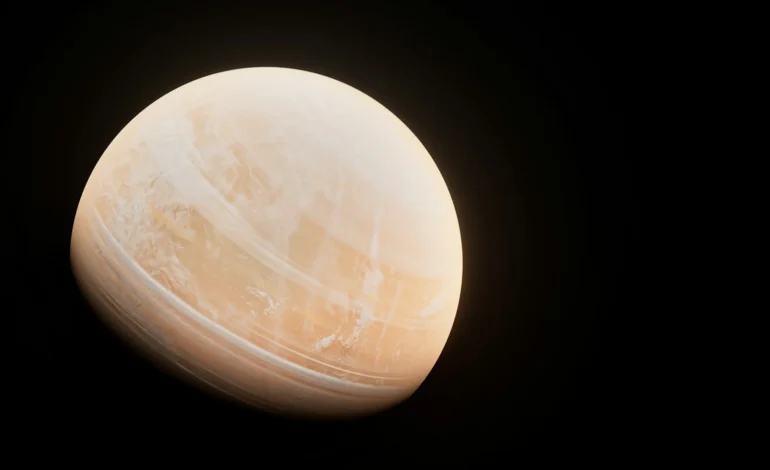
June brings several notable events for skywatchers, including a close pairing of Venus and Jupiter, a rare occasion when the Moon passes in front of Venus, and the arrival of astronomical summer.
Anyone looking toward the western horizon shortly after sunset during the first half of the month will be able to spot Venus and Jupiter appearing unusually close together in the evening sky. Around 9 June, the two bright planets will be at their closest apparent separation from Earth’s perspective, creating one of the month’s most eye-catching celestial displays.
As interest in the Solar System continues to grow, recent research has also helped scientists better understand Saturn’s rotation and the complex processes taking place around the giant planet. Historical observations remain an important part of modern astronomy, with researchers recently revisiting medieval records that may change what we know about the earliest sightings of Halley’s Comet.
The planets are not actually near one another in space. Instead, they appear close because they follow a similar path across our sky known as the ecliptic. The display becomes even more striking between 11 and 15 June when Mercury joins Venus and Jupiter low above the western horizon. The result is a brief three-planet gathering visible after sunset for observers with a clear view of the sky.
Venus will be the easiest object to identify thanks to its brightness, while Jupiter will appear nearby. Mercury will sit much lower and may be harder to spot before twilight fades.
Another highlight will arrive on 17 June when the Moon passes directly in front of Venus for observers located within a specific viewing path across parts of the Americas. Known as a lunar occultation, the event will cause Venus to disappear behind the Moon before reappearing later. The occultation will be visible from parts of the United States, Canada, Brazil, and Venezuela. Outside the path of complete coverage, many observers will still see the Moon and Venus appearing unusually close together.
Some locations will experience the event during daylight hours. Anyone using binoculars, telescopes or cameras should avoid pointing equipment near the Sun without proper solar protection, as doing so can cause serious eye damage.
The month also includes the June solstice on 21 June, marking the start of astronomical summer in the Northern Hemisphere. As the season begins, the Summer Triangle and a range of popular deep-sky observing targets will start to rise into view during the evening.
For anyone interested in astronomy, June offers several opportunities to observe changing positions in the Solar System and some of the brightest objects visible in the night sky.
Planning to watch the conjunction? Keep an eye on our science coverage for more astronomy events and space discoveries visible from Earth this year on EyeOnLondon.
Follow us on:



Subscribe to our YouTube channel for the latest videos and updates!

We value your thoughts! Share your feedback and help us make EyeOnLondon even better!