James Webb Space Telescope solves Saturn rotation mystery through aurora-driven winds

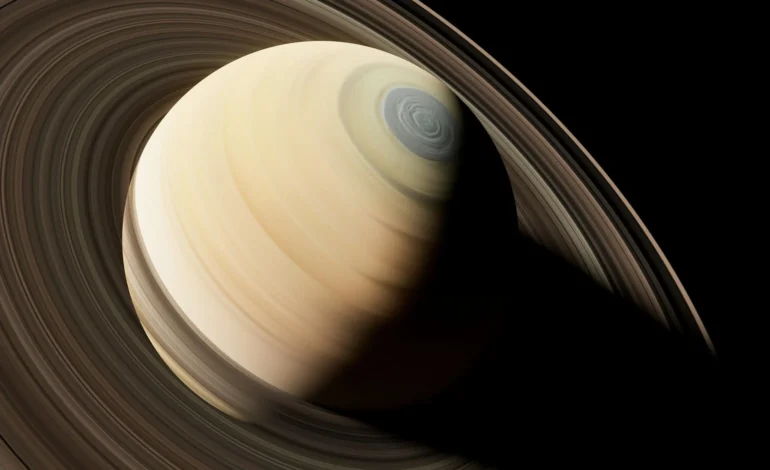
For years, Saturn appeared to be doing something scientists could not fully explain. Measurements suggested the giant planet’s rotation rate was changing over time, raising a question that puzzled planetary researchers for decades. New observations from the James Webb Space Telescope have now solved that mystery.
The findings show Saturn was never speeding up or slowing down at all. Instead, powerful winds high in the planet’s atmosphere were distorting the magnetic signals scientists had been using to estimate its spin. The breakthrough confirms a theory first proposed in 2021 by Professor Tom Stallard and colleagues at Northumbria University, who argued that Saturn’s apparent rotation shifts were being caused by atmospheric activity rather than any real change in the planet’s spin.
The discovery offers another reminder of how much remains to be learned about the universe, echoing recent work where undergraduate researchers built a cosmic radio system to search for dark matter. As scientists explore whether future missions could dramatically cut travel times to Uranus, understanding how giant planetary atmospheres behave is becoming increasingly important. The findings also connect with wider research suggesting that unusual atmospheric patterns may one day help reveal evidence of alien life beyond our solar system.
Using Webb, researchers observed Saturn’s northern auroral region continuously across a full Saturnian day. By tracking infrared light emitted by the trihydrogen cation molecule, the team produced the most detailed temperature maps yet of the planet’s upper atmosphere.
Earlier measurements carried uncertainties of around 50 degrees Celsius, making subtle atmospheric changes difficult to detect. Webb’s data proved roughly ten times more precise, allowing scientists to pinpoint localised heating and cooling patterns for the first time. Those patterns revealed what appears to be a self-sustaining planetary heat pump.
Energy from Saturn’s aurora heats parts of the atmosphere. That heating generates fast-moving winds, which then create electrical currents. Those currents feed energy back into the aurora, sustaining the cycle. It is this atmospheric process that changes the electrical signals scientists detect, creating the illusion that Saturn’s rotation is shifting.
Researchers say the study strengthens evidence that Saturn’s atmosphere and magnetosphere are closely connected, with energy flowing continuously between them. That relationship could also exist elsewhere in the solar system.
The study, published in the Journal of Geophysical Research: Space Physics, involved researchers from Northumbria University, Boston University, the University of Leicester, Aberystwyth University, the University of Reading, Imperial College London, Lancaster University and Johns Hopkins University Applied Physics Laboratory. Funding was provided by the Science and Technology Facilities Council (STFC).
What James Webb is revealing about our solar system is reshaping planetary science in real time. Explore more science reporting at EyeOnLondon.
Follow us on:



Subscribe to our YouTube channel for the latest videos and updates!

We value your thoughts! Share your feedback and help us make EyeOnLondon even better!