Newly Discovered Neutron Star Challenges Decades of Astronomical Theories

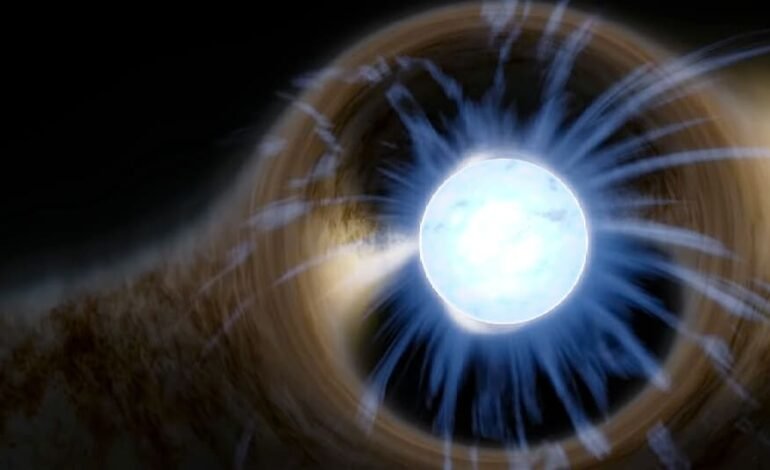
Astronomers report a newly discovered neutron star so unusual that it may reshape our understanding of these dense stellar remnants. Detected by the ASKAP radio telescope in Western Australia, the ‘zombie star’, named ASKAP J1839-0756, lies 13,000 light years away and rotates at an extraordinarily slow pace of 6.45 hours per spin. This makes it the slowest-spinning neutron star ever observed to emit radio waves, and the discovery is sparking excitement and debate within the scientific community.
Typically, neutron stars—created when massive stars explode in a supernova—are known to spin rapidly, emitting radio pulses as they rotate. These pulsars can complete several rotations in just a second. However, this new discovery joins a growing list of long-period radio transients, or slow-spinning pulsars, which emit pulses far less frequently. The previous record holder had a 54-minute period, but ASKAP J1839-0756 blows that out of the water.
Discover More Science & Environment Stories on EyeOnLondon
Stargazing Events to Look Forward to in 2025
What sets this newly discovered neutron star apart is its unusual “interpulse,” a weaker radio emission from the opposite magnetic pole. Astronomers initially suspected it could be a white dwarf, but its size and emission properties ruled that out. Another possibility is that it’s a magnetar—a type of neutron star with a magnetic field trillions of times stronger than Earth’s most powerful MRI machines. However, no magnetar with such a slow rotation has ever been observed to emit radio waves, leaving scientists scratching their heads.
Dr Manisha Caleb, who led the team at the University of Sydney, describes ASKAP J1839-0756 as one of the most bizarre objects discovered in recent years. “This new object is completely rewriting what we thought we knew about radio emissions from neutron stars,” she said. “It challenges our understanding of how slow a pulsar can spin while still emitting radio waves.”
Traditionally, pulsars were thought to cease emitting radio signals once their rotation slowed beyond a certain point, crossing a so-called “death line.” But discoveries like ASKAP J1839-0756 defy this theory, behaving like “zombie stars” that continue to pulse despite expectations.
The implications of this discovery are profound, prompting scientists to revisit long-standing assumptions about neutron stars and their behaviours. For the UK’s space enthusiasts, this marks another thrilling chapter in our quest to unravel the mysteries of the cosmos.
To learn more about the cutting-edge research conducted by the ASKAP radio telescope, visit the CSIRO ASKAP project page.
Journal citation: Nature Astronomy. DOI: 10.1038/s41550-024-02452-z
For more insights into groundbreaking astronomical discoveries, visit EyeOnLondon.
Follow us on:



Subscribe to our YouTube channel for the latest videos and updates!

We value your thoughts! Share your feedback and help us make EyeOnLondon even better!