Crystal Palace sports centre faces overhaul as heritage meets modern demands

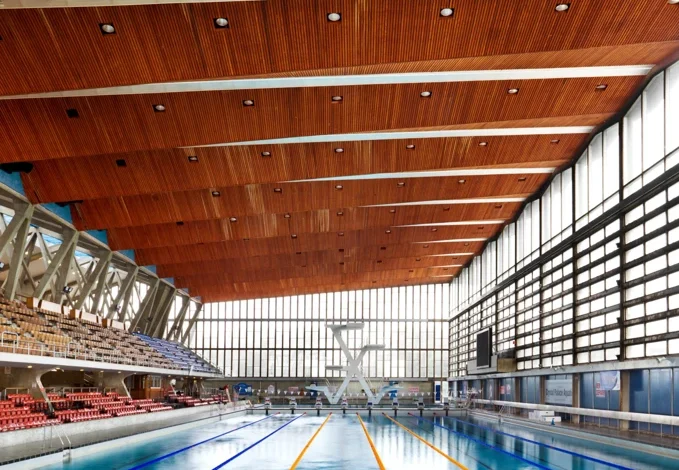
In Crystal Palace, where five boroughs meet and the park still carries the memory of the great glass palace that once stood there, a quieter but no less important decision is taking shape.
Plans to redevelop the National Sports Centre, first built in the early 1960s, have been backed by Historic England this week, with the clear message that modernisation does not have to mean starting again.
More reporting from EyeOnLondon
Policy, science and global developments shaping London’s wider world.
The building itself has never been subtle. Its concrete A-frame still cuts across the skyline with a kind of post-war confidence, and inside there is that rare thing in London, a sense of space that feels almost generous. It is the sort of place many people recognise even if they have not been inside for years.
What is being proposed now is not a replacement but an adjustment. The Greater London Authority’s scheme would improve energy efficiency, accessibility and circulation, while keeping the structure and atmosphere that define the building. Historic England, which has been involved in shaping the plans before submission, has described the approach as one that retains “the key characteristics which contribute to its architectural significance”.
That phrase can sound technical. In practice, it comes down to something more intuitive. Does the building still feel like itself when you walk through the door.
One of the more telling changes is the introduction of a glazed partition between the pool and the surrounding sports areas. It is a practical move, designed to manage heat and humidity, but it has been handled carefully to avoid breaking the visual openness that gives the space its character. The aim is not to divide the building, but to make it work better without losing that sense of continuity.
Elsewhere, later additions that have gradually cluttered the layout are set to be removed. Anyone who has navigated the entrance in recent years will recognise the problem. What was once clear has become muddled. Restoring that clarity is not just aesthetic, it changes how people move, gather and use the space.
Lee Askey, operations director at Morgan Sindall, described the project as “a once in a generation opportunity” to bring the centre up to modern standards while keeping its identity intact. That language is familiar in redevelopment schemes, but here it carries a little more weight. The building is not an empty site. It already works, just not as well as it should.
Historic England has been equally direct about what matters. The centre is “a much-loved building with an innovative and memorable post-war design”, and while some original materials will inevitably be lost, the overall scheme has merit if the replacements are handled with care.
That question of loss sits just beneath the surface of the whole project. London has spent decades knocking down and rebuilding in the name of progress. More recently, there has been a shift, not always consistent, but noticeable. The idea that reuse, adaptation and patience might offer something better than demolition.
The sports centre sits inside Crystal Palace Park, itself listed and shared across borough boundaries, which gives the decision a wider resonance. This is not just about a single building, but about how a piece of civic infrastructure fits into the life of a city.
The Greater London Authority’s broader planning work reflects that tension. Its emerging strategy for London, which you can see set out in its own programme for future development, is trying to answer a similar question at scale. How to deliver change without stripping places of the character that made them worth building in the first place.
In Crystal Palace, that question has become concrete, quite literally. The outcome is not final, and further details on materials and design are still being worked through. But the direction is clear enough.
London is beginning, cautiously, to treat its recent past as something to work with rather than clear away.
Follow EyeOnLondon for clear reporting on how London’s architecture, heritage and public spaces continue to evolve.
[Image Credit | Historic England]
Follow us on:



Subscribe to our YouTube channel for the latest videos and updates!

We value your thoughts! Share your feedback and help us make EyeOnLondon even better!