Dante’s Eternal Muse: The Unforgettable Beatrice Who Shaped a Masterpiece

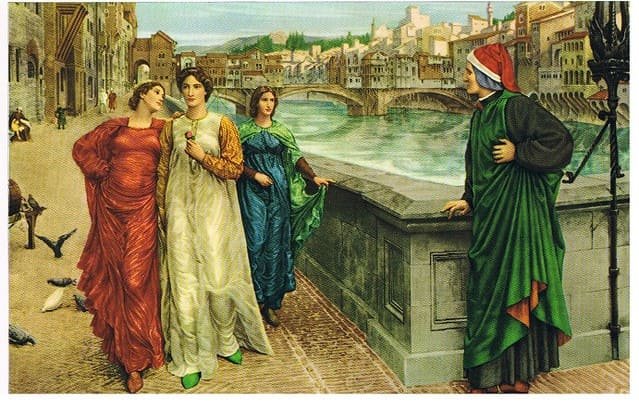
Beatrice Portinari, Dante’s eternal muse and the great love of Italian poet Dante Alighieri, may have only crossed his path twice, yet her presence left an indelible mark on his life and work. In the world of literature, few muses have captivated the imagination quite like Beatrice. For Dante, she was not only the subject of unrequited love but a divine figure guiding him through the celestial realms in his epic work, The Divine Comedy.
Born into a prominent Florentine family, Beatrice married another wealthy banker, Simone de Bardi, in an arranged marriage. Dante, too, was bound by social obligations, marrying Gemma Donati. But it was Beatrice who occupied his heart and soul, inspiring poetry that transcends the centuries. Her mere appearance as a child in a “most noble colour, crimson girded” captivated young Dante, igniting a passion that would last a lifetime.
Related Articles on Literature and Art
A Love That Inspired Literature’s Finest Work
In his Vita Nuova, Dante recounts his first encounter with Beatrice, describing her beauty and elegance. Although they interacted only briefly, her image haunted him, leading him to immortalise her in words. In The Divine Comedy, Beatrice appears as his divine guide through paradise, an idealised symbol of love, purity, and faith. Her presence in his poetry represents not just romantic love but the pursuit of spiritual salvation.
The scholar Jorge Luis Borges remarked that Dante “created literature’s finest work so as to stage therein some encounters with the irrecoverable Beatrice.” Dante’s love for Beatrice was so powerful that he elevated her to a near-divine status, making her both a literary figure and an allegorical representation of faith. Her influence transformed his writing into a blend of earthly love and spiritual devotion.
The Enduring Mystery of Beatrice
No portraits of Beatrice survive, leaving her appearance a mystery. Was she blonde or brunette? Fair or dark? We’ll never know. Centuries later, the Pre-Raphaelite artist Dante Gabriel Rossetti painted her as a slender, ethereal beauty with red hair, using his own muse, Elizabeth Siddal, as the model. Yet, without a true likeness, readers are free to imagine their own vision of Dante’s Beatrice, seeing in her any woman who might have once stirred their hearts.
Beatrice’s untimely death at around twenty-four only deepened her mystique. For Dante, she became an eternal figure, symbolising both the beauty and tragedy of unfulfilled love. His words painted her as an ideal companion—gentle, pure, and possessing the otherworldly grace of the Madonna.
As readers journey through Dante’s Divine Comedy, Beatrice remains a beacon of hope, a reminder of love that transcends life itself. She’s both a real figure, rooted in Florence, and an immortal muse who continues to inspire those in search of a love beyond reach.
For more on Dante and Beatrice, you can read Emily Zarevich’s article, “Becoming Beatrice” at JSTOR Daily, where she examines the complex legacy of Dante’s muse.