Scientists say T. rex may have evolved tiny arms as giant predators relied more on powerful skulls

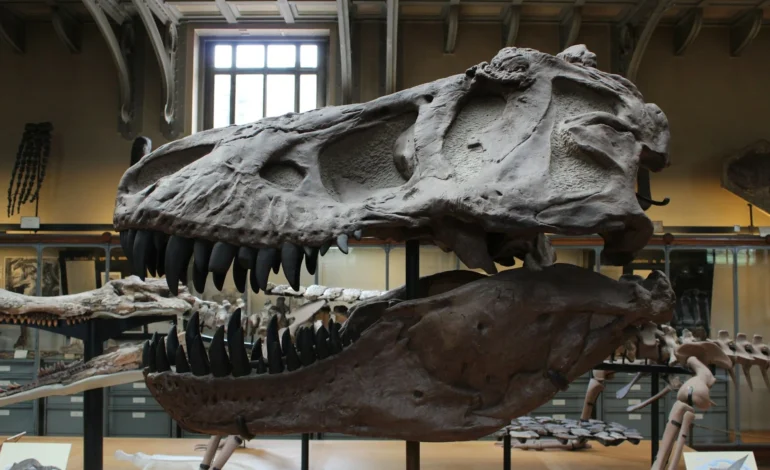
The famously small arms of T. rex may have evolved because the giant predatory dinosaurs increasingly relied on their skulls and jaws to hunt prey, according to a new study from researchers at University College London and University of Cambridge.
The research examined 82 species of theropod dinosaurs, finding that reduced forelimbs evolved independently in at least five different dinosaur groups, including tyrannosaurids. Researchers say the pattern was more closely linked to heavily built skulls than overall body size. Published in Proceedings of the Royal Society B, the study suggests giant predators gradually shifted away from using their arms to grasp prey as powerful skulls and strong bites became more effective hunting tools.
Lead author Charlie Roger Scherer, a PhD student at UCL Earth Sciences, said the same pattern appeared repeatedly across multiple dinosaur lineages. “Everyone knows the T. rex had tiny arms but other giant theropod dinosaurs also evolved relatively small forelimbs,” he said. “The head took over from the arms as the method of attack.”
Researchers believe the shift may have been connected to the spread of enormous herbivorous dinosaurs such as sauropods. Instead of trying to hold massive prey with claws, predators may have relied more heavily on powerful jaws and heavily reinforced skulls.
The team developed a new method to measure skull robustness using factors including bite force, skull shape, and how tightly skull bones were connected. Dinosaurs with more compact skulls were considered structurally stronger than those with longer, narrower heads.
T. rex ranked as the most robust skull in the study. Tyrannotitan, another giant theropod that lived in what is now Argentina more than 30 million years earlier, also ranked highly. The researchers found that reduced forelimbs appeared in several dinosaur groups including tyrannosaurids, abelisaurids, carcharodontosaurids, megalosaurids and ceratosaurids.
Not all of these predators were enormous. Majungasaurus, which lived in Madagascar around 70 million years ago, weighed about 1.6 tons but still evolved extremely small arms alongside a heavily built skull. Researchers said it was still considered an apex predator despite being much smaller than T. rex.
The study also found that dinosaur groups reduced their forelimbs in different ways over time. Some species evolved dramatically smaller hands, while others showed a more even reduction across the entire arm. Researchers concluded that separate dinosaur lineages likely reached similar evolutionary outcomes through different developmental pathways.
The wider UCL dinosaur evolution research group works closely with the Natural History Museum and includes specialists studying dinosaurs, crocodiles and birds.
Researchers continue to uncover new details about dinosaur survival and biology, including recent evidence showing a T. rex bone preserved signs of healing after injury. The findings also connect with wider research into prehistoric ecosystems, including studies suggesting life recovered surprisingly quickly after the extinction of the dinosaurs.
Follow EyeOnLondon for more science reporting on new discoveries shaping our understanding of prehistoric life and evolution.
Follow us on:



Subscribe to our YouTube channel for the latest videos and updates!

We value your thoughts! Share your feedback and help us make EyeOnLondon even better!