The Bayeux Tapestry at the British Museum is one of history’s greatest works of community art

The Bayeux Tapestry Experience at the British Museum | 10 September 2026–11 July 2027
“Community” has become an over-used word, meaning anything from a Shaker village to half a dozen people gathered on a street corner. In cultural contexts the word is a little more refined, coming to refer to creativity in partnership in a single project.
Communities address art in all disciplines: pottery classes, am-dram groups, Art Society lectures, painting clubs. The Dulwich Symphony Orchestra is a full-size ensemble made up entirely of amateur musicians who play at almost professional standard in a large local church three times a year.
There’s the Foundation for Community Dance, 40 years old now, in which professionals work with community practitioners and aim at people’s “rights of equal access to quality experiences in dance of all kinds”. Blackheath Concert Halls has its own 80-strong amateur opera chorus about which the critic Claudia Pritchard wrote: “I know of no chorus as gifted at suggesting the all-walks-of-life nature of a story’s observers and participants as the Chorus, or rather, choruses, of Blackheath Halls Opera”.
Birmingham Opera has a full-time staff of three and no venue, just an office, but trains hundreds of volunteer participants to create large-scale outdoor performances, once on a burnt-out ice rink, to “reflect the city we work in, with our audiences, artists and stories that we tell”. The Tower Theatre Company in London has more than 700 members, amateurs from all backgrounds and age groups, and puts on 18 full-scale productions a year in its own Stoke Newington theatre.
Today you need only to look up as you walk our city’s highways and byways to see the array of street art on the walls around you to know that visual art has become an essential part of urban life. Tate defines community art as “based in a community setting, characterised by interaction or dialogue with the community and often involving a professional artist collaborating with people who may not otherwise engage in the arts”. It says it was a development of the cultural democracy that emerged after the Second World War whose purpose was “to break down the boundaries between high and low culture in order to make art accessible to a wider audience”.
The British Museum’s recent samurai exhibition similarly explored how craftsmanship and storytelling can preserve the memory of entire civilisations across centuries.
But there’s nothing new in community art. The Bayeux Tapestry, travelling probably for the first time since the 12th century to come to the British Museum, is one of the most astounding works of art from any age, and there’s no signature on it. It was made by many hands and minds, a creative community.
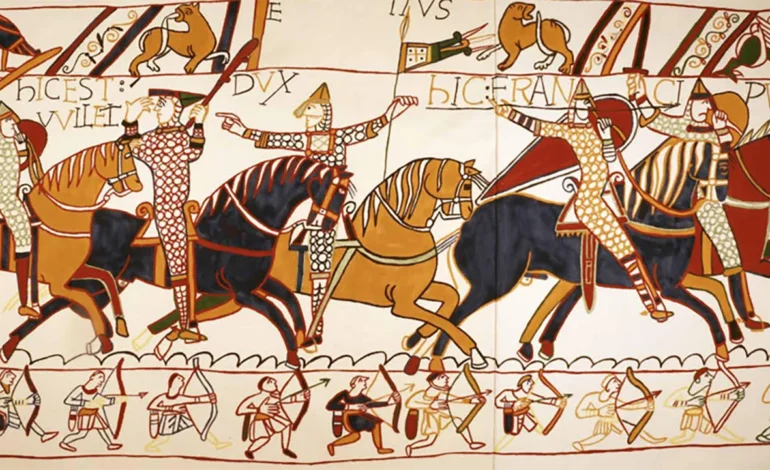
It is not, of course, a tapestry but an embroidery, a careless 19th century use of the word giving it the wrong name. Medieval critics, used to the heavy wall hangings that kept their draughty halls warm, were affronted that the whole of the 70-metre-long linen space wasn’t entirely covered. Instead, the images leap out of the white background at us now, almost as vividly colourful as when they were stitched, and the exquisite lines are as strong as ever.
The Bayeux Tapestry is a miraculous survival. Embroideries like this were not uncommon, recording events and particularly battles, but apart from this one none has survived. It was not, of course, the work of a single hand, and research is still ongoing as to how it was done and who might have been behind it.
For a long time the assumption was that it had been made by William the Conqueror’s queen, Matilda, and her ladies-in-waiting in Normandy. But unless the queen was a remarkably accomplished artist in her own right, and her ladies as versatile as any Royal College of Art graduate, it’s much more likely that it was commissioned by William’s high-living and apparently art-loving half-brother Bishop Odo. Nor is it likely to have been a team of nuns, as one theory has it. The enthusiasm and graphic detail with which the naked couple having sex is portrayed in one of the margins puts the lie to that.
The exact process would have been complex. It was begun probably in about 1070 and took more than a decade to finish. There must have been a single overview for this narrative, a director for what is as close as the Middle Ages get to a movie. The embroiderers would have had drawn templates to work from, probably, but not necessarily, produced by monks in a scriptorium. There would have to have been a large well-lit space for a workshop, and carpenters would have had to build a substantial frame, or series of frames.
Researchers have detected maybe as many as 17 different hands at work on it, so that the likelihood is that those on the project at the start were no longer involved at the end. The stitchers, and there might well have been men among them, had extraordinary skill. They could convey facial expressions on faces, imply perspective not with shading but with colour choice, depict movement in the body shapes of the horses, and portray particular instants such as the death of Harold by isolating an image.
As a work of art it stands out against that of any age and still draws 400,000 visitors a year. The skills displayed are many and the narrative, it’s accepted that the end probably showing William’s coronation is missing, is as thrilling now as in the 11th century, created by a changing community of artists and craftspeople. And it’s not merely Norman propaganda. Its graphic portrayal of acts of war, severed heads and limbs sent flying, suggests a pacifist undertone rather than bloodthirst.
Few places in London better reflect the relationship between scholarship, history and public access to knowledge than the British Museum Reading Room.
Though the tapestry was probably made in Kent, maybe Canterbury, where Bishop Odo was the earl and had his powerbase after the conquest, he was also Bishop of Bayeux and built the cathedral there, an outsize presence in a small community. It is now believed that the tapestry survived because it has spent almost its entire life in the cathedral there where it would be brought out on display once a year, traditionally in June for the Feast of St John the Baptist.
And in medieval times our public art galleries were our churches, so that rather than it being shut away in a princely palace for the occasional delectation of some magnate, when it was brought out the tapestry was there for all to see, free of charge, and not just by members of the Bayeux community: community art for all communities.
For more London exhibition coverage, historical features and cultural criticism, explore EyeOnLondon’s Arts & Culture section.
The Bayeux Tapestry Experience
British Museum , Bloomsbury, London
One of the world’s greatest surviving works of medieval art comes to London for the first time in centuries, exploring the craftsmanship, storytelling and collective creativity behind the Bayeux Tapestry.
Dates: 10th September 2026 to 11th July 2027
Admission: Details to be confirmed by the British Museum.
Opening times: Museum opening hours apply. Check official website for updates.
Follow us on:



Subscribe to our YouTube channel for the latest videos and updates!

We value your thoughts! Share your feedback and help us make EyeOnLondon even better!