Whistler at Tate Britain is the most important exhibition of the year

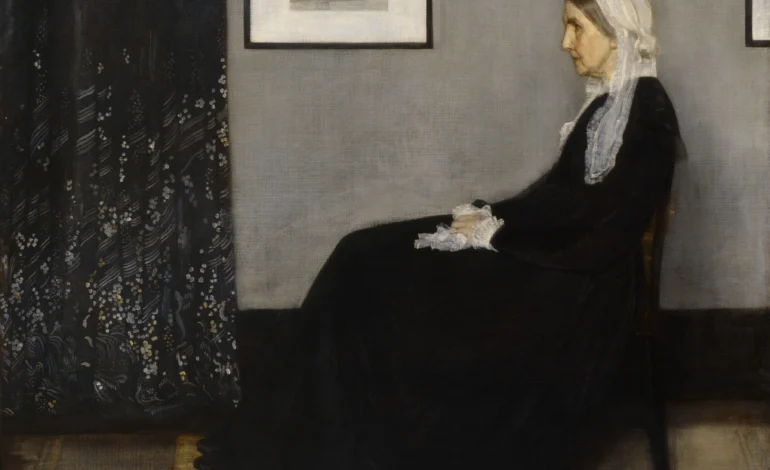
James McNeill Whistler | Tate Britain | 21 May to 27 September 2026
There are three things about the painter James Whistler most people know: he was American, he had a mother, and he went bankrupt after winning a libel suit against a critic.
Well, perhaps not the last fact, but Whistler stands out in art history as a larger than life character who challenged Victorian society’s practices and proprieties, even if he didn’t always win. His influence during his life and subsequently was profound — through his belief in realism, his detestation of academic moralism, and his idiosyncratic use of colour.
He painted nature, but in his Chelsea studio rather than in the plein air of the Impressionists he knew well. Often he would paint scenes from memory.
This exhibition is the biggest Whistler retrospective for 30 years, delving into his philosophy not only through his paintings but through the drawings, etchings and print-making that contributed to the style that found its place in history with his iconic Arrangement in Grey and Black, better known now as A Portrait of the Artist’s Mother. Later came a true signature achievement, his famous Nocturnes, which were also to cause disaster.
He liked to give an impression of an American abroad, dressing to suggest both dandyism and bohemianism, with a flowing moustache and sometimes a small goatee beard in the style of Buffalo Bill. He adopted his paternal grandmother’s maiden name of Abbott and, after she died, his mother’s name, McNeill.
![Arrangement in Grey, Portrait of the Painter, James McNeill Whistler, 1872. Detroit Institute of Arts. [Image Credit Detroit Institute of Arts]](https://eye-on-london.com/wp-content/uploads/2026/06/Arrangement-in-Grey-Portrait-of-the-Painter-James-McNeill-Whistler-1872.-Detroit-Institute-of-Arts.-Image-Credit-_-Detroit-Institute-of-Arts-752x1024.webp)
Born in Lowell, Massachusetts, in 1834, Whistler was a true man of the world. His father was a railway engineer who, when the boy was eight, transported the family to Russia and St Petersburg, where Whistler considered his real childhood to have occurred. It was where he began to draw, and at 11 he enrolled in the Imperial Academy of Arts, where he excelled. The exhibition shows for the first time sketchbooks from this period, giving us a remarkable glimpse of young Whistler’s precocity.
His father died suddenly and the family moved back to Connecticut. His mother’s family had military connections and Whistler was sent to West Point, from where he was expelled for lack of application. Instead, he became a draughtsman mapping the US coastline and learning etching techniques. Around this time he decided to be a painter.
In 1855, aged 21 and with a small bequest, Whistler went to Paris and never returned to the United States. Here, closeted among artists such as Courbet, Fantin-Latour and Manet, writers such as Baudelaire, and teacher-painters like Charles Gleyre in the creative hothouse of Montmartre, he discovered his talent. He was ahead of the Impressionists in his thinking, but had already developed a deep admiration of 17th century masters such as Rembrandt, whose inspiration we can see in the early Whistlers in this show. He believed that line was more important than colour. Black, which the Impressionists rejected as a non-colour, he considered the basis of all tonal harmony. He travelled widely in France, Germany and later South America, while in Paris making etchings of street life, drinking sessions and interior studio scenes.
He liked to associate painting with music, using musical terms such as nocturne, symphony and harmony in his titles. “As music is the poetry of sound,” he said, “so is painting the poetry of sight.” It was a conviction shared, from a different direction, by Georges Seurat, whose coastal studies from the same era are currently on show at the Courtauld in Seurat and the Sea.
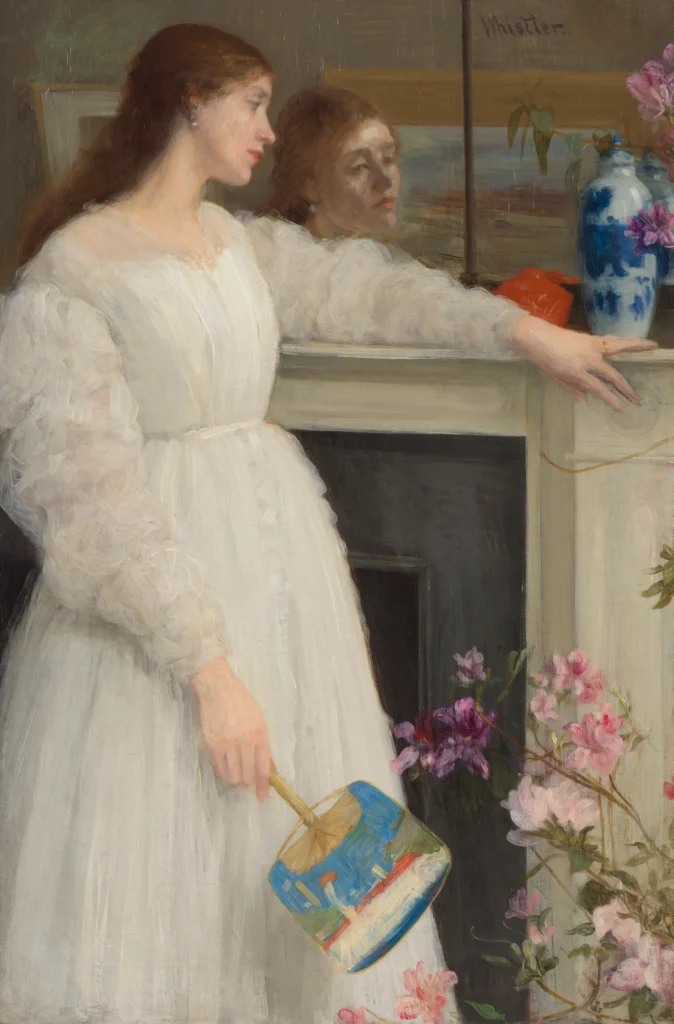
He moved to London in 1858, which became his home, where he pursued realism with an underlying conviction that art is not a copy of nature but an artist’s interpretation of what he sees. The following year his painting At The Piano, a rather austere realist composition of subdued colour, was exhibited and critically well received. He became close to some of the Pre-Raphaelite painters and set about painting portraits. Symphony in White, portraying his mistress and business manager Joanna Hiffernan, caused a small sensation, though it was refused by the conservative Royal Academy.
In 1863 Whistler’s mother Anna, fleeing the civil war, came to live with him, which meant a serious toning down of life, including moving Hiffernan out. Eight years later he painted Anna, still in mourning black, in a studio of uncompromising vertical and horizontal lines in which only the model curves. He used different brushes, at least 18 inches long, and a variety of strokes for the different elements of the composition.
The exhibition makes much of the artist’s inspiration from Japanese prints and ceramics, and his admiration of their asymmetry and the simplicity of flat colours. He tried these out with a series of night views of the Thames, his Nocturnes, which he felt matched the musical tones of Chopin. The filthy stench, mists and smoke of the river he was able to transform into magical and mystical light on water. He used long, flowing strokes for the river and thin paint to depict rising mist. “Paint should be like breath on the surface of a pane of glass,” he said.
Seeing Nocturne: Black and Gold of 1875, which depicted a firework display in Cremorne Gardens, the critic John Ruskin didn’t get it, accusing Whistler of being slapdash and flinging a pot of paint in the public’s face. The artist decided to sue for libel on principle. After a prolix legal process in 1878 he won, with damages of one farthing, costs to be shared. It bankrupted Whistler, who had to sell his house and studio and leave London for Venice for a while.
![Nocturne, Black and Gold, The Fire Wheel, James McNeill Whistler, 1875 7. [Image Credit Tate]](https://eye-on-london.com/wp-content/uploads/2026/06/Nocturne-Black-and-Gold-The-Fire-Wheel-James-McNeill-Whistler-1875-7.-Image-Credit-_-Tate-1-1024x716.webp)
His reputation gradually recovered. In 1885 he expressed his belief in realism and art for art’s sake in his Ten O’Clock Lecture, which received general applause, including from Oscar Wilde. Through the 1890s Whistler expanded his practice, experimenting with photography and building a reputation as a raconteur. When Wilde, admiring a witticism, said “I wish I’d said that,” it was Whistler who responded: “You will, Oscar, you will.”
He had portrait commissions again and founded an art school, but as the century changed his health deteriorated rapidly and he died in London in 1903. He is buried in the same graveyard as William Hogarth.
This is the biggest Whistler retrospective for 30 years. It is also one of the most richly rewarding exhibitions London has seen in some time. Go.
For another major London exhibition explored by Simon Tait, read his piece on the Bayeux Tapestry arriving at the British Museum this September.
For more arts and culture coverage from across London, explore EyeOnLondon.
James McNeill Whistler
Tate Britain , Millbank, London SW1P 4RG
The first major European retrospective of Whistler’s work in 30 years, bringing together portraits, Nocturnes, Thames views, drawings, prints and designs spanning his entire career from St Petersburg to London.
Dates: 21st May to 27th September 2026
Opening times: Daily 10.00am to 6.00pm. Last entry one hour before closing.
Admission: From £24. Tate Members free.
Getting there: Closest station Pimlico (zone 1). Buses 2, 36, 87, 88, 185, 436, C10.
Follow us on:



Subscribe to our YouTube channel for the latest videos and updates!

We value your thoughts! Share your feedback and help us make EyeOnLondon even better!