Barbara Hepworth’s Use of Colour Gets Its First Full Reckoning at the Courtauld

Hepworth in Colour | Courtauld Gallery until 6th September
The Courtauld Gallery opens Hepworth in Colour this summer making a strong case that Barbara Hepworth’s relationship with colour was never as simple as history has made it appear.
Barbara Hepworth’s garden at Trewyn, her hillside idyl overlooking St Ives where she loved to work but also to look, is anything but monochrome. It’s alive with joyous colour, planted by Hepworth, as it looks down on Carbis Bay and up to iridescent blue Cornish skies, with cascades of cherry blossom in the spring and explosions of roses and hydrangeas at this time of year.
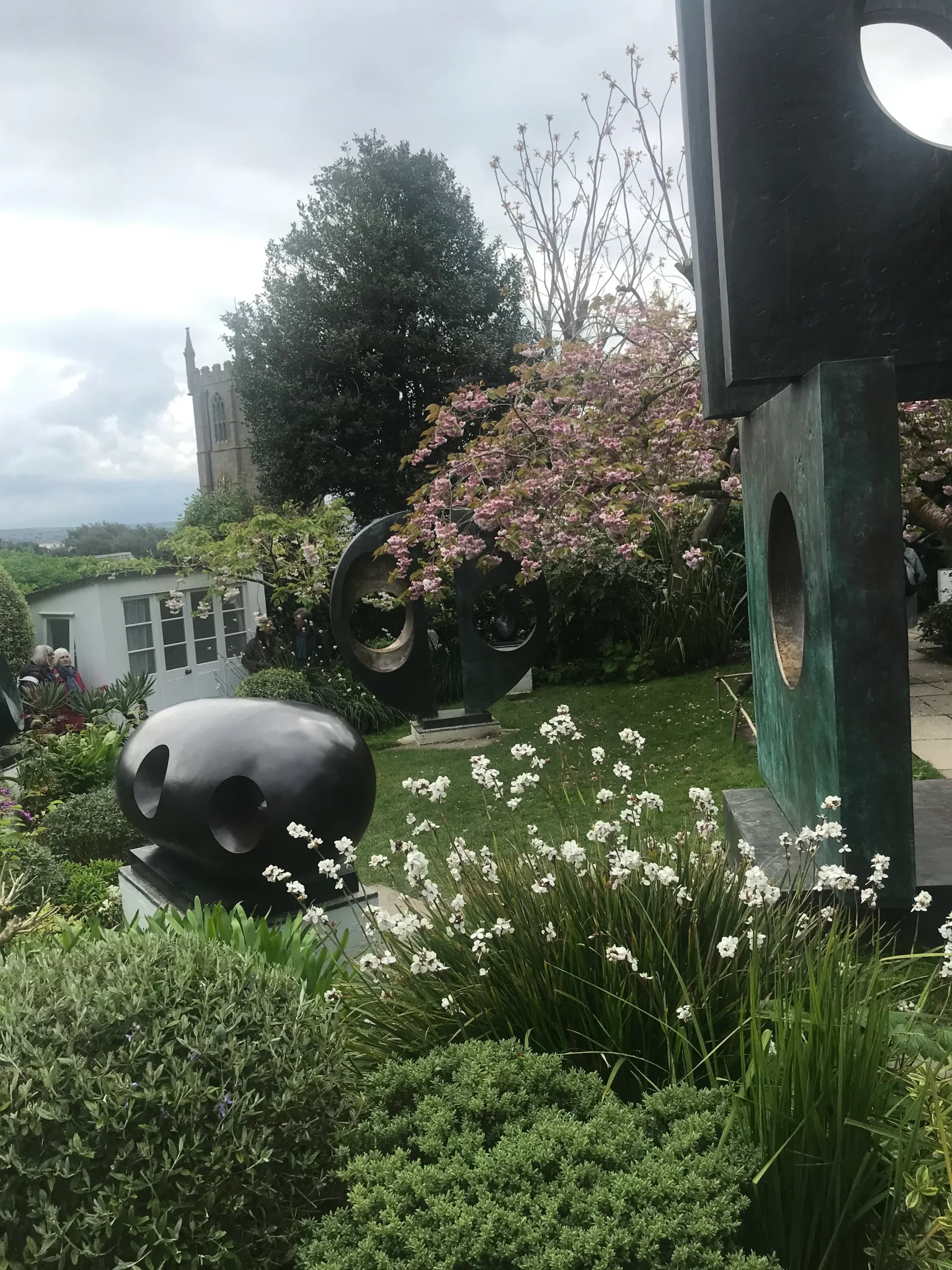
But the monumental bronzes that turn this garden into a gallery are black, the great geometrical puzzle shapes that Hepworth created here and by which we know her. We could be excused for thinking that she chose to work chiefly in black and white images, in line with the mid-twentieth century austerity that looked at colour with suspicion.
This exhibition sets out to show that the exact opposite was true, and that colour, or the use of certain colours to add a dimension to a piece, was very much a part of her practice. “My colour,” she said in 1970, five years before her death in a fire at her studio at the age of 72, “has been accepted but never understood.”
Colour, in fact, had a big part early in her career when she and her husband, the abstract artist Ben Nicholson, were part of the European avant garde (when she contributed to exhibitions of anti-fascist art) and fell under the spell of Mondrian. Two rare Mondrianesque forays from 1935 show her curiosity about the potential of colour (though mercifully not eschewing green as Mondrian did) and the space it offers. In Paris she met Brancusi, Picasso and Kandinsky before returning to Hampstead in London to exhibit and consolidate a growing reputation.
A few days before war was declared Hepworth and her triplet daughters moved to Cornwall, her home for the rest of her life. She took with her a single, small maquette for a sculpture with colour, which would eventually become a key piece in this exhibition, Sculpture with Colour (Oval Form) Pale Blue and Red. Her quarters, with friends, at first were very cramped and, with three six-year-olds to care for, time was at a premium in that she was confined mostly to drawing and planning while the children slept.
What she discovered, first with her very exact technical drawings made with compasses and rulers in which spaces are crossed by fans of strings, was that colour (mostly a single colour but sometimes two) can add a new dimension, and offer an extra spiritual sense to a piece. Hepworth was a deeply spiritual artist.
In 1940 she wrote to her friend Leslie Martin, architect of the Royal Festival Hall, “I have achieved what I think is a good new sculpture”: two small plaster carvings with the central voided painted dark blue, the colour of calm in architectural principle.
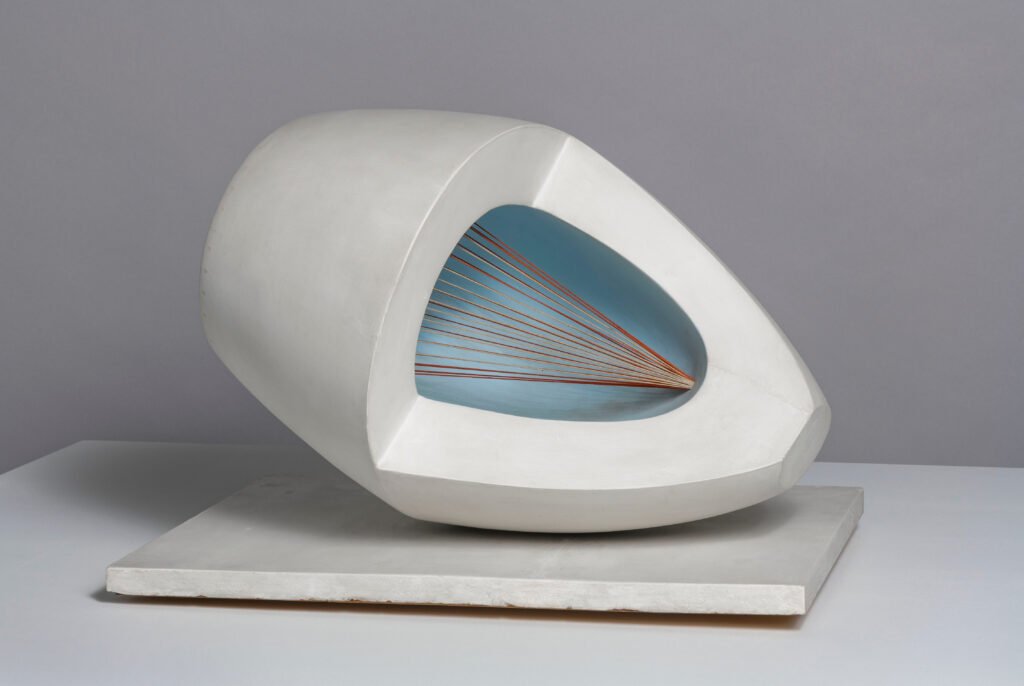
Hepworth continued with her colour experiments through the forties and fifties, and by chance a key piece in the story was set in place less than a year ago when Sculpture with Colour (Oval Form) Pale Blue and Red, made in 1943 and based on that single maquette she took with her from London to Cornwall bundled up with her little girls, was saved from export after a successful appeal raised £3.8m to buy it for the nation. It has been placed at the Hepworth Wakefield gallery but is on loan for this exhibition and given a central place as a key part of the exposition on Hepworth’s relationship with colour.
In this carved wooden sculpture (she did not always work in clay, stone and bronze), Hepworth has chosen the sky blue she was inspired by from the early morning summer skies of Cornwall, denoting peace and hope, but strung with coloured lines adding drama to the pastoral egg-like capsule. This piece is one that you can easily get lost in, as Hepworth herself did.
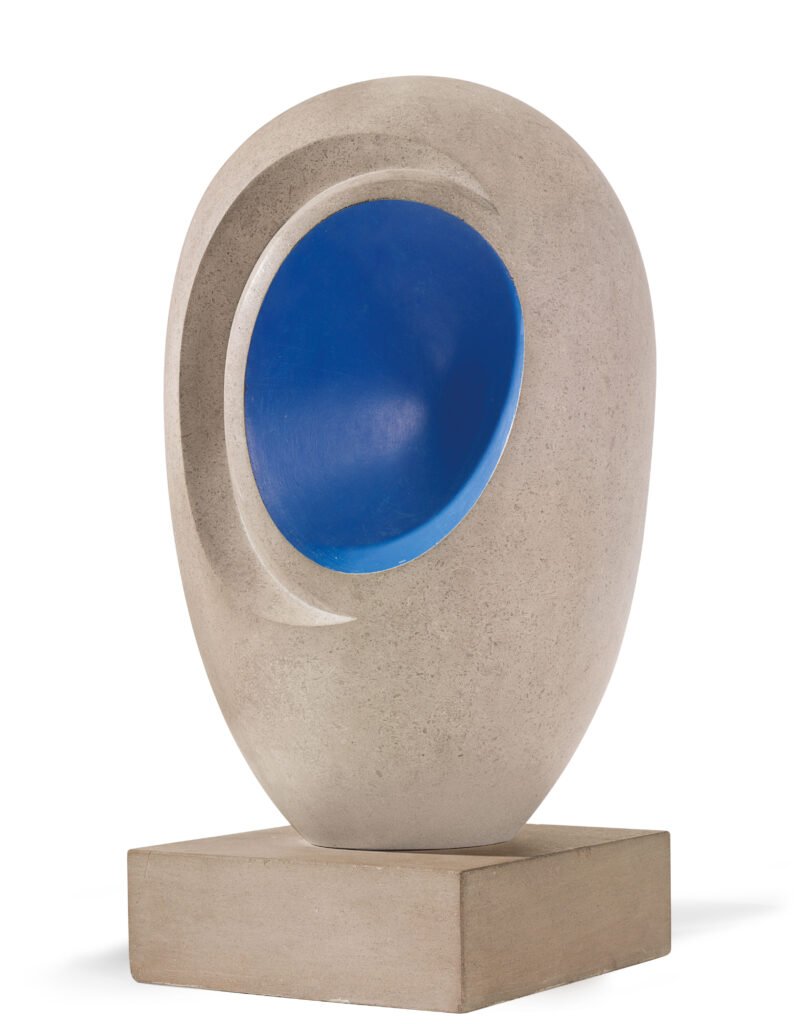
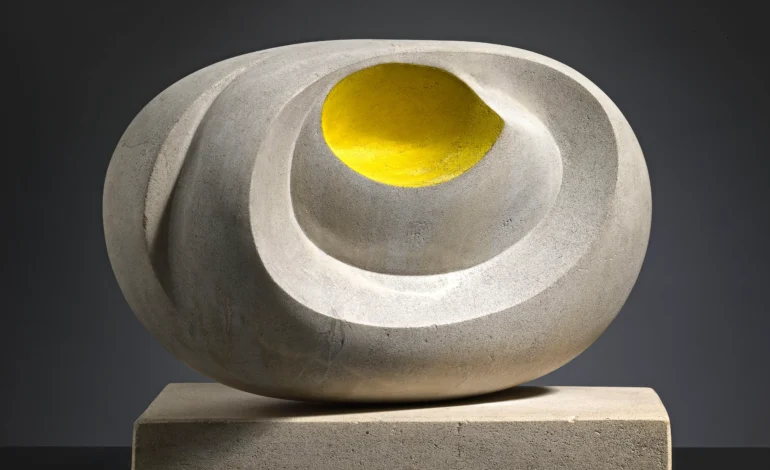
But in her 1946 Sculpture with Colour (Eos) she has created in polished stone an organic form of inter-folded ovals, almost maternal as the one envelopes the other, with at its heart that intense blue of her early Cornwall morning. Eos was the Greek goddess of the dawn. Here it is seen next to Eidos, the Greek for shape, made a year later and reunited with Eos for the first time in 72 years. But here the ellipsoids are folded horizontally instead of vertically, with at their heart a bright cadmium yellow for the sun.
Often the pigments Hepworth has used have faded over the decades, and even visibly flaked. When the owner of Eidos asked for the deteriorating yellow to be repainted, she declined, saying the deterioration was part of the personality of a sculpture. She would often use household paint.
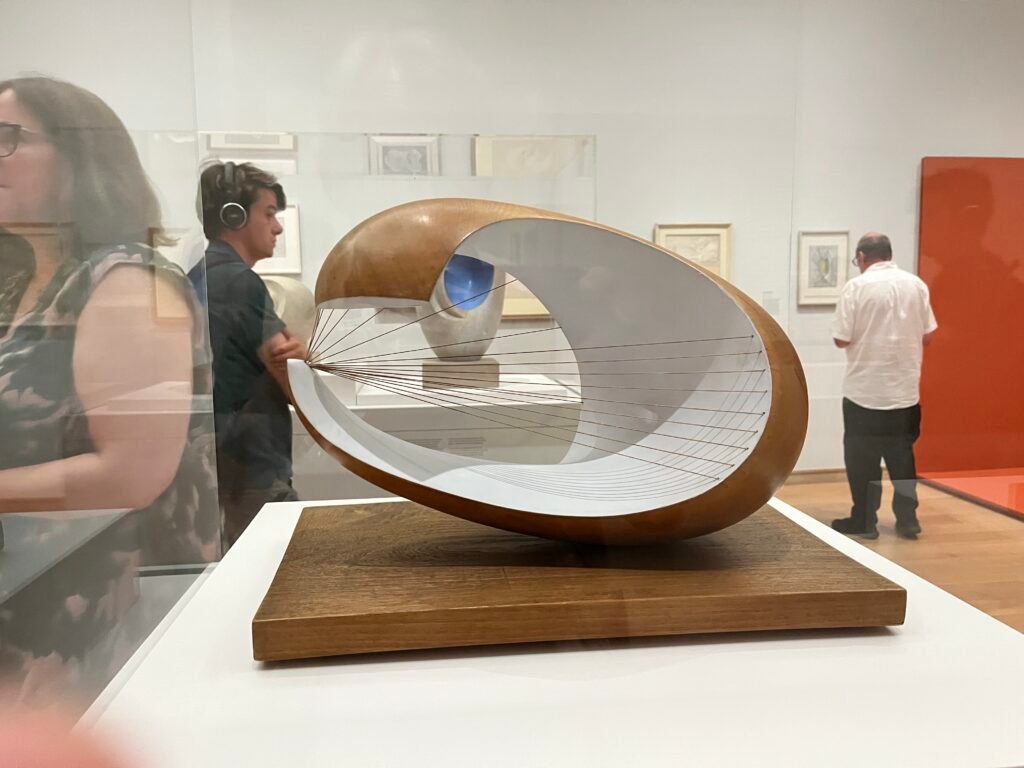
As restrictions were lifted towards the end of the war Hepworth used wood which she found she could carve into contrasting outer and inner forms and in one of the earliest of these, Wave, she appears to have been over-subtle with the colour element existing only in the strings that span it. In fact, the interior had originally been painted pale blue but has faded to white.
She continued to paint works through the sixties and seventies, including a series of marbles which she saw as a challenge to her ingenuity, and her approach is symptomatic of her whole approach to working colour with her forms (as with Oval With Black And White of 1965). “It (marble) was a new material that I hadn’t carved before,” she said in 1970. “I don’t usually like a patterned marble, and I didn’t know how intense the markings would be until we began polishing the stone,” adding, in a telling phrase: “They needed taming.”
Hepworth’s concern with colour places her in a long tradition of artists for whom it was a structural rather than decorative instinct, one that runs equally through the Whistler retrospective at Tate Britain, where a similarly idiosyncratic relationship with colour defines an entire career.
Hepworth in Colour is at the Courtauld Gallery on the Strand until 6th September. EyeOnLondon recommends it as one of the most revealing exhibitions in London this summer.
For more London arts and culture, visit EyeOnLondon.
[Image Credit | The Courtauld Gallery]
Hepworth in Colour
The Courtauld Gallery , Somerset House, Strand, London WC2R 0RN
The first exhibition devoted to Barbara Hepworth’s lifelong use of colour, bringing together 20 sculptures and 30 drawings spanning her career.
Dates: 12 June – 6 September 2026
Opening times: Daily 10am – 6pm. Late openings until 8pm on selected Fridays.
Admission: Ticketed. Under 18s and students with valid ID free. Art Fund members 50% off.
Getting there: Nearest Tube: Temple, Covent Garden or Embankment.
Follow us on:



Subscribe to our YouTube channel for the latest videos and updates!

We value your thoughts! Share your feedback and help us make EyeOnLondon even better!

![The Original Tour hop on hop off double decker bus in Union Jack livery passing Big Ben and the Houses of Parliament in London - [Image Credit | The Original Tour]](https://eye-on-london.com/wp-content/uploads/2026/07/The-Original-Tour-hop-on-hop-off-double-decker-bus-in-Union-Jack-livery-passing-Big-Ben-and-the-Houses-of-Parliament-in-London-770x470.webp)