Brixton Windmill up for a National Heritage Prize, telling London’s story through its millers

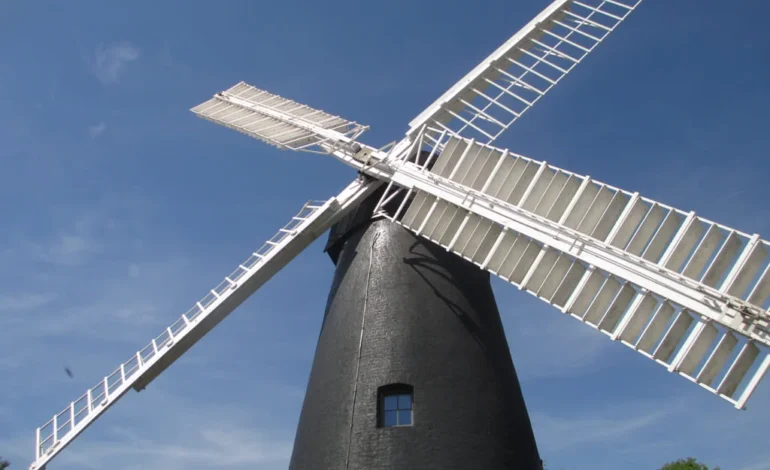
There is a windmill on Brixton Hill that most people who live nearby have never been inside. It sits behind railings in a small municipal garden, five storeys of restored brick and sail, and on the second weekend of most months a handful of volunteers grind flour on the same millstones that were turning in 1902. This month it is up for a national prize, and the reason it has been shortlisted has nothing to do with the building itself.
Brixton Windmill has been named one of three London & South East finalists in Everyday History Heroes, a new public vote created by Heritage Open Days and the family history website Findmypast, and launched by the historian and broadcaster David Olusoga.
The award is not about grand architecture or famous names. It celebrates the historic and cultural sites that champion the stories of ordinary people, from nurses and miners to teachers, soldiers and changemakers, centring on the grassroots histories that often go untold.
Twenty-four sites across England made the shortlist. Three are in London and the South East, and one of which is within Greater London. That distinction matters, because what Brixton Windmill is being recognised for is not its survival as a piece of industrial architecture but the way it has kept the working lives around it legible.
A treasured South London landmark, the windmill connects people with the history of the workers and families who once relied on it for their livelihoods.
The site was built in 1816 and leased to the Ashby family the following year, and it produced flour under three generations of that same family until 1934, first as a genuine windmill and later, once London’s expansion blocked the wind it needed, as a steam-powered mill housed inside the original tower. The building’s own biography is really the biography of the people who worked it: millers, apprentices, the bakers next door who turned Ashby’s flour into bread sold to local families on Brixton Hill.
That is the specific thread the volunteer trust running the site, the Friends of Windmill Gardens, has chosen to pull on for its Heritage Open Days programme.
With activities planned throughout the year such as bookable tours, demonstrations, baking and milling workshops and storytelling, volunteers create an impression of life at the mill, bringing the lives of millers, apprentices and bakers into vivid focus and keeping heritage skills alive.
It is a small, deliberately unglamorous form of history telling. Nobody is claiming the Ashby family changed the world. The claim being made, and the one the award exists to reward, is narrower and arguably more useful: that a working-class trade and the households built around it are worth researching and re-enacting in as much detail as any statesman’s biography.
The other two London and South East finalists make an instructive contrast, because they are working the same idea from very different angles. The Royal Victoria Chapel in Netley is the last surviving fragment of a military hospital that once stretched for a quarter of a mile along Southampton Water, and its volunteers spend their time reconstructing the daily experience of the patients, nurses and support staff who passed through it rather than the generals who commissioned it. Horton Cemetery in Epsom is starker still: it holds roughly nine thousand people buried between 1899 and 1955, each of them a patient at one of Epsom’s psychiatric hospitals, and for decades they existed as little more than names in a forgotten register. Volunteers there have researched and written more than five hundred individual life stories from that register, restoring identity to people who were, in a very literal institutional sense, filed away.
Voting is open until 31 August, with a national winner and seven regional winners announced on 10 September, each receiving a donation toward their community work. Every shortlisted site, Brixton Windmill included, is also opening for a free Heritage Open Days event during the festival’s national run from 11 to 20 September, under this year’s theme of Everyday Histories. For a building that spends most of the year quietly closed behind its garden railings, that is arguably the more immediate prize: a fortnight in September when the mill is not just a landmark on Brixton Hill but genuinely, briefly, open.
Image: Matt Brown
For more London arts and culture, visit EyeOnLondon at eye-on-london.com
Follow us on:



Subscribe to our YouTube channel for the latest videos and updates!

We value your thoughts! Share your feedback and help us make EyeOnLondon even better!