London Museum’s Smithfield Bet, A Coffee Stall and a Lord Mayor’s Coach Sharing the Same Room

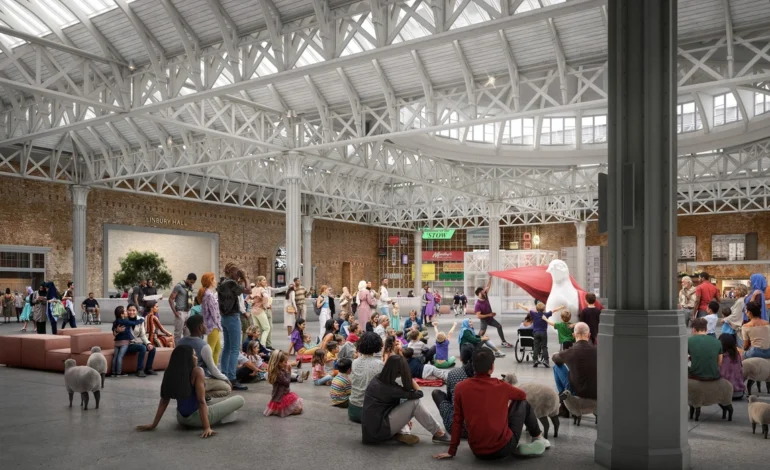
Somewhere beneath Smithfield, a live Underground train will keep running past a museum gallery, visible to visitors through a glass window built specifically so they can watch it go by. Above it, in a hall with a full-height Victorian dome, a Lord Mayor’s ceremonial coach will sit near a coffee stall that spent a century trading in Shoreditch. This is London Museum’s answer to the question every civic institution eventually has to ask itself, what actually belongs in the room when you try to put an entire city on display.
The museum has confirmed it will open its new permanent galleries in Smithfield’s General Market on 28 November 2026, ending a decade of restoration and a construction bill that has climbed from an original £337 million budget to £437 million. That much is straightforward fact, and plenty of coverage will stop there. What’s more interesting is the argument the museum is subtly making with its floor plan, because a museum’s choice of what to display next to what is never neutral. It’s a theory of the city, stated in objects rather than words.
The clearest expression of that theory sits in Our Time, the museum’s new central hall inside the restored Linbury Hall.
Visitors move through Real Time, a covered former street acting as the museum’s main entrance, into Our Time, a vibrant central hub for events and activities, anchored by 13 large installations of eclectic objects from London in living memory.
Among those 13 installations, the museum has chosen to put the Lord Mayor’s Coach, paraded annually through the City in a ceremony that dates back centuries, in the same room as Syd’s Coffee Stall, a stall that traded in Shoreditch for a hundred years before joining the collection in 2019. One object represents the City of London’s formal, ceremonial self. The other represents the improvised, everyday London that actually keeps the place running. Putting them in the same hall isn’t an accident of curation. It’s a statement that both are equally London, and that the museum doesn’t rank one above the other.
That same instinct runs through the rest of the building. Downstairs, in the subterranean Past Time galleries set at what was once Roman street level, the Cheapside Hoard, one of the most significant surviving collections of Elizabethan and Jacobean jewellery, will be displayed in full for the first time alongside a chunk of the Whitechapel Fatberg, the mass of fat and wet wipes dredged from London’s sewers in 2017 that became an unlikely tabloid sensation and, eventually, a museum object in its own right. Charles I’s execution vest sits in the same institution as Banksy’s Piranhas artwork. Emmeline Pankhurst’s hunger strike medal sits somewhere in the same building as a set of Roman writing tablets from the Bloomberg Collection, the largest archaeological deposition ever gifted to the museum. Grit and glitter, to use the museum’s own phrase, are being treated as two sides of the same coin rather than kept in separate rooms for separate audiences.
The building itself makes the argument physically. The General Market’s restored dome, its glass viewing window onto a working railway line below, and its combination of a restaurant, a shop and a social hall around 13 anchor displays are not incidental design choices. They’re the museum trying to prove that history and daily life can share a floor without one crowding out the other. Whether that actually works in practice, whether a visitor wandering in for a coffee at Syd’s stall genuinely lingers to look at a Roman writing tablet, is the real test the museum has set for itself, and one that press releases and opening dates can’t answer. Only the finished building, full of actual visitors, can.
The museum’s inaugural public programme makes the same bet in miniature. London Tastes, running from the November opening through August 2027, hands curatorial authority to Ruby Tandoh and Jonathan Nunn, sponsored by Sainsbury’s, whose first store on Drury Lane predates the museum by over a century. Rather than the museum’s own historians deciding what London’s food culture means, two food writers with their own established, sometimes contrarian voices have been given the brief. Future seasons, built around sounds, plays and wears, will hand the same authority to different guest editors each time, meaning the museum’s version of London will keep shifting depending on who’s been invited to hold the pen. That’s either a genuinely democratic curatorial model or a way of never quite having to commit to a single, stable account of the city. Probably it’s both, and the museum seems comfortable with that ambiguity.
Sharon Ament, the museum’s director, framed the whole decade-long project in exactly those terms. “At the beginning we asked ourselves how to be the best museum for London, the answer is, to be London itself, in all its grit and glitter,” she said, adding that she hoped the finished museum would be a place where visitors “feel at home, and find themselves grounded in the lives, treasures, challenges and innovations of this city’s vast history.” It’s a director’s line, understandably optimistic ahead of an opening. Whether Londoners themselves would choose the same objects to represent their city, whether a coffee stall really does deserve equal billing with a ceremonial coach, is a question the museum has answered for them. It’s now up to the public to decide if they agree.
The real test of London Museum’s Smithfield gamble won’t come from a press release, it will come the first Saturday someone wanders in for a coffee at Syd’s stall and ends up staring at a Roman writing tablet. EyeOnLondon will be back once the doors actually open to see if that’s what happens.
For more London arts and culture, visit EyeOnLondon at eye-on-london.com
[Image Credit: London Museum]
Follow us on:



Subscribe to our YouTube channel for the latest videos and updates!

We value your thoughts! Share your feedback and help us make EyeOnLondon even better!