Astronomers widen search for alien signals by exploring overlooked radio frequencies

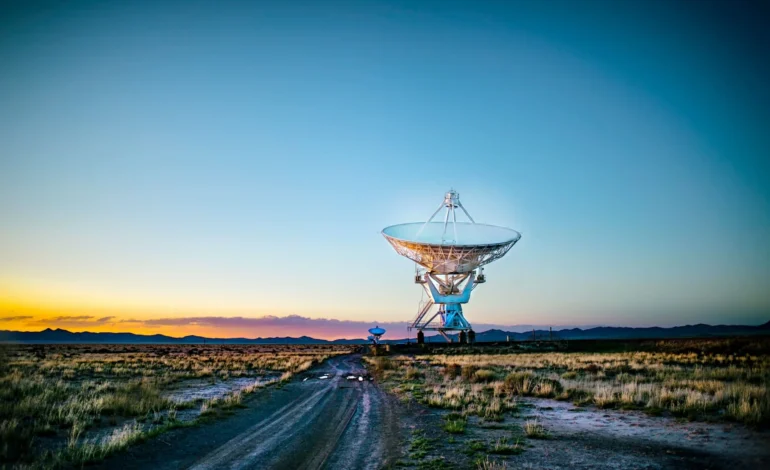
For decades, scientists searching for evidence of intelligent life beyond Earth have focused on a small section of the radio spectrum believed to be an ideal place for interstellar communication. New research suggests that strategy may have been too restrictive, with higher radio frequencies offering another promising avenue in the hunt for possible extraterrestrial technology.
The findings were presented at the Royal Astronomical Society’s National Astronomy Meeting (NAM2026) in Birmingham by Louisa Mason, a PhD researcher at the University of Manchester, who carried out the first Search for Extraterrestrial Intelligence (SETI) investigation using archived observations from the Atacama Large Millimeter/submillimeter Array (ALMA) in Chile.
Rather than requesting new telescope observations, Mason analysed existing ALMA data that had originally been collected for unrelated astronomical studies. The project searched for extremely narrow radio signals that could indicate technological activity rather than naturally occurring cosmic emissions.
Unlike many previous SETI programmes, which have concentrated on the so-called “water hole” between 1.42 and 1.66 GHz, the study explored higher-frequency millimetre and submillimetre wavelengths that have received little attention in past searches.
Although no potential technosignatures were detected within the two frequency windows examined, the research demonstrates that existing telescope archives can be repurposed to investigate unexplored parts of the radio spectrum without the expense of dedicated observing campaigns.
The project also suggests that scientists may already have surveyed far more stars than previously realised. While telescopes are typically pointed at a specific astronomical target, their observations often include countless additional stars within the same field of view.
Instead of relying solely on the Gaia star catalogue to estimate this “stellar bycatch”, Mason used the Besançon Galactic Model, which simulates the distribution of stars across the Milky Way. Applying the model to an earlier SETI survey increased the estimated number of stars observed from around 288,000 to more than 6.1 million, indicating that previous searches may have covered a much larger portion of the galaxy than first believed.
Mason stressed that failing to detect a signal should not be interpreted as evidence that intelligent life does not exist elsewhere. The investigation examined only four archived ALMA observations across limited frequency ranges, leaving vast areas of the radio spectrum still unexplored.
The research was carried out with Professor Michael Garrett, Dr Andrew Siemion and Dr Kelvin Wandia. The work, titled Strategies Utilising High-Frequency Interferometric Data to Explore SETI Parameter Space, was presented during the Statistical Challenges for Next-Generation Astronomical Surveys session at NAM2026.
What do you think, is expanding the search beyond traditional radio frequencies the next logical step in the hunt for intelligent life? Share your thoughts in the comments and follow EyeOnLondon for more science and space news.
Follow us on:



Subscribe to our YouTube channel for the latest videos and updates!

We value your thoughts! Share your feedback and help us make EyeOnLondon even better!