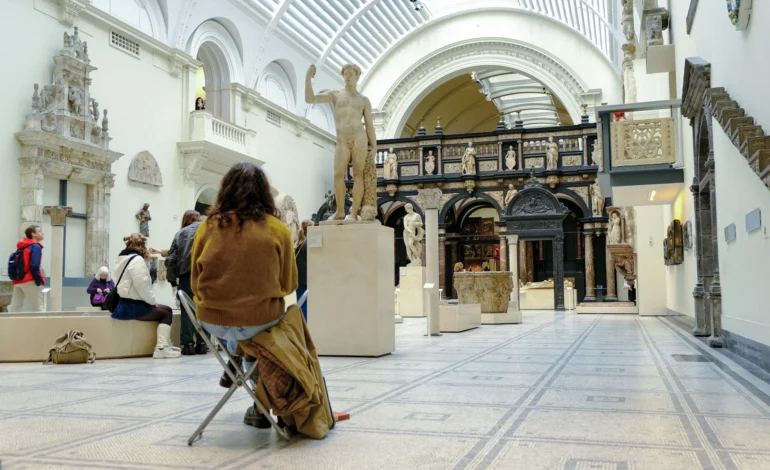
Inside the V&A’s Gilbert Galleries, redesigned around touch and scent for visitors with dementia

A nutmeg grater made from a cowrie shell and silver sits in the newly reopened Gilbert Galleries at the V&A, and it is not behind glass in the way the rest of the collection’s gold boxes and micromosaics are. Visitors can touch a version of the shell, and stand near a scent installation built around the smell of nutmeg itself, the museum’s first permanent scent display in a gallery. That single decision, to let one small object be handled and smelled rather than only seen, is the clearest sign of a redesign that took people living with dementia seriously enough to build around what they actually told the museum they needed.
The Rosalinde and Arthur Gilbert Galleries reopened in March 2026 after a redevelopment that expanded the space from four rooms to seven, designed by Citizens Design Bureau. Most of the coverage since has focused on the scale of it: more than 500 objects on display, a dedicated room for over 200 gold boxes shown in the round, a new space finally bringing together the majority of the collection’s glass micromosaics, two large-scale views of Rome by Domenico Moglia going on public display for the first time. What has had far less attention is that the accessibility work threaded through those seven rooms began years earlier, in consultation sessions with people who have dementia and the people who care for them, and that those sessions changed specific, concrete decisions about what the galleries would contain.
The V&A’s own account of that process, published on its blog by Jessica Insley, curator of the Rosalinde and Arthur Gilbert Collection, describes three in-person workshops facilitated by someone experienced in working with people with dementia, held ahead of the redesign. Participants responded to tactile materials such as handling small stones, and to scents like nutmeg, which the museum found triggered strong reminiscence and cognitive engagement rather than the passive looking a traditional gallery visit tends to ask for. That feedback did not stay in a report. It became the shell visitors can now touch and the smell they can now stand in.
The same sessions shaped a decision about how to tell Rosalinde Gilbert’s own story. She had a distinguished career as a couture designer in London before her later diagnosis with Alzheimer’s disease, and feedback from participants steered the museum toward foregrounding that creative career rather than leading with the diagnosis, a choice that treats her as a collector and maker first rather than as a case study. A mother-of-pearl snuffbox she personally selected for the collection, among a set of diamond-studded boxes commissioned by Frederick the Great of Prussia, now carries that context in the new galleries.
The physical redesign of the Gilbert Galleries sits alongside programming the V&A had already been running for years. A fourteen-week Cognitive Stimulation Therapy course, adapted from a UCL model and delivered with the NHS Memory Service and Resonate Arts, and monthly Closer Look Tours led by trained volunteer guides since 2019, both predate the Gilbert redesign and gave the museum a direct line into what actually works in a gallery setting for people with early-stage dementia. In December 2025, ten participants living with dementia and their carers took part in handling sessions with gold boxes from the collection, followed by workshops making their own clay memory boxes, fired in the museum’s own kiln and returned to participants as keepsakes. The Learning Team also produced a printed resource called Scrapbook Stories, built around the gold boxes and distributed from the Learning Centre from March 2026, giving carers conversation prompts rather than leaving them to improvise.
None of this is unique to South Kensington. A Dementia, Museums and Wellbeing conference held at the Wallace Collection in October 2025 drew heritage organisations from across the country working on the same problem, and academic reviews of museum-based dementia programmes have found consistent benefits to mood, sense of identity and social connection, even where memory itself cannot be recovered. What the V&A’s approach adds is scale and permanence. This is not a temporary outreach session that ends when the funding does. It is built into seven rooms that will stay open for years, which is a different kind of commitment than a pilot scheme.
Nearly one million people live with dementia in the UK, a figure expected to rise to 1.4 million by 2040. The museum’s staff have made the case, consistently, that the multisensory design choices made for that audience end up serving a far wider one, since a scent installation or a handling display does not check a visitor’s diagnosis before it works on them. On 11 May 2026, the V&A ran a full Dementia Action Week Creative Day, offering a self-guided visit to the Gilbert Galleries alongside a Closer Look Tour that sold out and a screen-printing workshop inspired by the museum’s Schiaparelli exhibition. The wider evidence base for this kind of work is not new. London hospitals and GP surgeries have already begun referring patients into museum spaces as a form of social prescribing, treating a gallery visit as a legitimate part of a care plan rather than a pleasant extra.
For more London arts and culture, visit EyeOnLondon at eye-on-london.com
Follow us on:



Subscribe to our YouTube channel for the latest videos and updates!

We value your thoughts! Share your feedback and help us make EyeOnLondon even better!