The skeleton who complicates the Bayeux Tapestry’s story of 1066

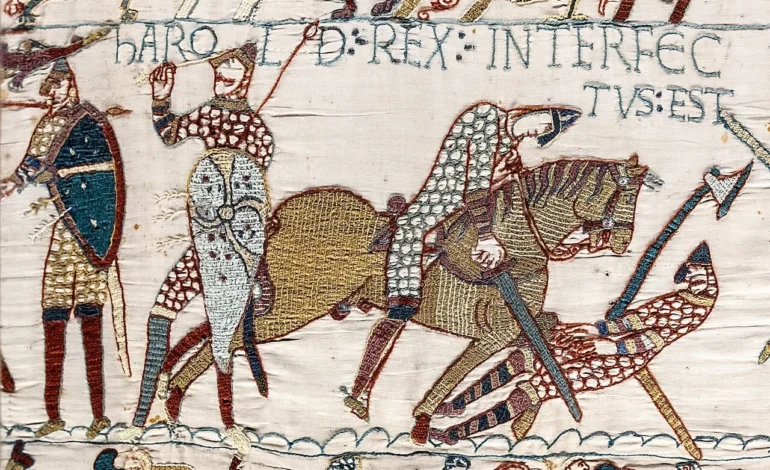
The Bayeux Tapestry, arriving at the British Museum, tells 1066 from one side only, stitched by hands that answered to a Norman patron, its Englishmen mostly silent or dead by the final panel. A skeleton found under a Lincolnshire church floor nearly fifty years ago has just given that story something the tapestry never could: an ordinary man’s face. He has been known only as Conquest Man since archaeologists lifted his coffin from St Peter’s Church in Barton upon Humber in the late 1970s.
English Heritage, working with Historic England, the Crick Institute, the British Geological Survey, the University of Southampton, muVIS, and the Face Lab at Liverpool John Moores University, has now put ancient DNA, isotope analysis and digital facial reconstruction to a body that had sat mostly unexplained in storage for decades. The result is the first time researchers say they can genuinely picture what an ordinary survivor of the Conquest actually looked like.
The bones themselves describe a hard life. He stood just over five feet, was stocky and muscular, died somewhere between fifty and sixty, and carried multiple healed fractures on his skeleton. He was buried with unusual care for a man of no obvious rank: laid in an oak coffin felled around 1079, his arms folded, his head propped on a grass pillow and steadied against two lumps of local chalk so it would not tip sideways in the ground. Three apple wood staffs, objects associated with Scandinavian burial custom, were placed beside him.
That combination is what makes the find genuinely strange, not just old. He was buried inside the private church of one of William the Conqueror’s own knights, a Norman-owned building, yet the objects and gestures around his body point somewhere else entirely, toward Scandinavian tradition. His teeth carry the same contradiction. Oxygen levels consistent with a cold climate in adolescence sit alongside strontium levels that match the ground around Barton upon Humber itself, meaning he may have travelled from the north as a young man or grown up locally in a community already shaped by those wider connections.
Kevin Booth, English Heritage’s head curator of collections, has spent twenty years trying to work out who this man was, and says the science now lets researchers get close enough “to feel we can almost speak to him.” His reading of the evidence pushes back hard against the version of 1066 most people carry in their heads, the one the Bayeux Tapestry itself has done more than anything else to fix in the popular imagination: Norman conquerors on one side, defeated Saxons on the other.
Booth argues that framing was never accurate even at the time, since by the eleventh century England was already an Anglo-Scandinavian nation, and Normandy carried its own deep Scandinavian influence through its Viking founders. Conquest Man, born in the reign of the Danish king Cnut and buried more than a decade into Norman rule, embodies exactly the layered identity that the tapestry’s clean narrative of invaders and invaded has no room for.
Dr Sarah Stark, human skeletal biologist at Historic England, is more cautious about drawing a single origin story from the evidence, and that caution is itself part of what the research shows. She points out that the skeleton, the burial, the DNA and the isotope results all point toward a man connected to the wider continental world without settling on one simple homeland, and argues that whether he travelled to Barton or was born into a community already shaped by those connections, his burial rites were clearly meaningful and recognisable to the people who buried him. Her conclusion is that identity in eleventh-century England resists the neat Saxon-or-Norman labels historical shorthand still reaches for.
The Bayeux Tapestry was made for people who wanted a settled account of what had happened and who deserved credit for it, embroidered at the likely direction of a Norman patron using drawings drawn from Canterbury workshops. Conquest Man left no such account, only a body arranged with evident care by people who knew him and buried him according to customs that meant something specific to them. English Heritage is not asking visitors to pick a side when they see the tapestry or attend the Battle of Hastings re-enactment at Battle Abbey on 10 and 11 October, only to remember that the men who fought and died at Hastings were, as Booth puts it, human above all rather than symbols of a single loyalty.
Conquest Man himself will be on public display at St Peter’s Church in Barton upon Humber on 20 September 2026, from midday to 4pm, offering a rare chance to see the reconstructed face alongside the skeleton and coffin that made the research possible in the first place.
Book ahead for the Bayeux Tapestry this autumn, but keep in mind that the embroidery only ever told one side of the story.
For more London arts and culture, visit EyeOnLondon at eye-on-london.com
Follow us on:



Subscribe to our YouTube channel for the latest videos and updates!

We value your thoughts! Share your feedback and help us make EyeOnLondon even better!