Franz & Marie Has Real Musicianship but Rewrites Büchner Into Nonsense


Franz & Marie | Charing Cross Theatre until 14 November 2026
Franz and Marie is beautifully sung, if dramatically bonkers.
Georg Büchner died in 1837 at twenty-three, of typhus, leaving behind a play he never finished and never titled. Woyzeck survives only as a stack of disordered fragments, and every production since has had to decide, more or less from scratch, what order those fragments go in and what, if anything, fills the gaps between them. Franz & Marie, now at Charing Cross Theatre, is the latest attempt, and it arrives with a genuinely unusual pedigree: a folk score written two decades ago by Chris Broderick and Rob Shepherd of the Medway band the Singing Loins, commissioned by the Korean company Acom and first staged at the LG Arts Center in Seoul in 2014. Broderick died in 2022. Shepherd has spent the years since bringing the show to London without him, and this new version, adapted by Teresa Howard, is the result.
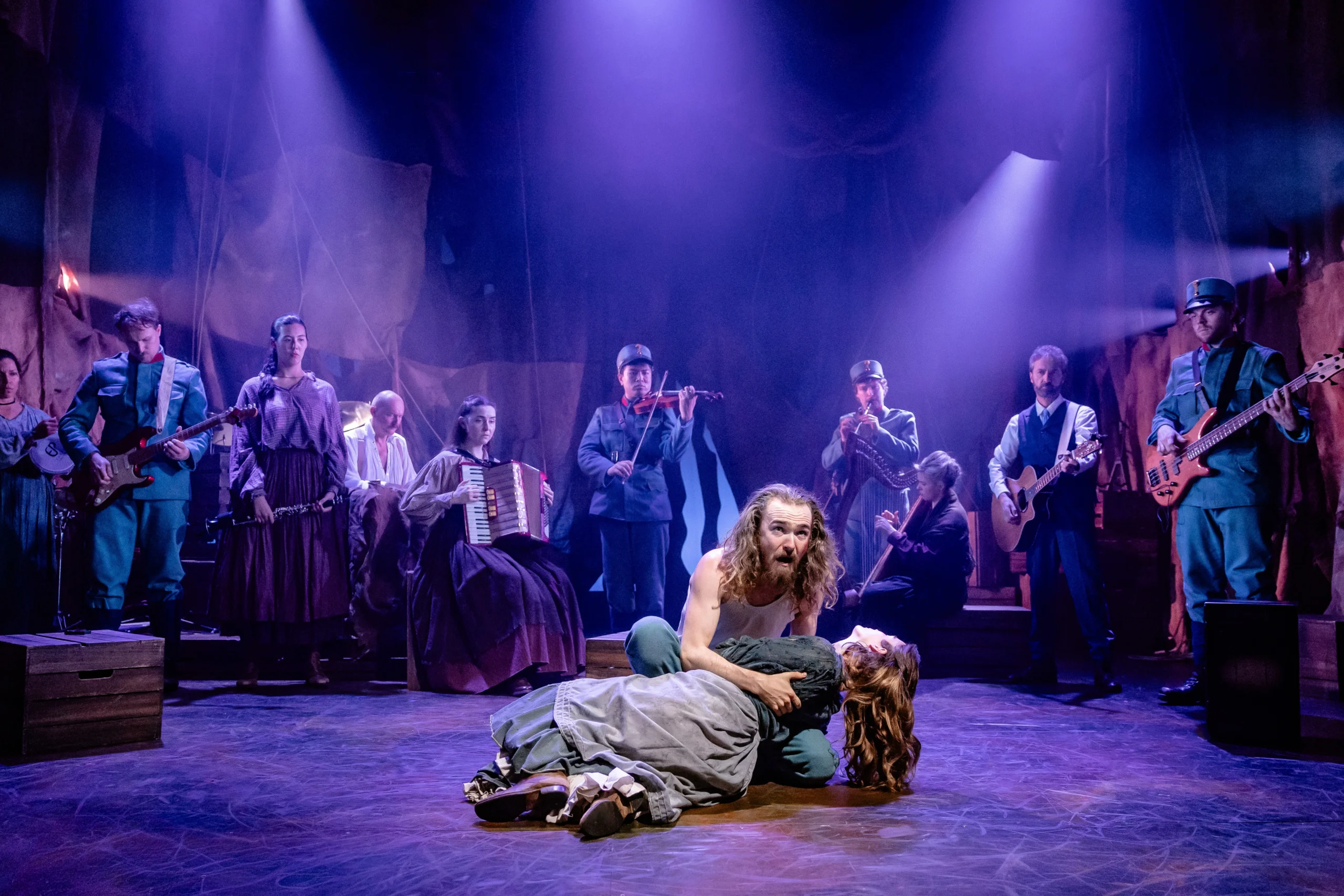
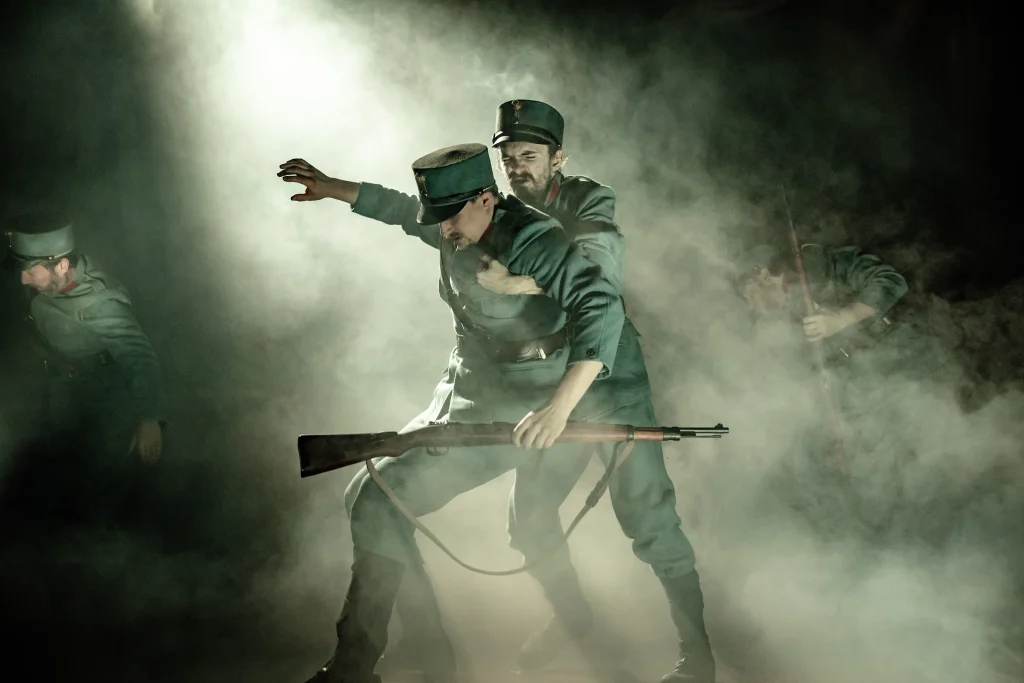
The setting has shifted to an unnamed, vaguely Prussian European war, with the company of actor-musicians doubling as the platoon stationed at an isolated outpost. Franz Woyzeck, played by Brenner O’Connor, is haunted by nightmares and devoted, completely and without qualification, to Marie and the baby they’ve had together but can’t yet marry, because he’s never been granted leave. He is subjected to an army doctor’s experiments, kept on a diet of nothing but peas, a detail lifted straight from Büchner, and at one point strapped into a chair for something resembling electric shock treatment. O’Connor gives all of this everything he has, attacking the role with the commitment of a much bigger part than the show around him earns. It isn’t his fault that Franz & Marie never quite explains why any of this experimentation is happening to him in the first place, only that it is, and that we’re meant to watch him come apart because of that experimentation.
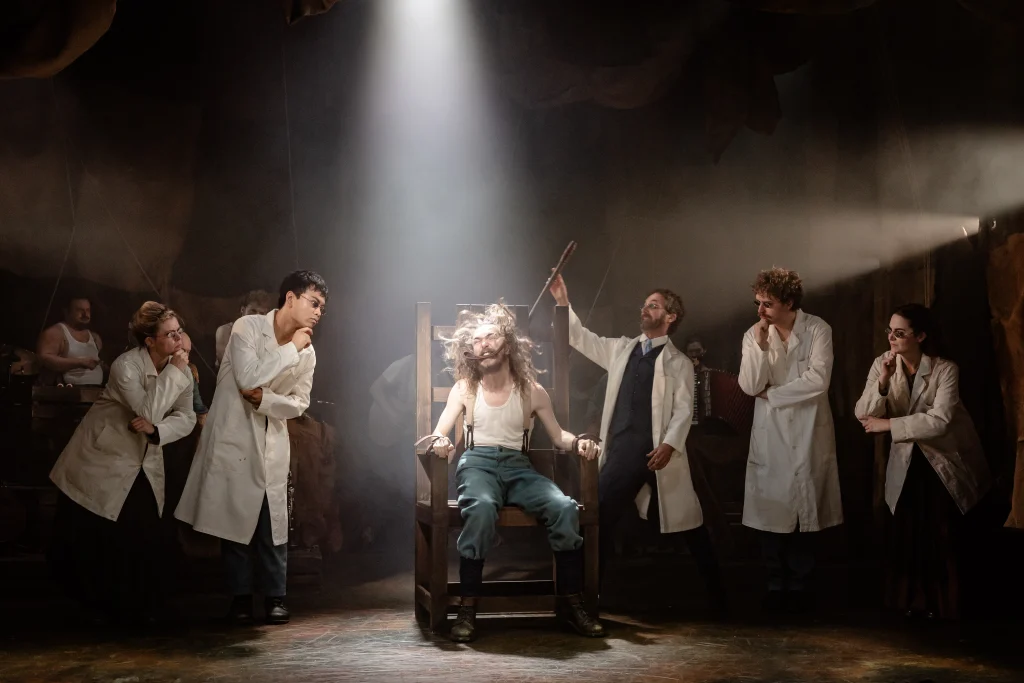
The production’s most significant departure from Büchner sits with Marie, played by Jade Oswald, whose role has been substantially expanded from the fragments Büchner left behind. When Drum Major Varg attempts to assault her, this version has her fight him off, successfully, a point the staging and the other characters return to more than once. It’s an understandable instinct: give the character agency, don’t let her be acted upon. But the tragedy that follows depends entirely on Franz believing, wrongly or rightly, that something happened between them, and on his jealousy curdling into violence because of that belief. Make the assault fail, make Marie’s resistance explicit and witnessed, and the engine driving the second half starts running on nothing. By the time the show reaches its tragic ending, the emotional logic connecting what Franz believes to what he does has gone missing, which is a strange thing to lose in a show that gave itself permission to add material Büchner never wrote.
None of this would matter much if the songs were doing real narrative work, picking up where the book leaves gaps. They aren’t. Strip every number out of Franz & Marie and the plot would arrive in exactly the same place, a few songs lighter and perhaps twenty minutes shorter. The cast sing them well, often gloriously well, the folk harmonies landing with real weight when the company locks in together. But a second-act number built entirely around choosing a knife produces the line “this machete killed a yeti,” which tells you roughly how seriously the show expects its own lyrics to be taken, and how little connection exists between the music and the story it’s supposedly carrying forward.
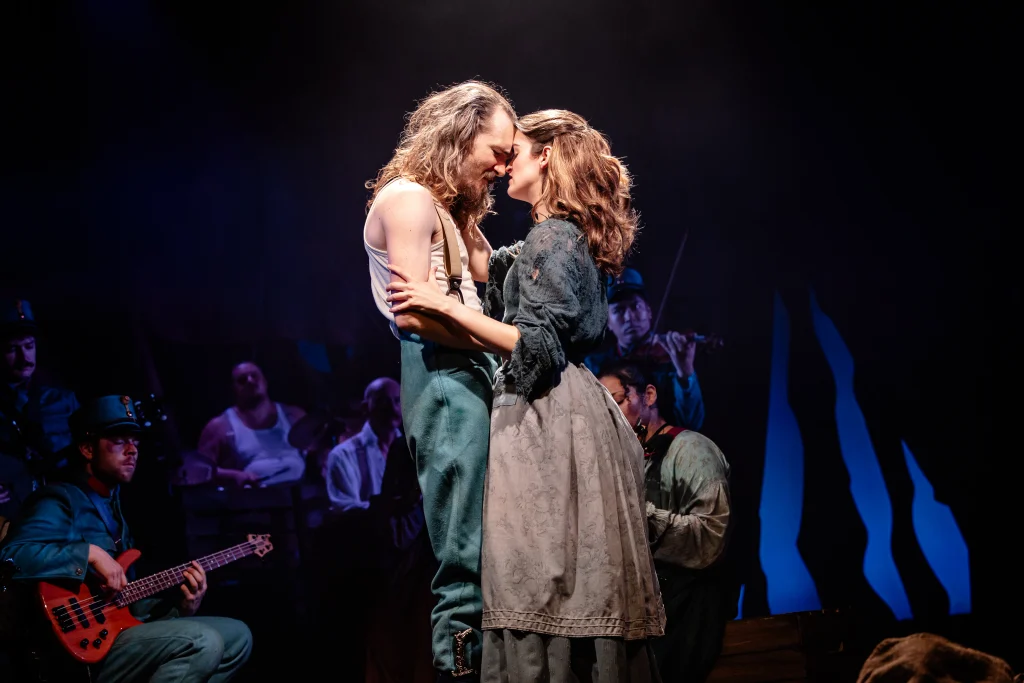
Actor-musician shows live or die on how well the playing integrates into the storytelling, and here the integration is minimal. Musicians shuffle to the rear of the stage between scenes and stand there, instruments in hand, waiting for their next cue, rather than being folded into the world of the piece. When the ensemble commits to the music itself the sound is genuinely rich. When they’re asked to act, the performances outside the two leads have the slightly stiff, overcommitted quality of a school production taking on material well beyond its years, a strange thing to say about a company this evidently talented as musicians. One moment stands out precisely because it’s so unexplained: soldiers marching in formation abruptly break into a grapevine step, with no apparent reason and no follow-through.
At the performance reviewed, Tom Aubrey, who usually covers a handful of smaller roles, stepped into the part of the Captain. He’s considerably younger than the role is written for, and while he did the job competently, the age gap pulled the authority dynamic the role depends on slightly out of true. That’s a note on one specific performance rather than the production’s regular casting, and it’s worth stressing: this isn’t how the role is cast night to night.
The programme notes that the original Korean production landed harder with audiences who live with conscription, where a story about military hierarchy crushing an ordinary soldier has an immediacy British audiences mostly don’t share. That’s a reasonable guess at why the staging feels heavy-handed here, laying its points about class and institutional cruelty on thick without quite finding the resonance to justify the weight, though it’s worth saying plainly that it’s a guess, not something this production or anyone connected to it has actually confirmed.
Büchner wrote it in fragments between July and October 1836, died of typhus the following February with it still unfinished, and it did not reach a stage until 1913, in Munich, three decades after his death. Every production inherits that incompleteness as a kind of freedom, since there’s no definitive version to be faithful to. Franz & Marie uses that freedom to add songs, add scenes, and give Marie a fuller voice than Büchner’s manuscript does, which is a legitimate choice. The trouble is that the additions don’t talk to each other. The expanded Marie undercuts the tragedy’s internal logic. The songs decorate the plot without advancing the story. The staging borrows a programme note about Korean conscription to explain a heavy-handedness the London production hasn’t actually earned on its own terms. It is in the performing, not the writing, that this production has real strengths.
Franz & Marie is beautifully sung, by a company that can play and harmonise with real conviction. It just isn’t, in any way that holds together, a tragedy anymore.
Go for the singing and the sheer commitment of the cast, not for a coherent evening of theatre, EyeOnLondon would say.
For more London arts and culture, visit EyeOnLondon at eye-on-london.com.
[Image Credit | Danny Kaan]
Charing Cross Theatre · London
Franz & Marie
Until 14 November 2026
★★☆☆☆
Franz and Marie is beautifully sung, if dramatically bonkers.
| Book | Chris Broderick, adapted by Teresa Howard |
| Director & Choreographer | Michael Oakley, choreography by Ben Wright |
| Music | Rob Shepherd and Chris Broderick, additional music and orchestrations by Steven Edis |
| Cast | Brenock O’Connor Jade Oswald Steve Simmonds Paula James Richard Emerson Gould Matthew Heywood Max Alexander-Taylor Mark Meadows Eve Polycarpou Elaine Hua Jones |
Further Reading on EyeOnLondon
- Jane Eyre: A Musical Boasts Gorgeous Voices but a Book That Can’t Keep Pace — this connection is already woven into the review above as an in-body link, but it’s worth flagging again here: both shows ask strong-voiced casts to carry adaptations of canonical texts whose books can’t keep up with the songs.
- A Mirrored Monet Struggles to Turn Strong Visuals Into a Compelling Musical — another Charing Cross Theatre musical, reviewed by EyeOnLondon, where striking production values couldn’t compensate for a story that never quite justified its own musical form.
Follow us on:



Subscribe to our YouTube channel for the latest videos and updates!

We value your thoughts! Share your feedback and help us make EyeOnLondon even better!