The Coin Gap That May Explain a Roman Villa’s Vanished Household

Ninety Roman coins. Eighteen years missing between them. Dug from the ground at Brading Roman Villa on the Isle of Wight, this ought to be a simple sequence, one coin after another, decade after decade. It isn’t. Somewhere around CE 330, the coins stop. They don’t start again until 348, a pattern not seen at many other Roman sites in Britain. That silence, not the scattered human bones that will inevitably grab the headlines, is the real discovery buried inside a new study of the villa.
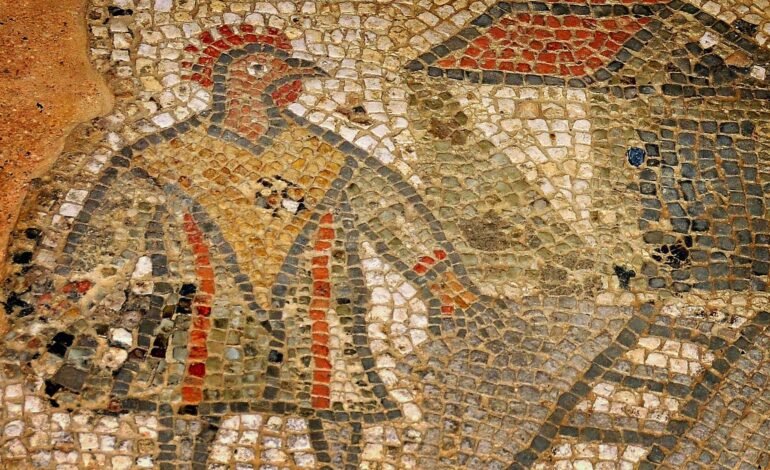
Brading’s discovery came almost by luck. William Munns was digging post-holes for a sheep pen in 1879 when he hit stone that turned out to be a mosaic floor, and Captain John Thorp, already in the area hunting for Roman remains, was close enough to help him uncover it the next day. Over the following two years the pair excavated what turned out to be one of Roman Britain’s finest villas, its floors decorated with Bacchus, Medusa and the site’s famous cockerel-headed man. But threaded through that decorative splendour was something considerably darker: human bones, scattered through the rooms and grounds, that kept turning up in digs across the 1990s and 2000s, including, according to the study, a teenager found in a well alongside three young dogs.
For decades those bones were a puzzle without a timeline. Nobody could say whether they belonged together, whether they marked one bad day or several bad decades, or whether they had anything to do with each other at all. That changed when Michael Fulford, professor of archaeology at the University of Reading, and Derek Hamilton sent five bones to the University of Glasgow for radiocarbon dating. One sample failed. The other four did not, and when the results came back, they pointed toward the same late Roman window, rather than scattering randomly across the centuries the villa was occupied.
“The radiocarbon dates make it clear that the bones are of late Roman date, not post-Roman, and that is the important result,” Fulford said. That is a carefully chosen sentence, and it matters what it does not claim. The dating rules out a much later, post-Roman explanation for the bones, but it does not, on its own, prove violence, disease, or anything else. That is where the coins come in, offering a second, independent line of evidence that happens to point at the same narrow stretch of the fourth century.
“The coins point to a possible historical context … but it is no more than a suggestion,” he added. The historical context he is gesturing toward is genuinely dramatic. Those missing years in the coin record may be linked to a mysterious crisis, something serious enough to prompt a hurried visit from Emperor Constans in the winter of A.D. 343. A few years later, Roman Britain went through a period of real bloodletting. The darker possibility points to a bloody purge that occurred in Roman Britain in the 350s, when Roman Emperor Constantius launched a brutal crackdown on Britain after a usurper named Magnentius was defeated, sending an agent to hunt down any of the loser’s supporters. The ancient historian Ammianus Marcellinus recorded how Britons, both supporters and innocents, were tortured, imprisoned and executed, with many having their property confiscated.
None of that proves anybody died at Brading specifically because of Constantius’s purge. What the study does is line up two separate, unrelated bodies of evidence, radiocarbon physics and numismatic circulation patterns, and show they both point at roughly the same years. That kind of convergence is rare in archaeology, and it is why the coincidence is being taken seriously even while nobody involved is calling it proof. It is also, increasingly, not unique, as a newly excavated Roman sanctuary beneath Frankfurt is turning up its own evidence of how ritual shaped daily life in the empire’s provinces.
The bones themselves carry their own unsettling detail. Some show cut marks. Others have been gnawed. “The most disturbing aspect is the bones scattered within the villa itself,” Fulford said, asking how they got there, mixed in with other Roman domestic rubbish. One possibility raised in the study is that victims were first put into shallow graves, only for scavenging animals, dogs and foxes among them, to dig the remains up again and drag them across the site, leaving the gnaw marks as evidence of their own disturbance of the burials.
Matching any of the bones to individual people, or to the rooms they were found in, is no longer possible. The 1880s excavators were not trained to record that kind of detail, and what they did not write down is gone for good. It’s frustrating, Fulford says, but not unexpected with antiquarian finds, a phrase that says a great deal about how much of archaeology is spent working around the holes left by earlier, cruder digs rather than filling them.
What the study can say is that the remains belonged to at least four adults, one teenager and a baby, and that the villa’s grand reception rooms appear to have gone out of use around the same time, hinting at the sudden absence of whoever had owned the place. Put together, the radiocarbon window, the missing years in the coins, and the abandoned reception rooms make a plausible case that something catastrophic happened at Brading within a fairly narrow stretch of the fourth century.
He will not go further than that. It is plausible that the villa’s inhabitants fell victim to a massacre, as shown by the cut marks and the abandonment of the grand reception, hinting at the death or disappearance of its former owner. Plausible is not proven, and Fulford knows the difference. The paper’s own title ends in a question mark for exactly that reason. “I can’t be certain of a massacre, hence the question mark in the title,” he said. The bones are strange enough to demand an explanation. They are not, on their own, enough to hand him one.
EyeOnLondon will be watching for the full Britannia paper’s reception among Roman Britain specialists, since a coin gap this specific rarely survives scrutiny unchallenged.
For more London arts and culture, visit EyeOnLondon at eye-on-london.com
[Image Credit | wmf.org]
Follow us on:



Subscribe to our YouTube channel for the latest videos and updates!

We value your thoughts! Share your feedback and help us make EyeOnLondon even better!