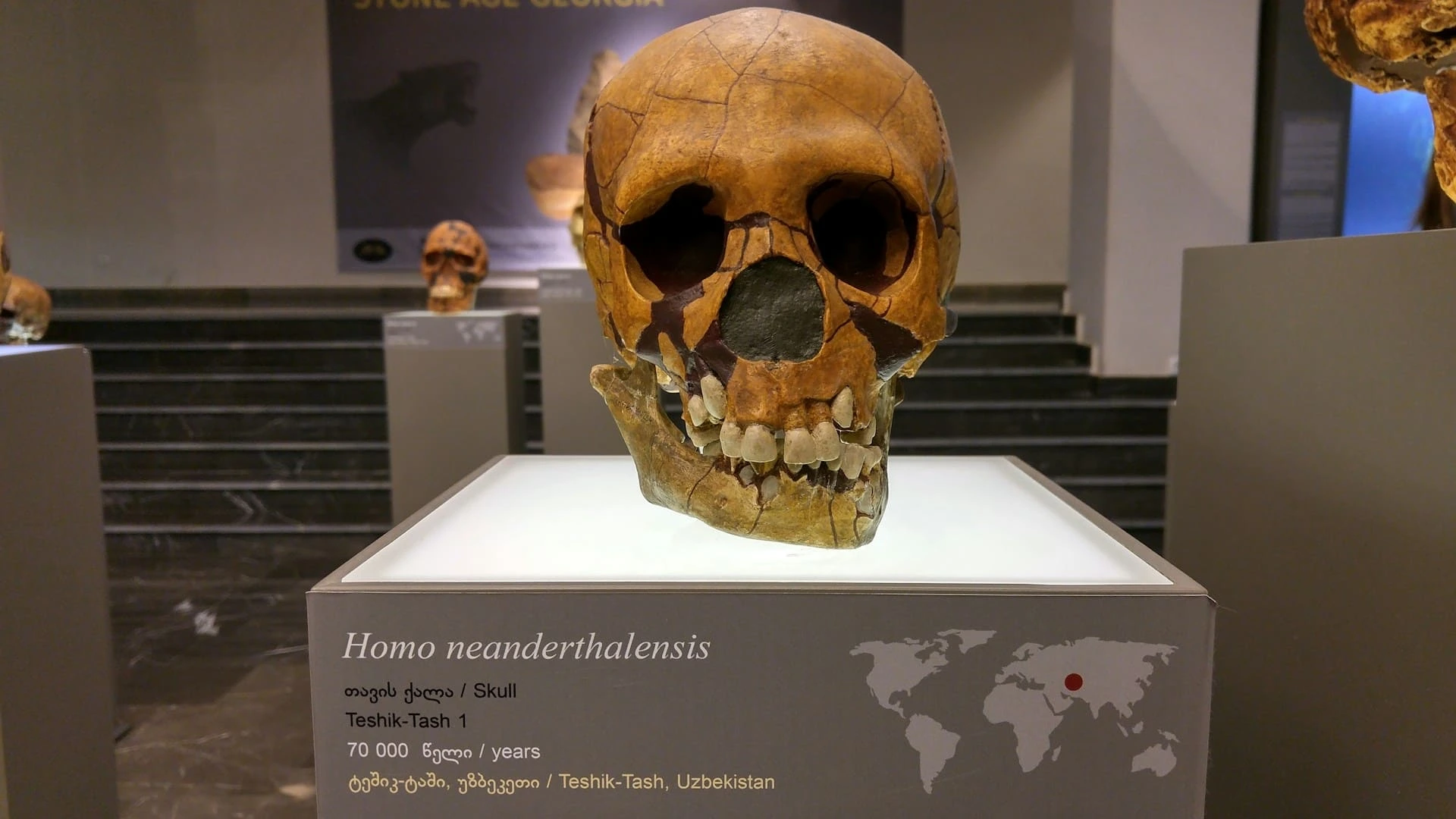
Abric Romaní find causes rethink of Neanderthals


For more than forty thousand years, a rock shelter on a limestone cliff near Barcelona held onto something almost no archaeological site ever keeps: the shape of wood that has long since rotted away. Water dripping through the travertine above Abric Romaní deposited calcium carbonate into every hollow left behind as branches, poles and tools decayed, hardening around them like a mould closing over a cast. When archaeologists began excavating there in 1983, they were digging through stone tools and animal bone. It was not until 1995 that they noticed something else entirely: empty voids in the sediment, shaped unmistakably like wood that was no longer there.
Three decades later, a team led by Palmira Saladié of the Catalan Institute of Human Palaeoecology and Social Evolution has completed the first full analysis of everything that site preserved.
Over decades of digging through 19 sandy layers, researchers recovered 597 wood specimens and natural imprints from 16 archaeological layers spanning roughly 62,000 to 40,000 years ago, with evidence of human presence reaching back as far as 110,000 years in deposits still unexcavated. Of those nearly 600 pieces, 13 are clearly modified tools and other domestic objects, published this month in the journal Science Advances.
What those thirteen objects describe is not a people who happened to occasionally pick up wood between bouts of knapping flint.
At 300 square meters, the rock shelter was the size of a generously proportioned house. Different types of fireplaces and concentrations of tools in various parts of the cave suggest Neanderthals divided it into separate sleeping and work areas.
The team identified meter-long digging sticks near hearths and trash pits. “We know what was happening in the kitchen, in the sleeping areas, in the hearths,” Chacón says.
A thin log more than five metres long, stripped deliberately of its branches, may have formed the spine of a windbreak, or part of a structure built for sleeping. Among the finds are two spears, one of them roughly two and a half metres in length, four charred bark objects that may have served as trays or containers for carrying food or ash, and an object that has defeated every attempt at explanation so far: a thirty-centimetre club with a narrow handle and a distinctly shaped, bumpy head, for which researchers have found no clear parallel anywhere else in the prehistoric record.
None of this would be especially startling if “Stone Age” had always been understood as shorthand for “the age before we found the wood.” But the term carries more weight than that, and the weight is worth tracing. It was coined not by Neanderthals’ own contemporaries, obviously, but by a Danish museum curator named Christian Jürgensen Thomsen, who in the 1810s and 1820s was faced with the unglamorous task of making sense of a chaotic jumble of donated antiquities at what became Denmark’s National Museum.
He noticed the collection could be sorted by the material its tools were made from, and from that sorting exercise came the three-age system: Stone, Bronze, Iron, each one assumed to mark a step up from the one before. Four decades later, the British archaeologist John Lubbock split the Stone Age itself into Palaeolithic and Neolithic, old and new, further entrenching the idea that human history could be read as a single ladder of material progress.
It was a system built to organise museum cabinets, not to describe how people actually lived, and it has proved remarkably durable precisely because it is useful for organising museum cabinets. The trouble is that it was built from what happened to survive, not from what was actually used. Stone lasts. Bone sometimes lasts. Wood, in the overwhelming majority of archaeological contexts, simply rots, and an absence of evidence quietly hardened into evidence of absence: a species defined by the one material durable enough to still be lying around to define it by.
That is precisely the gap that Abric Romaní closes, and why its researchers are framing the find in terms that go well beyond woodworking alone. Added to older wood-tool evidence from sites in Germany and Italy, the Spanish finds now provide, in the words of Science’s own coverage, strong evidence that Neanderthals were craftspeople roughly on a par with early Homo sapiens.
What makes Abric Romaní different from earlier wood discoveries is not really the age of the finds, since older wooden spears have turned up at lakeshore kill sites in Germany. It is that this was a home, not a hunting ground, lived in repeatedly across thousands of years, which lets researchers see wood doing the ordinary, unglamorous work of daily life rather than only the dramatic work of killing prey. The researchers themselves describe wood developing as a technology alongside stone tool-making, not trailing behind it as some lesser, improvised alternative.
That is the real correction here, and it has taken a century and a half to arrive. Thomsen never met a Neanderthal, and never claimed to be describing them specifically. But the classification scheme he built to tidy a storeroom in Copenhagen went on to carry an entire species’ reputation for a hundred and fifty years, mostly because stone was the material patient enough to wait around to be found. Wood was never missing from Neanderthal life. It was only missing from the record, until a cliffside shelter outside Barcelona happened to keep it in exactly the one form that could survive: not as wood at all, but as the shape wood leaves behind.
For more, visit EyeOnLondon at eye-on-london.com
Follow us on:



Subscribe to our YouTube channel for the latest videos and updates!

We value your thoughts! Share your feedback and help us make EyeOnLondon even better!