Virginia Woolf and the Mind at Gordon Square

“I am rooted, but I flow.”
— Virginia Woolf
Virginia Woolf spent much of her life trying to organise experience into something that might be understood, if not entirely trusted. The world, as she encountered it, rarely arrived in a coherent sequence. It appeared instead in fragments: moments, impressions, overheard phrases, the shifting sensation of time itself. She treated these not as obstacles to writing, but as its proper material.
Born Adeline Virginia Stephen in 1882, she grew up at Hyde Park Gate in a household that was both intellectually formidable and emotionally complex. Her father, Sir Leslie Stephen, was a critic and editor of considerable authority who believed, in the Victorian manner, that knowledge should be pursued with seriousness, if not a degree of severity. The house was filled with books, conversation and expectation. Woolf later described early life as something “embedded in a kind of nondescript cotton wool”, broken only by moments of heightened awareness.
More reporting from EyeOnLondon
Film, theatre and cultural stories shaping London’s creative life.
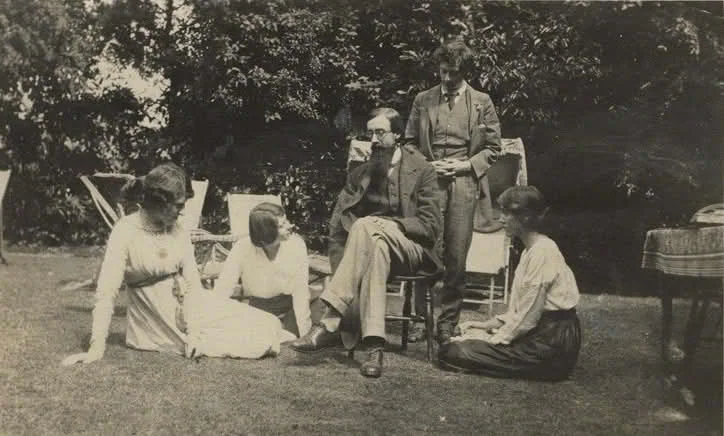
After her father’s death in 1904, Woolf moved with her siblings to 46 Gordon Square in Bloomsbury. Here, a different kind of life began to take shape. The gatherings that would later be called the Bloomsbury Group emerged gradually, without formal definition, a circle whose intellectual life is still documented through collections such as those held by the British Library. What united them was not a programme but a habit of conversation. Among those who passed through were Lytton Strachey, John Maynard Keynes and E.M. Forster, along with Woolf’s sister Vanessa Bell, whose painting perhaps came closest to capturing the atmosphere of the group itself.
Woolf’s writing developed alongside this environment. She was not especially interested in plot in the conventional sense. What mattered was the movement of thought. In Mrs Dalloway, a single day unfolds with the weight of a lifetime behind it. In To the Lighthouse, time passes almost incidentally, as if occurring just beyond the edge of the page. “Life,” she wrote, “is not a series of gig lamps symmetrically arranged; life is a luminous halo.” The image resists neat interpretation, which is precisely its strength.
There is a tendency to describe Woolf simply as modern. She was, though the term has broadened to the point of imprecision. What she did, more exactly, was to take consciousness seriously as a subject. That required patience, and a willingness to accept that clarity might not always be available.
Her essays, often lighter in tone, reveal a different aspect of her thinking. A Room of One’s Own remains quietly persuasive. “A woman must have money and a room of her own if she is to write fiction,” she observed, a sentence that endures not because it is rhetorical, but because it is practical.
Woolf’s life ended in 1941, when she walked into the River Ouse near her home in Sussex. It is an event often written about with more certainty than the facts allow. What remains more useful is the work itself, which continues to offer a way of attending to the world that is both exacting and humane.
There is still something distinctly Bloomsbury about Woolf. Not in geography alone, though the squares remain. It lies in the idea that thought might be shared, tested and occasionally contradicted without losing its seriousness. Or, as she once put it with characteristic clarity, “one cannot think well, love well, sleep well, if one has not dined well,” a reminder that even the most abstract ideas rest on practical foundations.
Follow EyeOnLondon for clear reporting on London, culture and the wider world.
Follow us on:



Subscribe to our YouTube channel for the latest videos and updates!

We value your thoughts! Share your feedback and help us make EyeOnLondon even better!