Albert Bridge closure brings London’s infrastructure pressures into view

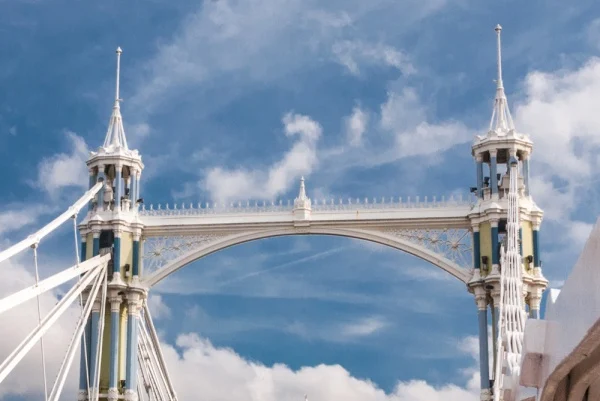
There is a point where maintenance becomes something else. The closure of Albert Bridge marks that moment.
The crossing between Chelsea and Battersea has been taken out of use for vehicles after engineers identified structural damage at its base. Repairs are expected to take up to a year, with costs estimated at £8.5 million. Pedestrians and cyclists will still be able to cross.
More reporting from EyeOnLondon
Policy, science and global developments shaping London’s wider world.
Built in 1873, the bridge belongs to a different phase of the city’s life. It was designed for lighter loads and slower movement. What it carries now is something else entirely.
That tension between design and demand is not unique to one bridge. It is becoming a pattern across London.
Responsibility for Albert Bridge sits with the Royal Borough of Kensington and Chelsea, which has managed it since the late 20th century. The current closure follows routine inspections that revealed cracks in a key structural component supporting the moving elements of the bridge.
Engineers are still assessing the full extent of the work required. A one-year timeline has been suggested, but officials acknowledge that certainty is limited while further data is gathered.
For businesses nearby, the impact is immediate but uneven. At No. Fifty Cheyne, Sunday service remains the anchor of the week. The expectation is not that customers will disappear, but that journeys will take longer, with consequences for timing rather than demand.
Albert Bridge has long been known as “The Trembling Lady”, a reflection of its ability to shift slightly with temperature changes. That flexibility was part of its design. It was never intended to absorb sustained modern traffic.
Across the capital, similar structures are under comparable strain. Hammersmith Bridge remains closed to motor vehicles after years of safety concerns, with repair costs rising well beyond initial expectations. Other crossings, including routes in outer boroughs, have faced prolonged restrictions or closure.
The question that follows is not only technical. It is financial and administrative.
Many of London’s non-trunk road bridges were transferred to borough control after the abolition of the Greater London Council. Maintenance responsibility sits locally, while the function of these crossings remains city-wide.
That gap is becoming harder to manage. Professor Tony Travers of the London School of Economics has described the situation as a sign of deeper policy failure, pointing to the difficulty councils face in funding repairs for infrastructure that serves far beyond their boundaries.
There are calls for a different approach. Elly Baker, who chairs the London Assembly’s Transport Committee, has argued that bridges of this kind should be treated as national infrastructure, regardless of ownership.
The government, through the Department for Transport, has set out plans for a structures fund aimed at supporting local authorities with repair costs. Details are still being finalised, and access will depend on applications from councils.
Transport for London has indicated it will work with boroughs on any proposals to reopen Albert Bridge to traffic, but no confirmed pathway has yet been set out.
For now, the closure adds to a growing list. In a city defined by movement, several crossings remain out of reach for drivers. The longer that continues, the harder it becomes to treat each case as an exception.
For more reporting on London and the decisions shaping the wider world, follow EyeOnLondon.
Follow us on:



Subscribe to our YouTube channel for the latest videos and updates!

We value your thoughts! Share your feedback and help us make EyeOnLondon even better!