Oviraptor nest recreated to answer palaeontological mystery

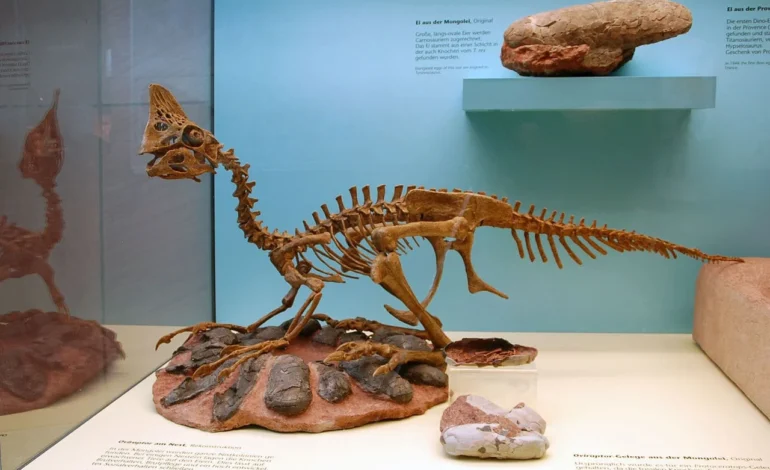
How the bird-like Oviraptor hatched its eggs has been a mystery for palaeontologists. Whether they relied on heat from the surrounding area the way crocodiles do or warmed up their eggs like birds, has puzzled researchers. Now, a study published in Frontiers in Ecology and Evolution aims to find an answer.
Researchers in Taiwan combined simulations of heat transfer with physical experiments to try and understand how the Oviraptor may have incubated its eggs. These findings were compared with modern bird incubation. A life size model of the dinosaur was built, along with a realistic nest to test how heat transferred through the eggs.
“We show the difference in oviraptor hatching patterns was induced by the relative position of the incubating adult to the eggs,” senior author Dr. Tzu-Ruei Yang, an associate curator of vertebrate paleontology at Taiwan’s National Museum of Natural Science said.
“Moreover, we obtained an estimate of the incubation efficiency of oviraptors, which is much lower than that of modern birds,” first author Chun-Yu Su, who attended Washington High School in Taichung when the research was conducted added.
Most modern birds rely on sitting directly on their eggs to heat them up. This relies on them touching all the eggs, allowing them to maintain a constant temperature. But Oviraptor arranged the eggs in a ring arrangement, making them unable to maintain contact with all the eggs at once.
“Oviraptors may not have been able to conduct TCI as modern birds do,” said Su. Instead, the dinosaurs and environmental heat likely worked together. While not as efficient as modern birds, it may have suited the nesting style preferred by the dinosaurs.
“Modern birds aren’t ‘better’ at hatching eggs,” says Yang. “Instead, birds living today and oviraptors have a very different way of incubation or, more specifically, brooding. Nothing is better or worse. It just depends on the environment.”
The researchers point out that the results are based on a reconstructed nest under modern conditions which are different from the environment of the Late Cretaceous.
Image: EvaK
Stay tuned to EyeOnLondon for the latest news and expert opinions.
Follow us on:



Subscribe to our YouTube channel for the latest videos and updates!

We value your thoughts! Share your feedback and help us make EyeOnLondon even better!