London’s housing problem is no longer just about numbers

There is something increasingly uncomfortable at the centre of London’s housing debate.
We talk about numbers. Targets. Delivery. The need for 880,000 new homes over the next decade. But beneath that sits a quieter problem that is now becoming harder to ignore. The homes being built are not always the ones people want.
That is the warning coming from the London Assembly’s planning committee, which has pointed to a growing gap between what Londoners say they value and what is actually being delivered across the city.
More reporting from EyeOnLondon
Policy, science and global developments shaping London’s wider world.
It is a simple idea, but it carries weight.
Because once that gap opens up, the system starts to slow itself down. Developments meet resistance. Consultations become confrontational. Planning delays stretch out. What should be a question of supply turns into a question of trust.
James Small-Edwards has framed it as a balance rather than a trade-off. Quantity and quality are not opposing goals. But too often in London’s current pipeline, they are treated as if they are.
What sits behind that tension is design.
The committee’s intervention reflects a broader concern that the character of new developments is not keeping pace with public expectations. That does not mean a rejection of modern architecture. It points instead to a lack of clarity about what people feel comfortable living alongside, and how those preferences are being captured, if at all.
One suggestion gaining traction is the use of local design codes shaped directly with residents. Not consultation as a formality, but participation that has some weight behind it. The argument is straightforward. If people recognise something of themselves in what is being proposed, resistance is less likely to follow.
There are already examples of what that can look like in practice.
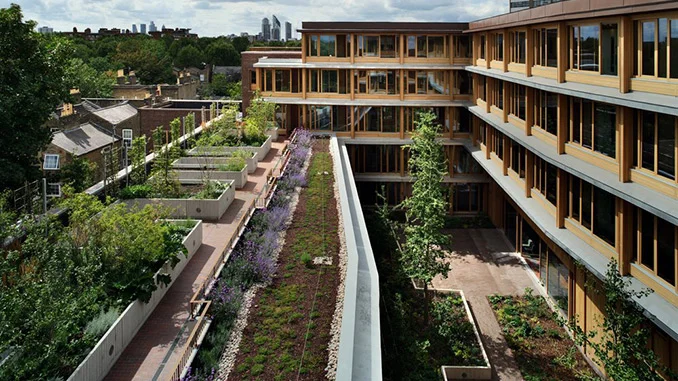
In Bermondsey, Appleby Blue Almshouse offers a different reading of what housing delivery can be. Not simply a collection of units, but a place built around shared space, light and a sense of care in how it is put together.
Commissioned by United St Saviour’s and designed by Witherford Watson Mann, the scheme went on to win the Stirling Prize. It is often described less in terms of its architecture than in terms of how it feels to live there.
That distinction matters.
Because much of London’s current housing output is driven by efficiency. Speed. Density. Viability. All necessary pressures. But when those become the only drivers, something else tends to fall away. The sense that a development has been thought about as a place, rather than assembled as a solution.
Architect Stephen Witherford has spoken about the role of imagination in housing. It is not a word often used in planning discussions, but it points to a gap in how the conversation is being framed.
City Hall maintains that community involvement sits at the centre of its Good Growth by Design programme, and that the next London Plan will continue to reflect that approach. The language is there. The intent is there.
The question is whether it changes outcomes on the ground.
Because London’s housing challenge is no longer just about how many homes can be built. It is about whether those homes feel like places people recognise, accept and want to be part of.
Until that is addressed, the cycle of resistance and delay is unlikely to ease.
For more reporting on London and the decisions shaping the wider world, follow EyeOnLondon.
[Image Credit | © Philipp Ebeling]
Follow us on:



Subscribe to our YouTube channel for the latest videos and updates!

We value your thoughts! Share your feedback and help us make EyeOnLondon even better!