What’s Changed at the National Gallery Sainsbury Wing?


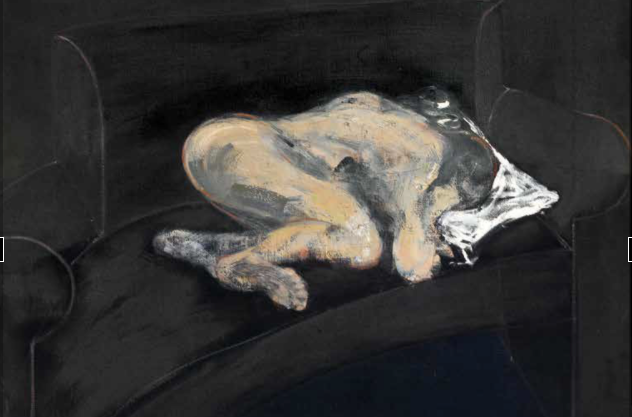
There’s a nice little irony in the reopening of the National Gallery Sainsbury Wing on the 80th anniversary of VE Day. Throughout the Second World War the gallery never closed – until the day the war ended and it was shut for the celebrations. Although the paintings were stashed away in a Welsh slate quarry for safety (one Picture of the Month was brought back as a reminder of what we were missing), the gallery was open every day for, among other activities, the famous free piano concerts of Myra Hess.
The Sainsbury Wing was opened by the Queen in 1991 amid some controversy, and closed again in February 2023 for a revolutionary £85m “democratisation” of the National Gallery – though the money has all been privately raised with nothing coming from the public purse – and the first thing you notice as you approach is that the name “The National Gallery” is now emblazoned over the door. This is no longer just a wing.
“We wanted to make it clear, in large letters,” said Gabriele Finaldi, celebrating his tenth year as its director. “What we are delivering is what we want the National Gallery to be – welcoming to people, a place of warmth, light and space. The gallery is yours,” as he has said before and repeats now. “The paintings belong to you.”
Marking the end of a year of celebrating the gallery’s 200th anniversary, the new open redesign is the work of a German architect based in New York, Annabelle Selldorf, whose watchword seems to be subtlety: subtle colours, subtle lighting, subtle space. Technical developments in glass-making mean more natural light can be allowed into an expanded foyer through what seem to be much larger windows, so that from a place of comparative tranquillity now there is an immediate connection with the bustle of Trafalgar Square outside.
Gone are the cluttering pillars, much of the concrete ceiling, the cloakroom, the walls hiding the broad staircase to the galleries, the great rambling shop, which always seemed an odd thing to find at the start of a museum visit rather than at the end. Selldorf has shifted stuff you didn’t know was there till it was gone.
There are no search tables now; all that’s done electronically and remotely from slender pillars: to the right, the stairs to the collection; to the left, a new coffee bar. Where a ceiling once was is a balcony revealing a new Giorgio Locatelli restaurant that overlooks Trafalgar Square. And ahead, as you enter, is a 12m-wide media wall showing enlargements of some of the most loved paintings in the collection – Raphael, Van Eyck, Gainsborough, Vermeer just in the few minutes I stood there – in very high resolution, with detail you couldn’t make out on the painting itself with the naked eye.
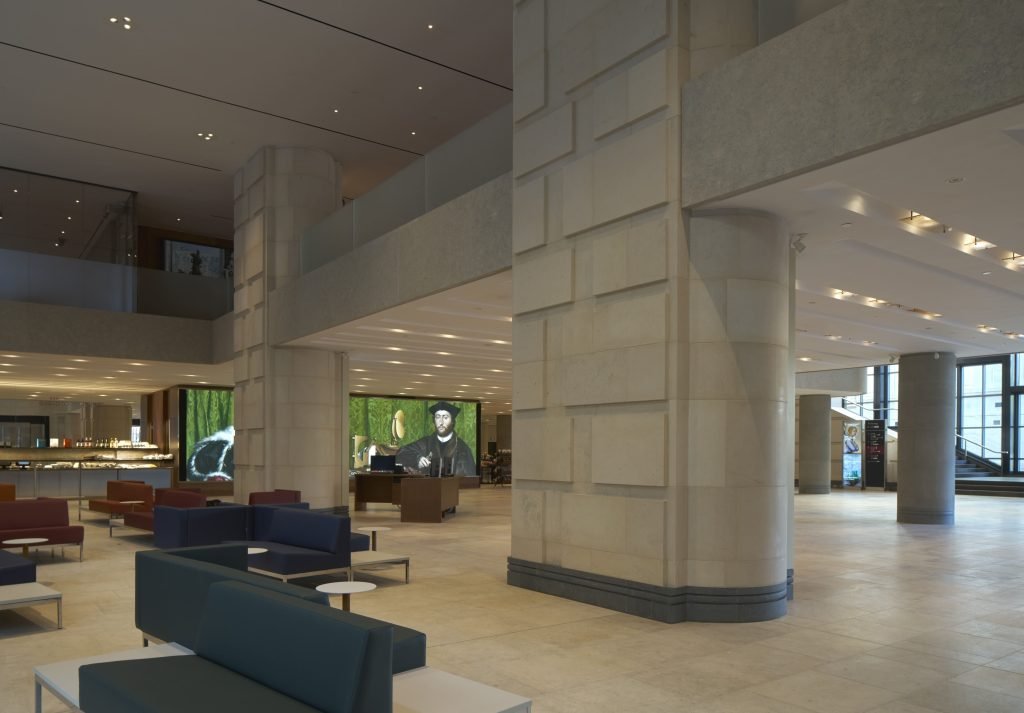
Halfway down towards the temporary exhibition gallery there are new toilets and cloakrooms where a tunnel has been half-dug between the Sainsbury and the old Wilkins building, allowing for a new gather space beside the 320-seat lecture theatre.
What isn’t here, however, is the long-argued-for extended temporary exhibition space. That remains in the basement, cramped and without natural light: it wasn’t, said the deputy director, Paul Gray (unhelpfully), in the brief. The permanent collection is the focus.
The National Gallery should have been celebrating at least its 250th birthday with an exhibition bearing more than a passing resemblance to what you would see in the Hermitage in St Petersburg today. When Sir Robert Walpole died in 1745 there was already a yearning for something to match the great galleries beginning to spring up across Europe, and his outstanding collection was offered for sale to the nation. But while the government dithered, it was snapped up by Catherine the Great.
It wasn’t until 1823 that the die was cast, when the collection of a recently deceased banker, John Julius Angerstein, came on the market with works by Raphael, Rembrandt and Titian. Mindful of the Walpole debacle, Parliament hastily voted to buy the collection, and it opened in Angerstein’s house in Pall Mall as the National Gallery on 19 May 1824.
But it was too pokey, unfavourably compared with Paris’s palatial Louvre, so in 1832 a new building designed by William Wilkins opened on the site of the royal mews at Charing Cross and, despite fears that pollution from the foul air of central London might ruin the pictures, the National Gallery duly moved in.
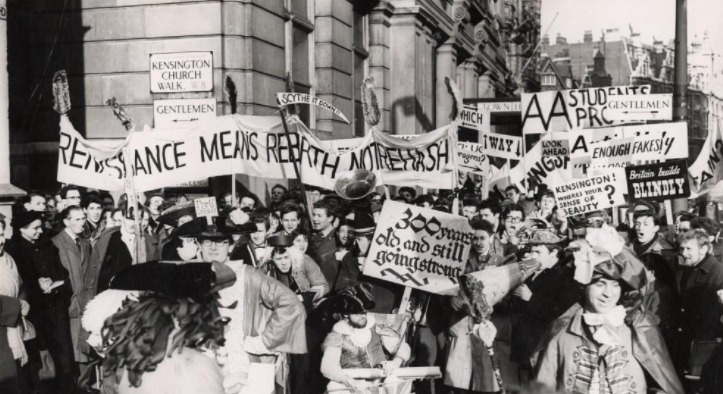
However, it has become cramped again, and in the 1980s the three grocer Sainsbury brothers made a donation to create a new wing. The first proposal, by ABH, was scrapped when it was scorned by the then Prince Charles as a “monstrous carbuncle on the face of a much-loved and elegant friend”. A new competition was won by Robert Venturi working with Denise Scott Brown, and it opened in 1991.
Its Selldorf renaissance is a revelation on many levels, and there is still Phase II to be done, starting next year, to finish the tunnel and establish new archive, research and library facilities.
There is also a complete rehang, with more paintings on show than before – 1,000 as against 700 – with feature rooms for individual artists such as Titian, Rembrandt and Monet, tracing the development of European art from the 13th century to today, signified by Richard Long’s new commission, Mud Sun, that dominates as you climb the staircase. Some favourites, like the Wilton Diptych, have returned to where you would expect to find them. New works acquired as part of NG200 are up.
And themes have been devised to engage visitors, such as one gallery devoted to pastels. Paintings have been conserved and restored, and intriguing new discoveries made. Cézanne’s Bathers is now in a new frame along with the French newspaper cuttings used in a previous relining.
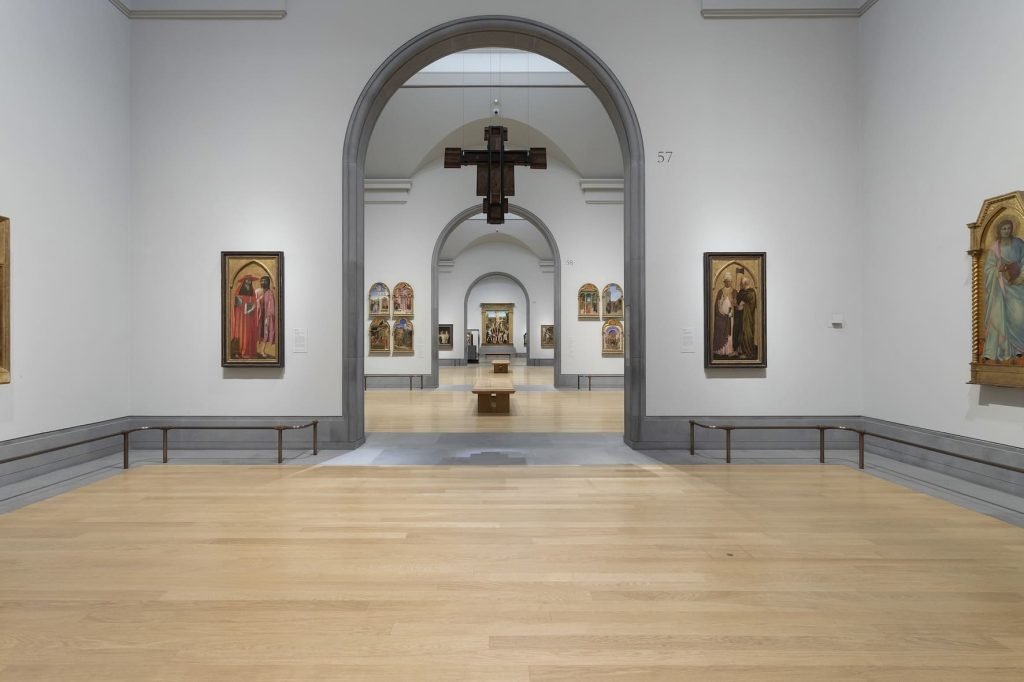
The National Gallery was welcoming six million visitors a year pre-pandemic, and with the National Gallery Sainsbury Wing closed for two years since, it has seen barely three million across the threshold a year. That will change almost overnight, and although the new rehang bears more than a passing resemblance to a church hang, to echo the way medieval paintings would first have been seen, this is no evocation to worship. More pictures will be on show – 1,000 rather than 700 from the 2,600-strong collection.
“Thanks to the reimagining of the exterior and interior spaces by architect Annabelle Selldorf,” said Finaldi, “millions of visitors will be welcomed into the newly configured and subtly refurbished spaces, double height and brilliantly lit, and en route to exploring the gallery’s superb painting collection from Giotto to Monet.”
If you’re curious about how galleries evolve behind the scenes, this National Gallery archive on the making of the Sainsbury Wing offers a fascinating look at its architectural and curatorial development.
For more stories on art, history, and culture, and the people behind them, visit the Arts & Culture section at EyeOnLondon. We’d love to hear your thoughts in the comments.
Follow us on:



Subscribe to our YouTube channel for the latest videos and updates!

We value your thoughts! Share your feedback and help us make EyeOnLondon even better!