Kandinsky, Münter and the Blue Rider at Tate Modern

Expressionism, almost by definition, has no boundaries. It is arguably the most important movement in 20th century art, coming out of the first decade or so, from a century packed full of artistic invention and discovery. What it did was change the art from what we see of a subject, to what we feel about it.
It was also a contradiction to Impressionism, the gentle revolution that began in the 1870s with its devotion to nature, to painting in the open air, to conservative use of paint, to pastel colours, that took its name from Monet’s 1872 Turneresque swirl of sea and sky, around a solitary silhouetted boat beneath a red sun, Impression, Sunrise.
The origin of the title of the Expressionists is less easy to pin down – it was probably used first in 1910 by an art historian, by which time the movement was already underway. And it was a crashing out from the ‘pointless’ academic tradition, a natural development through the Post-Impressionists, taking in other movements including Fauvism and Cubism, and groups the Bridge (Die Brücke) led by Ernst Ludwig Kirchner mostly in Berlin, and the Blue Rider (Der Blaue Reiter), a community of artists that settled in Bavaria. However, it was not only in painting: Expressionism was heard in music, read in poetry, watched on the stage, even lived in as architecture – Kandinsky himself was synaesthetic, seeing music in visual colour, which was to preoccupy him later in his story when he had become a composer.
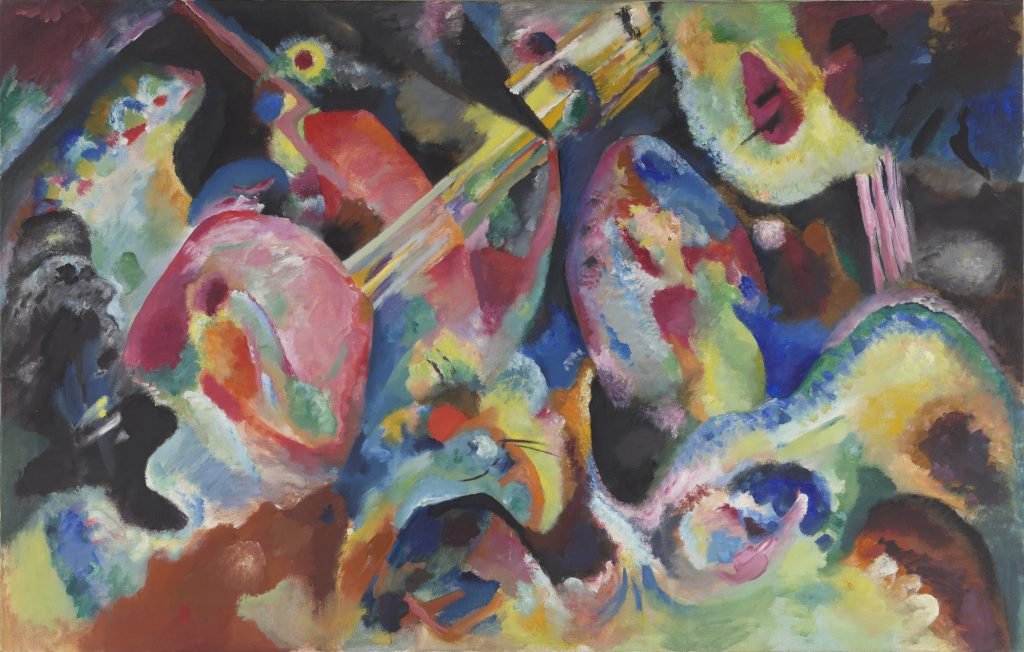
The Blue Riders, as this exhibition proposes, was the most influential, centred on the partnership of Wassily Kandinsky (1866-1944) and Gabriele Münter (1877-1962). Both were from moneyed middle class families; he was born in Moscow, she in Berlin. They met at art school in Munich in 1902, when she was 25 and he was 36, Kandinsky had abandoned his career as a law professor to paint and was already experimenting with the presentation of image as it is felt rather than seen. This partnership is at the heart of the exhibition and devoted to what was more of a community than a school of painting, attracting gifted but unconventional artists largely from Russia, Germany and the USA, to join them in bohemian Schwabing, Bavaria. “There I concerned myself with thoughts about ‘pure’ painting, pure art” Kandinsky wrote.
The Expressionism exhibition focuses on the years of their life together (1902-1916), the years before Kandinsky moved into abstract and his famous dancing ceiling mobiles. There is a touching early example of their style in Kandinsky’s 1903 presentation of Münter, in a floor length gown of electric blue, apparently in front of a camera tripod rather than an easel.
It is a large exhibition, drawn mostly from the extraordinary Lenbachhaus collection begun by the painter Franz von Lenbach in the 1920s, which eventually compiled the world’s largest holding of Blue Rider pictures, including more than 90 Kandinsky paintings, mostly bequeathed by Münter in 1957. It also includes works by other Blue Rider artists such as Paul Klee, Franz Marc, Marianne von Werefkin and Franz Marc.
In fact 17 artists are included as part of or close to the group, giving a holistic sense of who the Blue Riders were, together and individually. Their work shows the influence they had on each other and that they took from the likes of Van Gogh, Gauguin, Seurat, Cézanne, and Braque. They were unconventional socially as well as artistically, contemptuous of traditional practice in their search for the spiritual and the arresting, and not all particularly young.
In 1911 Kandinsky published the Blue Rider Almanac, effectively a handbook in words and pictures to Expressionism through the experiences of individual members of the group.
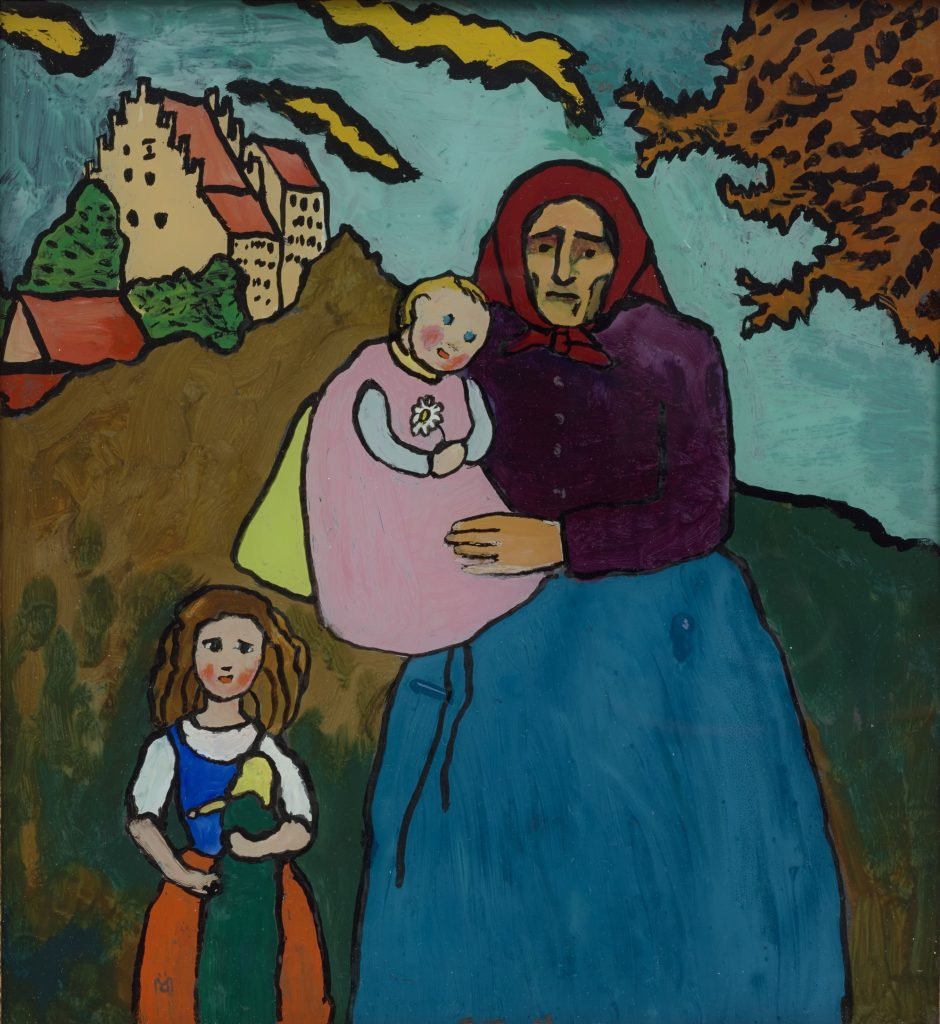
The ghost at this Expressionist feast, however, is the Blue Rider itself. The name comes from a 1903 oil-on-card painting by Kandinsky, which shows a horseman on a white steed galloping across a greensward, the contents – horse, rider, hills, trees, sky, clouds – compiled by colours rather than forms. It is not in the Lenbach cache but in a private collection in Switzerland and is presumably not available for loan.
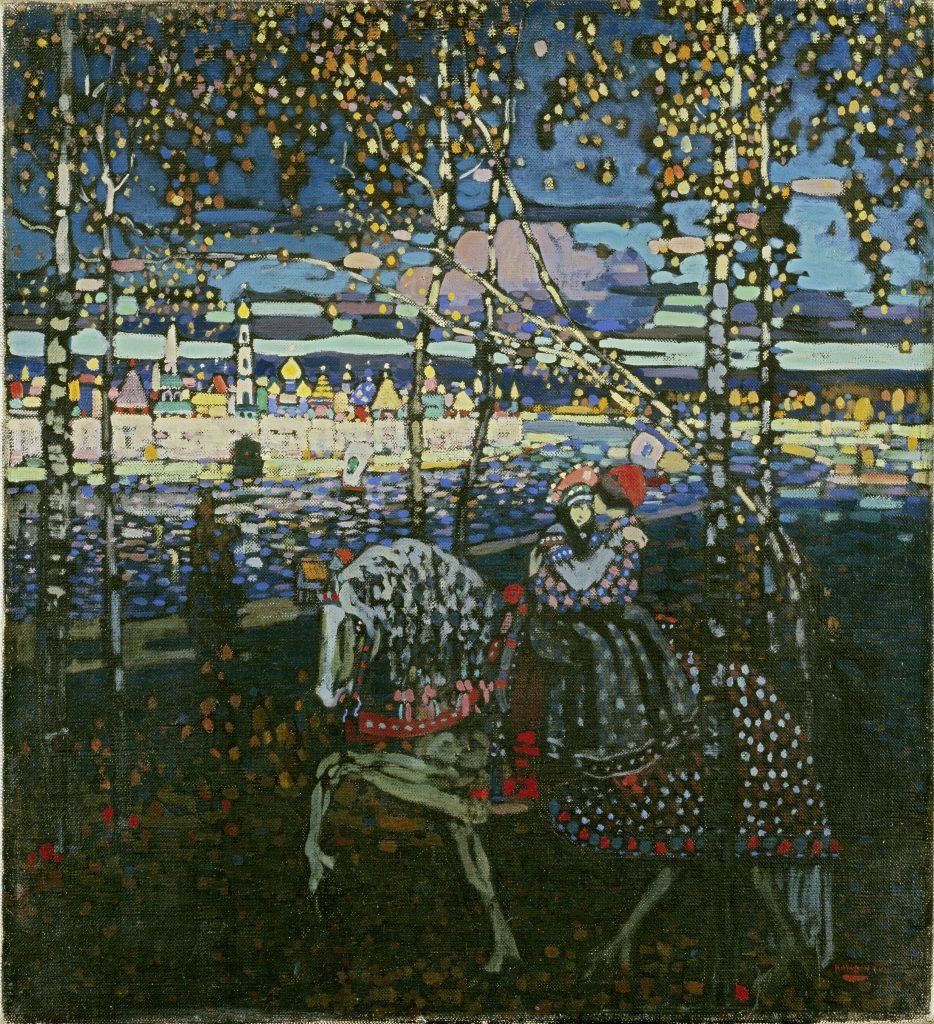
Instead, the show opens with another equestrian Kandinsky from a little later, Riding Couple, a more focused picture but with its narrative told in sharp, almost Pointillist colours. The subject figures are in the foreground in more subdued shades, while the architecture of the city across the water behind them glows brightly. It looks almost like an apprentice piece in its awkward references to classical shapes, like the high-stepping horse, in bold black lines, but marks another milestone in his journey to the more explosive drama of Expressionism, which was manifested a couple of years later. Münter is introduced in the same room through photographs she took during her long holiday in America with her sister a couple of years before she met Kandinsky, in which she shows her first use of a creative medium before she took to paint.
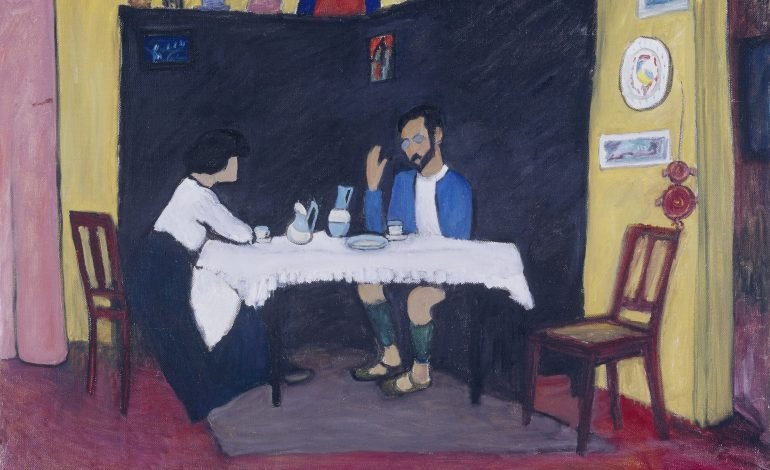
As a painter we first meet Münter through the portrait of Kandinsky, a pared-down cross with a still life made with fierce colour and delineation (Man at the Table) to bring that signature dramatic effect, and the more gentle but no less striking portrait of the opera singer Olga von Hartmann.
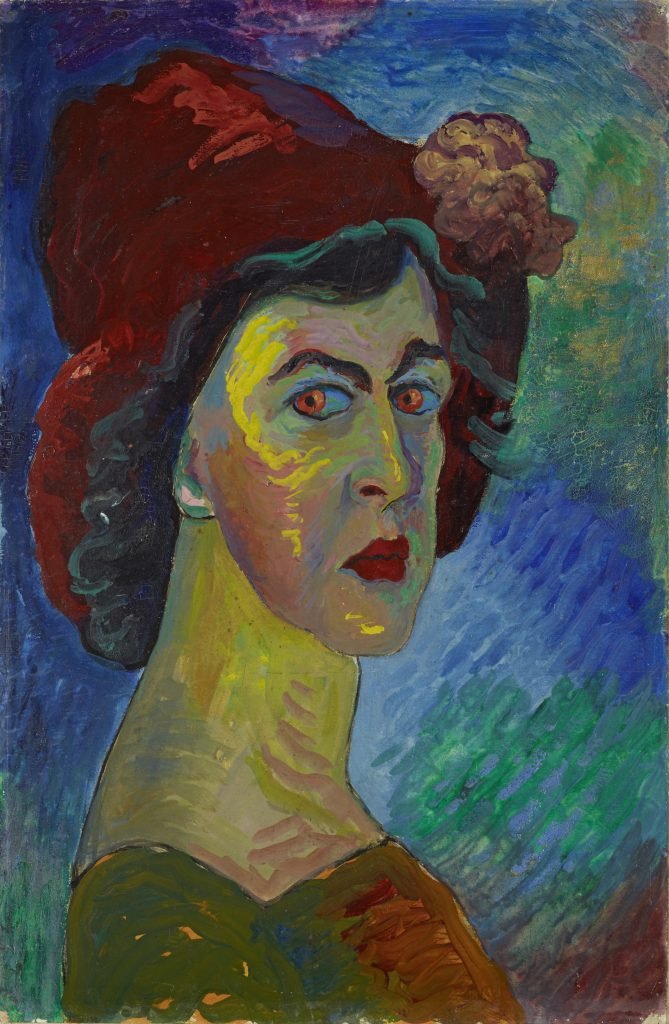
Female Blue Riders had equal billing, and one of the most powerful images is by the Russian Marianne Werefkin – who had a long-term unconventional partnership with another Russian Blue Rider, Alexej Jawlensky. Her 1910 self-portrait, celebrating her 50th birthday, features a bold glare at the viewer through blazing orange eyes beneath a crimson hat, in strikingly bold strokes that smack of masculine assertion rather than feminine grace.
Rather than being influential wholly in their own right, the Blue Riders were a leading element in the wide movement of Expressionism, which changed art forever, and is still influential now. It was a contemporary art that in the 1930s disgusted the Nazis so much they made their work the kernel of their 1938 exhibition of “degenerate art”; it has not only survived the Nazis, it is still freshly contemporary.
Until 20th October, 2024, at the Tate Modern.