City Plan 2040 in practice: Tom Sleigh’s Square Mile


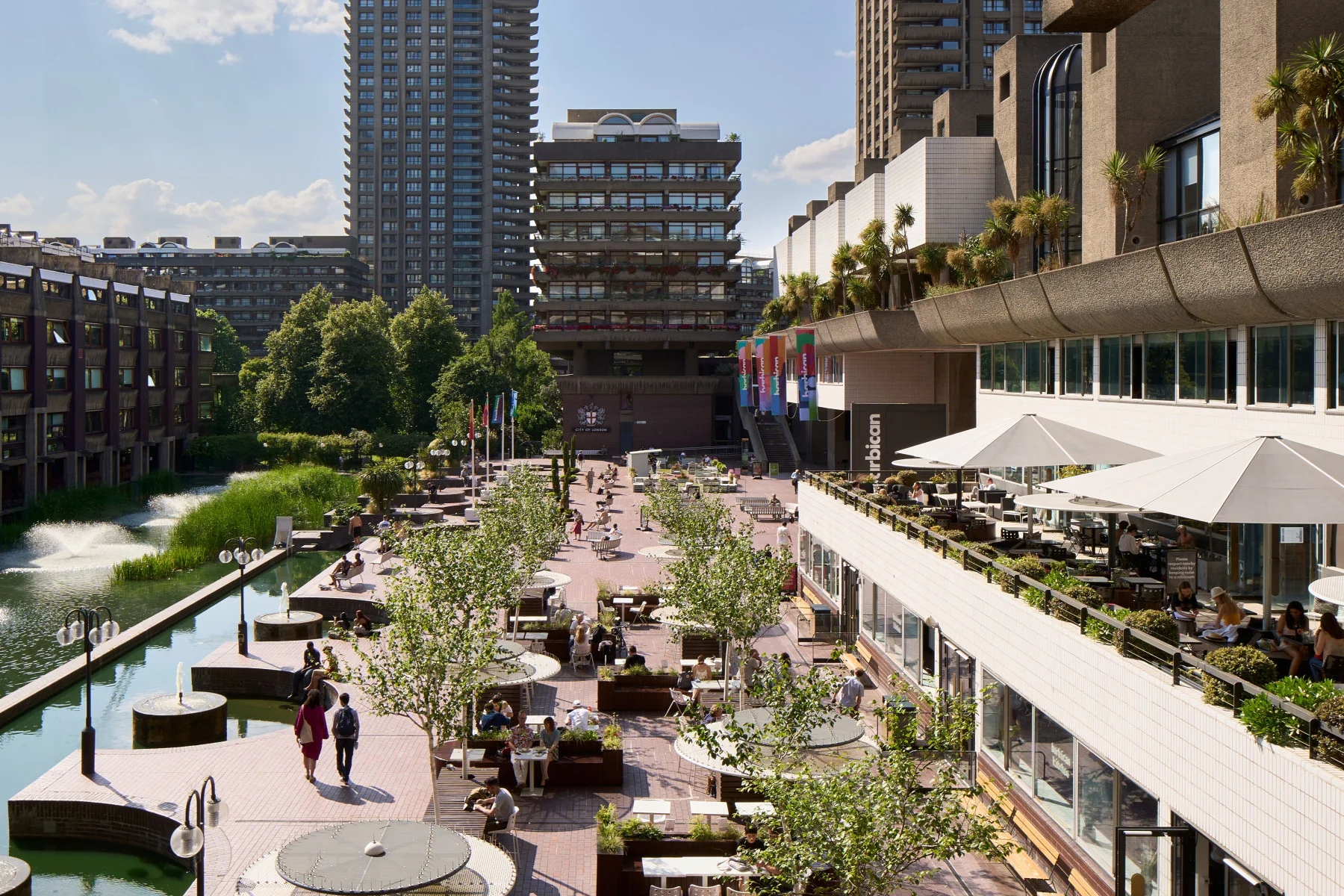
It’s a rainy afternoon when I duck into Tom Sleigh’s half-unpacked office. Boxes run the skirting boards and plans are everywhere. He’s newly appointed Chair of Planning & Transportation (2025), fresh from helping unlock £191m for the Barbican renewal. Talking at pace, Tom is intense yet steady, quick on the detail, with a strong, warm manner. Young for the brief, and switching easily between the pavement and the bigger picture, he’s now steering City Plan 2040 and working to make Destination City “a seven-day Square Mile” something you feel here on the ground and not just read about.
We asked him how he’ll put culture at street level, who pays once the ribbon’s cut, how the City will protect and share what lies beneath our feet, and why local media counts in telling that story in an age of fake news.
The City of London, on the ground – stories, features and reviews
Independent coverage of culture, planning and city life in the Square Mile.
Good Night, Oscar — Barbican review
A Barbican stage review tied to the City’s cultural life and the seven-day Square Mile.
Read this articleMore City stories
Pizza Pilgrims Brick Lane — review
A nearby spot City readers use before and after shows, meetings and late finishes.
Read this articleMore Square Mile reads
Brendan Barns on culture
An interview on culture and public life that speaks to what the City feels like on the ground.
Read this articleMore City stories
Tom’s route to the Planning & Transportation brief runs through culture and commerce. He chaired the Barbican Centre Board from 2020 and also Norwich Theatre, the South Bank Employers’ Group, alongside serving as Chair of Council at Goldsmiths. In business he’s led corporate affairs at The Bank of London, built public-sector partnerships at Amazon UK, ran Raisin UK in the British market, and before that served as Chief of Staff in Lloyds Banking Group and ran the BBC COO’s office. It’s an impressive and unusually mixed CV and one that explains why the Corporation has handed him the controls of skyline, streets and, increasingly, the City’s ground-floor life.
We begin with how he found his footing in the City.
Finding a political home
What drew him in was the City’s unusual set-up.
“The City has a completely unique governance structure, which doesn’t exist anywhere else,”
he says. “As a councillor you get much more responsibility than in most local authorities. You can choose an area – culture, open spaces, education, and really get hands-on experience.”
He was elected young. “If I had been elected in another borough the chances of becoming a cabinet member quickly… could have been less,” he says. “Politics here is civilised, political with a small ‘p’… more debate and committee-focused decision-making. That suits me.”
The conversation moves to the plan he is now steering.
City Plan 2040: rules of the road (and skyline)
City Plan 2040 is the City of London Corporation’s new Local Plan for the Square Mile. It sets the strategic planning rules for the next two decades, covering where height belongs, when to retrofit rather than rebuild, what happens at ground floor, and how people move.
Before you get to the fun stuff, there’s the rulebook. “It’s not yet fully in force but being inspected by government. We hope it will go live in the next six months,” Tom says. In simple terms: tall buildings mainly belong in the eastern cluster, and there’s a retrofit-first presumption, “if you can’t, you have to justify why.”
Rules are one thing. How the City feels at street level is another.
Destination City: public life on the ground floor
If City Plan 2040 is the rulebook, Destination City is the City Corporation’s flagship growth strategy – aimed at attracting businesses, workers and visitors so the Square Mile keeps powering London’s and the UK’s economy. In practice it’s about how the City should feel at eye level: a seven-day offer people value on the street, delivered mainly through the planning system and partnerships, not a new central budget. That often prompts a question about housing. I ask whether that means adding more homes. Tom is clear: this isn’t a housing push. “It’s not about more residents,” he says. “Provision for a very small number, one or two buildings, so essentially no.”
So what is it about?
“Amenities, culture, health, wellbeing, leisure,”
he says, “particularly at ground floor.” And how does it happen? Not with a new pot of money. “It doesn’t have any budget, it doesn’t have any tool. It’s all delivered…through planning.”
In plain terms, big projects get permission on the condition they include space people can use at street level; public rooms for arts and community use. The lever is simple: “When a planning application comes to us, if it’s 10,000 square metres or more, policy… in City Plan 2040 requires new cultural provision on site.” In theory an applicant could pay instead, but in practice, Tom says, “they can… pay cash that’s never happened. They come forward with proposals for some form of public-access for culture.”
Two current schemes show how it works. At 85 Gracechurch Street, archaeologists uncovered part of Roman London’s forum and basilica, the civic heart of Londinium. The plan is to bring those remains into public view within the finished scheme: “We’re going to put proper public use in that.”
At 63 St Mary Axe, a new tower is planned with a cultural space and improvements to the public realm at street level. The cultural offer will be secured through the planning consent.
That raises a practical point about what actually goes behind the shopfronts.
Bringing culture in early – theatres, concerts, rehearsal space?
I press the point, are we talking real cultural rooms, a small theatre, concert or rehearsal space, designed in from day one, not just display cases? Tom’s yes comes with pragmatism: “We already have a policy on whether cultural use is appropriate… The challenge is the timeline… a building can take five years… it’s quite hard to say… we will definitely put this theatre company in…” In other words, design for the use type, not a named tenant.
So it’s “case-by-case,” working “even more closely” with culture colleagues on “who needs a home, what’s the City missing, and what won’t cannibalise the Barbican.” Sometimes, he adds, “should we not put something in the building but instead receive the money and… fund existing cultural assets… we’re trying to be flexible… while accepting we believe there needs to be additional cultural activity.”
Developers don’t leave this to chance but they hire specialist cultural consultants to line up partners, “it might be a choir… or a theatre… looking for some sort of base.” And the idea of “public benefit” has widened: “It used to be… green space, sky gardens, and viewing galleries… we’re still very pro… but we’re adding… cultural use now.”
To see how this works, we need only look a few steps away onto Bishopsgate.
Bishopsgate is where policy meets pavement
If City Plan 2040 is the blueprint, Bishopsgate is the test. It sits on a fault line, “Bishopsgate is on the edge of the eastern cluster,” Tom says, which is why changes here will be visible quickly. “There are already over 10 office blocks… approved by committee that haven’t been built yet,” he notes.
At pavement level, the job is just as pressing. The “Bishopsgate corridor is quite neglected,” and the governance is fiddly: “Transport for London own Bishopsgate – it’s an A-road,” so any overhaul needs TfL at the table. Talks are live. “We’re already talking to them about a huge improvement… I’d like it to happen next year; it may happen in the next two or three years, but by 2040, definitely.”
How people move between the buildings matters as much as what gets built. “You’ve seen a doubling of cycling in the last few years,” he says. Expect “more pedestrianised” streets, “more cycling,” and, as he puts it, “new modes of transport that we don’t even know about.” “E-bikes didn’t exist five years ago. This afternoon I’m talking to a robot-delivery company… people are already… talking about drones.” Infrastructure multiplies everything: “Elizabeth line has transformed East–West travel. What’s the next version of that?… There’s a live planning application for Liverpool Street Station… If that is approved… you’ll have a new station.” The whole area, he says, “is kind of ripe for change.”
Ambition also needs a way to keep the lights on after opening day.
Who pays? The funding reality behind lively ground floors
Street life needs programming as well as paving, so I ask who funds the day-to-day running of the new public spaces once the ribbons been cut. Tom doesn’t sugar-coat it. “The brutal reality… we don’t have the levers to make them pay… Legally, no lever exists.” And even via conditions: “I don’t even think, and I might be wrong, that with the planning application we could condition them to continually fund something like a theatre in the basement.” What developers can do is provide facilities and zero rent, “which is in itself… is quite a big financial commitment.”
Public funding fills much of the gap. The City of London Corporation is one of the UK’s largest funders of heritage and cultural activity, investing over £130m every year. And, as Tom notes, the Barbican alone accounts for a substantial slice: “we’re spending £30 million… a year.” Some artforms will always need help, “opera and ballet will always require a subsidy; they’re… very expensive art forms.”
So organisations must get inventive: cross-subsidy in mixed centres like the Barbican; naming rights, “I’m sure as part of the Barbican renewal… you’ll have someone’s name at the pinnacle,” and turning technical teams into revenue, “taking our sound, lighting, engineering teams and turning them into a business… rented out for festivals.”
Costs can be planned. What lies in the ground rarely can.
Layers beneath the streets
As we just discussed with the recent uncovering of the Roman Forum, when you ask what is being funded on the ground floor, you quickly meet what is waiting under it. In the Square Mile, culture is not only programmed, it is often excavated. Money is one constraint. History is another, buried inches below the boots. “If you dig a hole, you’ll probably find Roman remains.” The rules are strict: “Developers engage archaeological experts, Historic England, the Museum of London, specialist units… There’s always an archaeologist…” and “Significant finds… stop works… It’s a legal requirement.” Many finds end up at the museum, “there was a Roman eagle found… maybe ten years ago… it ended up in the Museum of London.” It is also why schemes like 85 Gracechurch Street plan to bring finds into public view, or as Tom put it earlier, “We’re going to put proper public use in that.”
Finds and policies do not speak for themselves. Independent, fact-based local journalism connects archaeology, planning and funding to the choices people live with every day. I ask Tom what role local journalism should play in this, and why it matters when the City weighs growth, heritage and public trust.
Journalism, truth and civic life
When the conversation turns to media, Tom’s views are unambiguous. “I have deep respect for journalists.” One challenge, he says, is “opinion-based, factually incorrect” content amplified by algorithms – a drift into post-truth: He sees similar pressures in universities: “People are scared about debate now and free speech is under threat.” His own habits: “My best subscription is Apple News… and I listen to Times Radio,” he says – and it “terrifies” him when senior professionals say they get news from Twitter: “You’re not getting news.”
If clear, local storytelling matters anywhere, it’s in the most contested stories: the skyline. After talking about why facts beat feeds, I put to Tom the criticism he hears often, why so many tall buildings, and what that means for heritage, because that’s where residents, workers and historians need straight answers, not noise.
Clear reporting matters where height and heritage meet.
Growth and heritage – the long view
Not everyone loves tall buildings. Tom starts with first principles.
“Nobody cares more about the City’s heritage than the City of London Corporation. We have 600 listed buildings, 45 churches…”
The mix of old and new is the City’s signature. However, growth targets are real. “We know we need that 1.2 million sq m… and that has to go somewhere.” Hence the cluster: “Tall buildings go in the cluster… you’re not putting them to the west…”
That’s the point as the cluster keeps most of the height together and lowers it around sensitive sites so the historic skyline still reads. The Tower of London is the clearest test. “The cluster declines on its eastern edge towards the Tower… in deference… There’s a substantial buffer… carefully modelled.” Even so, “Historic England… thinks most of those 11 unbuilt schemes cause too much harm… we disagreed, and so did committee.” Concerns aren’t limited to the Tower; the Bevis Marks synagogue has also objected to nearby towers.
With the cluster defined, we look to the quieter places that could shape the next chapter.
Puddle Dock and Smithfield – the next frontiers
From the skyline to the gaps on the map, I ask about the quieter pockets that could define the next chapter. What about the stretch down towards Blackfriars, the old BT building and Puddle Dock, and, to the west, Smithfield? Are those the next frontiers? Tom’s answer: “Puddle Dock… includes City of London School for Boys… one could argue it’s the most exciting prime site in central London,” he says, though it’s long-term, adding that many of the buildings there are dated and of poor architectural merit. And Smithfield? He calls it another very interesting area. Both, he says, “are ripe for a rethink”.
To close, we look at the City’s most celebrated and public day.
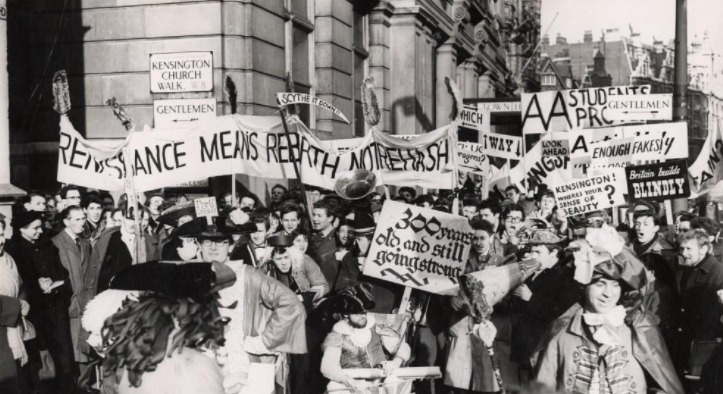
Development takes years. A single civic day can bring the City’s character into focus. So before I wrap up we turn to the City’s most public cultural moment, the Lord Mayor’s Show, and what it says about the Square Mile now. What would Tom want first-time visitors to take away?
“Britain does many things badly and a few things very well. Pomp and circumstance, we do very well.”
The City, he says, is very good at state occasions; the Lord Mayor’s Show is “a major national event with international coverage… It reminds people we’ve still got some good stuff going on.”
To learn more, see the City of London Corporation’s pages on City Plan 2040 and Destination City.
Enjoyed this interview? Follow EyeOnLondon City for smart, on-the-ground coverage of planning, culture and civic life – plus weekly interviews, venue reviews and what’s worth seeing this week.
Follow us on:



Subscribe to our YouTube channel for the latest videos and updates!

We value your thoughts! Share your feedback and help us make EyeOnLondon even better!