Cologne Fel!x – Combining The City With Early Music

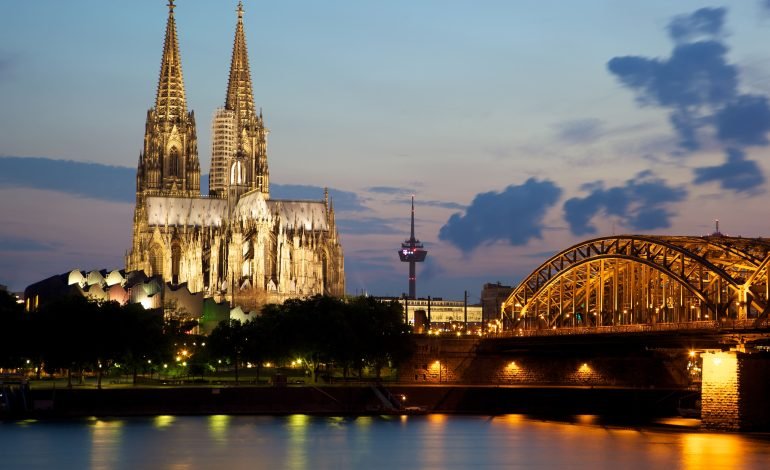
Cologne is not now a pretty city, but that is not its fault. It was once, but then WWII happened, and it was all but wiped out by the bombers. Many places in Germany opted to reconstruct as close to the original as possible, but in Cologne’s centre, only the cathedral, part of the town hall, and a few other special buildings, mostly churches, were fully restored. For the rest, square concrete structures arose from the rubble, a process that modern developers and museum architects are following with rigorous enthusiasm. Despite that, the city has its charms and is engagingly cosmopolitan, awash with tourists, for whom the main attractions are the west bank of the River Rhine and the bars that fill the remaining squares and back streets (very beer-intensive: wine seems to be regarded as an oddity – probably because the Rhineland’s and Moselle’s main vineyard areas are a little distant).
For the fastidious visitor, though, there are the region’s impressive music organisations. It has several full-time orchestras, the Gürzenich (named after the family of medieval traders who owned its original hall) and those of Westdeutsche Rundfunk (WDR), Germany’s largest public service broadcaster. There is also the opera, though the redevelopment of the actual opera house has been going on for most of this century, so performances take place in a makeshift exhibition hall across the river, which gives them a rather exciting experimental feel.
Last month I was invited to Fel!x, the week of Early Music (or more accurately, music played on the instruments of the period in which it was written; but that is too long), organised by but not all in Cologne’s main concert hall, the Philharmonie. Each year since 2019, the Philharmonie has promoted a festival concentrating on the music of – or groups from – a music-rich country. Last year it was Britain and next it will be Bohemia, but this August the focus was on Flanders and the Netherlands. Bruges/Brugge, Ghent, Utrecht, and The Hague have been central to the development of the early music movement over the last sixty years and many of the best groups are based in the first three, while the Royal Conservatory in The Hague has been a catalyst for performance practice study and scholarship.
By far the most glorious concert of the week was given in the voluminous acoustic of the Church of St. Mary’s Heavenly Journey (the German original is somewhat unfortunate sounding to the English mind). There Collegium Vocale Gent, under its venerable director Philippe Herreweghe, performed madrigals from Arcadia, mostly by Marenzio and Monteverdi, interspersed with instrumental sinfonias by Salamone Rossi. If Marenzio (fifteen years older than Monteverdi) was the great developer of the madrigal into a musical, not just poetic, form, Monteverdi was its apotheosis. The amazing suspensions and gorgeous settings of Italian (superbly enunciated by Herreweghe’s five singers) became rapturously beautiful in the vast echoing church. The soprano, Miriam Allen, was so clear and accurate it was often difficult to decide whether it was her or the cornetto (an early wind instrument that has a trumpet quality) that was sounding.
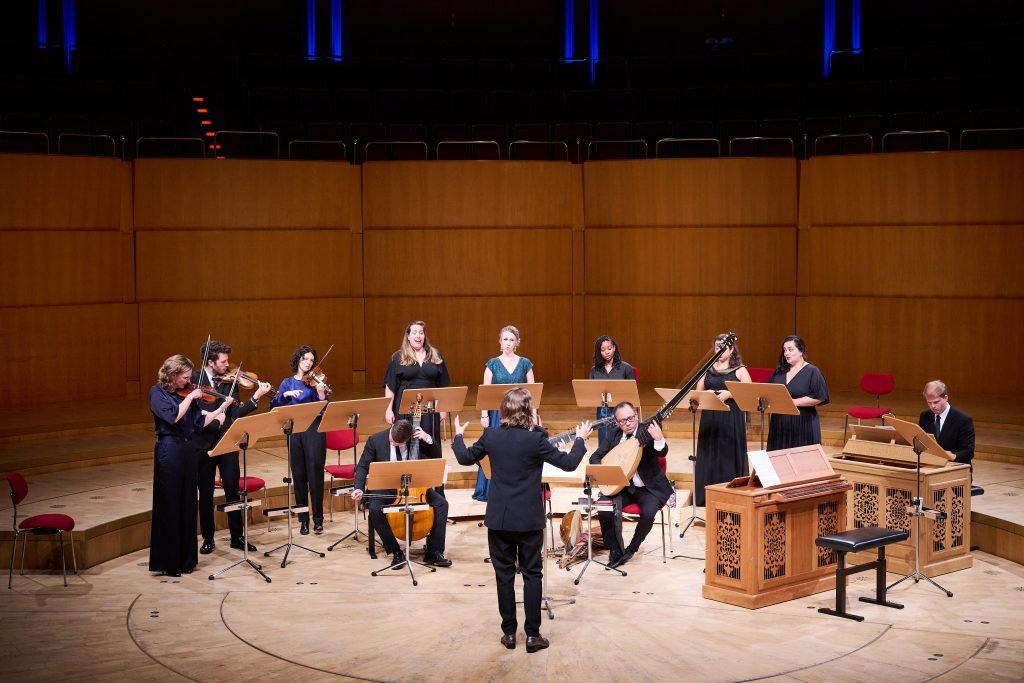
If voices could shine in the tall church, they had a harder time in the modern Philharmonie itself. This is a strangely hidden building, constructed underground beneath the contemporary art Ludwig Museum. The circular stage itself is below river level. For instruments (which sound mushy in the medieval churches), the acoustic is admirably clear but allows for no mistakes. For voices, though, it can be uncomfortably dry, and singers have to struggle to reach beyond the stalls. Holland Baroque worked hard to find a balance and largely succeeded in their concert of arranged and reconstructed religious music based around what was heard in the Dutch province of Brabant in 1653. In theory, there were only five singers on the wide circumference of the stage, but in several pieces, the instrumentalists joined in, creating an instant choir and a richer texture. Holland Baroque, led by twin sisters Judith (violin) and Tineke (keyboards) Steenbrink, is one of the most innovative ensembles in the field – often working with musicians from other traditions and adding in contemporary compositions (many by Judith). Like most of the Dutch music community, they are threatened with extinction by the anti-arts policies of the new far-right government which, taking its inspiration from Donald Trump, is trying to destroy the national broadcaster (NPO) and cancel all state arts grants. Sheer vandalism! We must all hope that other governments do not use the Dutch example as a barbaric but convenient model. The fact that North Rhine-Westphalia was showing off its investment in early music by inviting me to view it gives hope that there are administrations who still believe in backing the arts as a foundation of their region’s service and reputation.
From Belgium came B’Rock: despite the snazzy name, a thoroughly serious early music ensemble similar to Holland Baroque. The second of their pair of concerts was in the visually severe auditorium of Wallraf-Richartz Museum, which contains a fine collection of Renaissance and Baroque art. B’Rock’s instrumental group were joined by French mezzo-soprano Coline Dutilleul in music found in the archive of the Arenberg family in Brussels. In amongst all the arias by Gluck, Rameau, Handel, and Vivaldi was a little French 18th century chanson by the little known Louis-Joseph Francoeur that, with a gorgeous lute and cello accompaniment, Dutilleul sang deliciously as if it was early Edith Piaf.
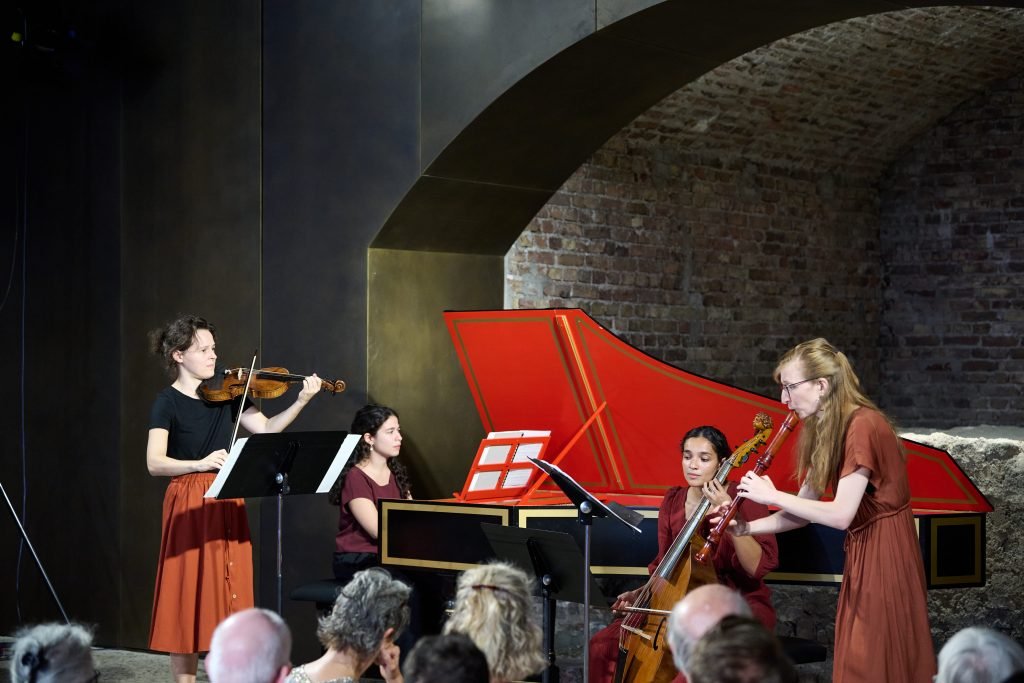
The last day of August was boiling in Cologne, well above +30; the sort of temperature that causes havoc with Baroque era strings and reduces audiences to pulp. The festival had reserved the day for six young groups, each giving two free concerts in small venues around the town. To everyone’s surprise (even the Philharmonie’s artistic team), the rooms were packed, to the extent that even your correspondent was locked out of all but one that I tried to hear. My success was to get in to Tra Noi, a quartet who had deservedly won the Göttingen Handel Competition. On recorder, violin, viola da gamba, and harpsichord, they played Handel and Telemann but interleaved them with Irish and Scottish folk tunes, an inspired idea.
The festival finished back in the Philharmonie early on Sunday evening with the veteran conductor Paul van Nevel and the singers of his Huelgas Ensemble singing unaccompanied polyphony from the early Flemish Renaissance. He included several versions of the Agnus Dei, enough lambs to form a small flock outside Antwerp, and – sticking to the sheepish theme, a part song from 1520 by the appropriately named Jean Mouton. In the forensic acoustic of the modern hall, this was dry stuff, gallantly sung. For all that, how wonderful that a major European concert hall is prepared to forget box office numbers and champion niche music at a time of year when most such venues are closed, assuming that their patrons are on beach towels. As the Proms prove each year, there is always an audience if the trouble is taken to find it.
To learn more about the Fel!x Festival and Cologne’s vibrant musical scene, visit the Cologne Tourism website.
Simon Mundy’s coverage was made possible by NRW Kultur International.