Abstract Erotic at the Courtauld Gallery: Tactile, Feminist, and Fierce


Abstract Erotic | Louise Bourgeois, Eva Hesse, Alice Adams | The Courtauld Gallery
Sex in art is as old as art itself, even to the point of pornography, but despite its title this exhibition isn’t about that. It’s about translating materials into something tantalisingly tactile and protean, a new entity.
Oh, you can see a sexy place for some of the substances these three artists have co-opted, like latex, rubber or even papier mâché, but wire fencing? And though some of the pieces are unmistakably genital, there is nothing arousing here. This is non-sexy erotica.
It all starts in the mid-1960s when free love was almost de rigueur among youthful creative New Yorkers, and American Abstract Expressionism was sweeping the world, even though much of what was being put on display was pretentious nonsense.
These three had a different take on the zeitgeist. All living and working in downtown Manhattan at the time, they were at different stages in their careers—one barely 30, one in her mid-30s and one already in her fifties. They knew each other, but perhaps surprisingly never collaborated.
This Courtauld Gallery show began almost 60 years ago with a small exhibition at the Fischbach Gallery in New York, called Eccentric Abstraction, for which the curator, Lucy Lippard – now hugely respected as one of the first to grasp the theory of conceptualism and to become an icon of feminist art, but then still only in her 20s and testing her early theories with this debut exhibition – gathered eight artists to create installations and sculptures using non-traditional materials, five men and three women.

These three, Louise Bourgeois, Eva Hesse and Alice Adams, were the women. “The work I was looking for,” Lippard says, “was abstract and formally simple, with rough edges and erotic undertones”, and it was these three women, she writes in the catalogue, that introduced the concept of feminism in art to her.
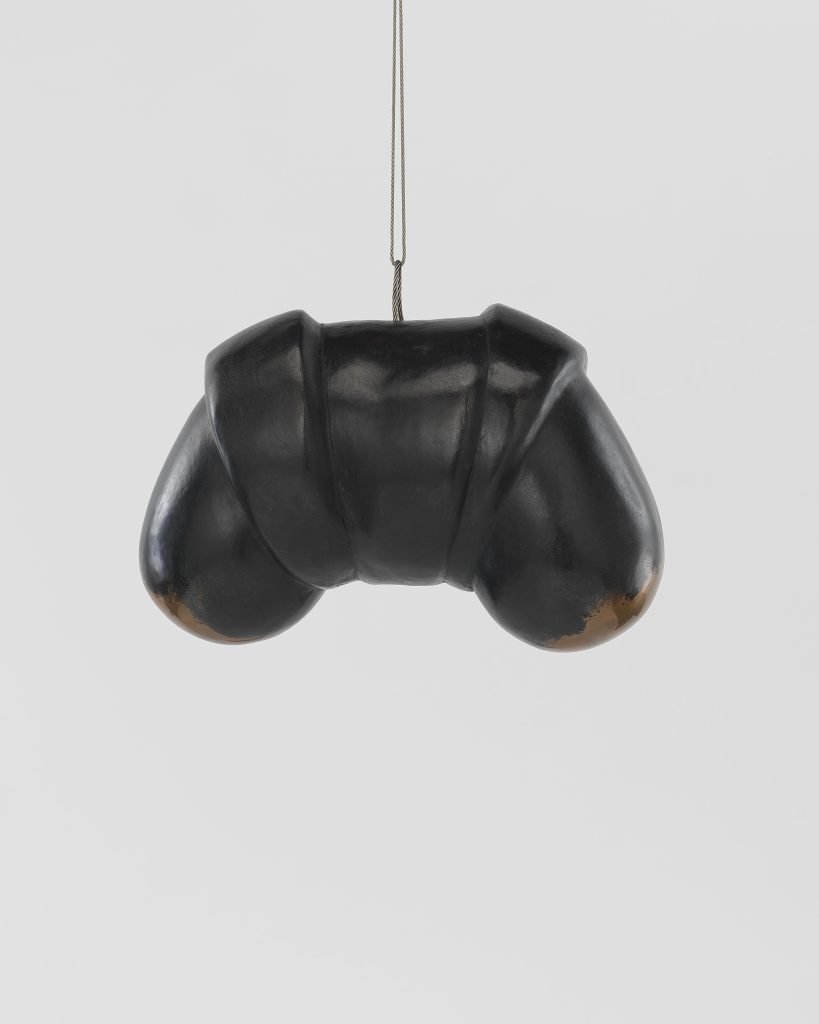
The one of the three with the most overt undertones is Louise Bourgeois. For many, she first became known for her giant spiders that presided over the opening Tate Modern 25 years ago, but she had already had a successful career in 1966 (she died in 2010 aged 98). One of her pieces here is the largely latex Fillette (Sweeter Version) and is a feminist announcement that shouts its point. It is an undoubtedly erect phallus and two pendulous testicles, but it’s wrapped in an enveloping labial shroud and hangs from a hook, so that the organ has been shorn of its power to become a rather ridiculous plaything. Latex is an ephemeral substance that changes its shape as it solidifies. And the fillette of the title is, of course, “Little Girl”.
In contrast Bourgeois’s rather grotesque piece here, Le Regard, “The Gaze” (which in the context of classical art means the male gaze), is an equally brutal evocation of a vagina. Made from fabric and latex the shape opens enough to only hint moistly at what might be within, delight or despair.

German-born Eva Hesse was one of the last to escape Nazi Germany on the Kindertransport and was to die a few years after the New York exhibition of a brain tumour, aged only 34. But by 1966 she had just progressed from drawing and painting to sculpture, often using industrial latex and polyethylene, as in her Untitled Or Not Yet, to create voluptuous shapes hanging from ropes or scrotal netting high on a wall, the strange asymmetrical globules freighted down with lead weights. She liked to use industrial materials and gave her pieces absurdist names – Tomorrow’s Apples (5 In White) is five tails of different length and colour apparently suspended from a crack in the wall and made of enamel, gouache, cord and papier mâché, nothing obviously to do with fruit.
Alice Adams was a textile artist, weaving tapestries, before she graduated to three-dimensional art and the possibilities of discovered industrial archaeology. She began adding materials to her tapestries, such as rope, sisal and found objects. She took to roaming industrial sites in New York looking for discarded items that might either be included in an ongoing work or inspire a new one. Tapestry with a Mop of 1959 is made of linen, wool and a dustmop.
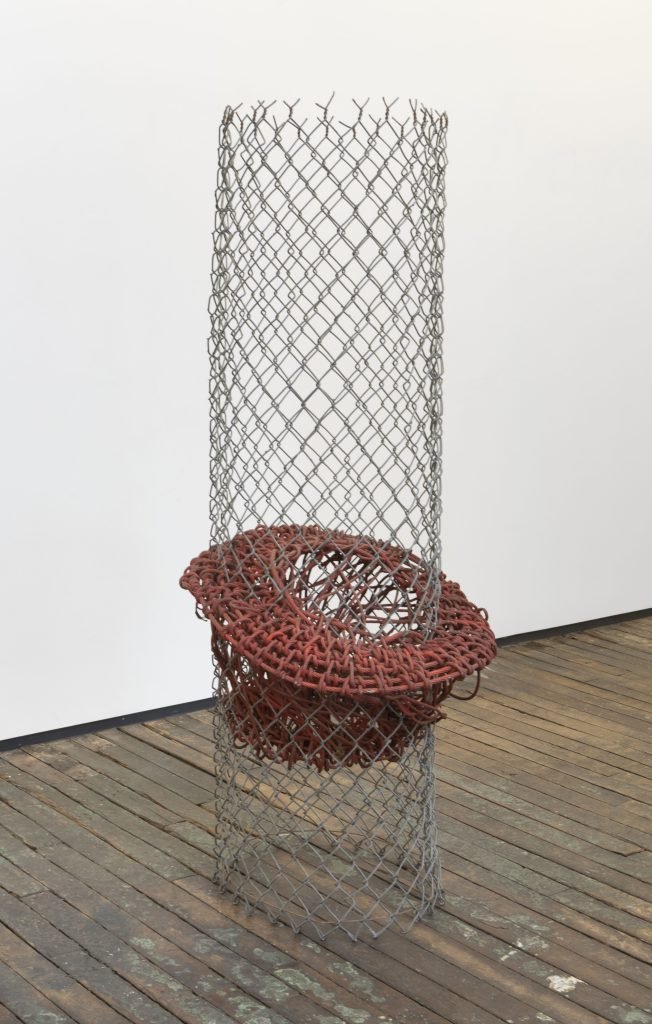
The Adams piece that dominates the second room of this exhibition, Big Aluminum 2, is a large, writhing form seeming to hover in mid-air, made from aluminium chain-link fence shaped into another provocative being altogether, or possibly two. Standing next to it is 22 Tangle in which a column of chicken wire stands erect but crippled, belted and cauterised by a binding of rusted steel cable.
Eccentric Abstraction with its new notions of minimalist shape-shifting of industrial detritus was quietly received when it opened in 1966, but its ongoing effects have proved to be profound, contributing, unintentionally at the time, to an understanding of feminist art. The point is driven home by this distillation from it, giving a new focus to the collation of abstract forms Lucy Lippard was looking for. It was, the Courtauld’s director Mark Hallett said, “a precise moment in the history of modern art”.
For more sharp takes on London’s art scene, from bold feminist exhibitions to underground gallery finds, follow EyeOnLondon for a different perspective every time.
Abstract Erotic – Exhibition Details
The Courtauld Gallery | 20th June – 14th September 2025
Exploring feminist abstraction and the sensual potential of materials, this exhibition brings together three ground-breaking artists of 1960s New York. Thoughtful, tactile, and arresting.
Admission included with Courtauld Gallery ticket
Find out more and plan your visit via The Courtauld website
For more cultural coverage across London and beyond, visit our Theatre & Arts section.
Follow us on:



Subscribe to our YouTube channel for the latest videos and updates!

We value your thoughts! Share your feedback and help us make EyeOnLondon even better!