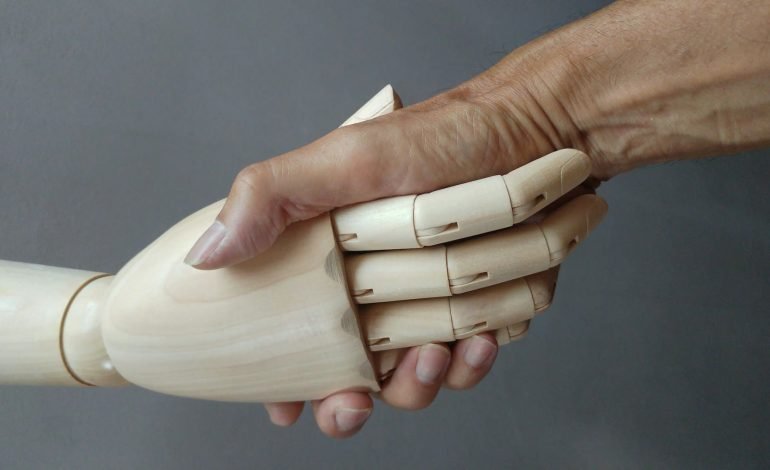
Engineers at Johns Hopkins University have developed an innovative prosthetic hand that can grasp delicate objects such as plush toys and water bottles with a human-like touch, adjusting its grip to prevent damage. The hybrid design, a pioneering step in robotics, combines both rigid and soft materials to replicate the dexterity and sensitivity of the human hand.
This breakthrough addresses a key challenge in prosthetics: creating a device that can handle a range of objects with varying textures and materials without causing harm. The development, which appears in Science Advances, offers new hope for individuals who have lost their hands, improving their ability to interact with the world around them.
“The goal from the beginning has been to create a prosthetic hand that we model based on the human hand’s physical and sensing capabilities – a more natural prosthetic that functions and feels like a lost limb,” said Sriramana Sankar, a Johns Hopkins biomedical engineer who led the work. “We want to give people with upper-limb loss the ability to safely and freely interact with their environment, to feel and hold their loved ones without concern of hurting them.”
The prosthetic hand is a collaboration between Johns Hopkins’ Neuroengineering and Biomedical Instrumentations Lab and features a multi-finger system with rubber-like polymers and a rigid 3D-printed internal skeleton. Its design mimics the structure of human skin, using three layers of tactile sensors to help distinguish between different textures and objects. The hand’s air-filled joints are controlled by muscle signals from the user’s forearm, with machine learning algorithms processing sensory data to create a realistic sense of touch.
In laboratory tests, the prosthetic hand successfully handled 15 everyday objects, from fragile items like stuffed toys and dish sponges to tougher objects like pineapples and metal water bottles. It achieved an impressive 99.69% accuracy in manipulating these items, adjusting its grip to avoid mishaps. One notable demonstration involved the hand delicately picking up a thin, fragile plastic cup filled with water, using just three fingers without causing any damage.
The team’s approach combines the strengths of both rigid and soft robotics to mimic the natural flexibility of the human hand. Nitish Thakor, a biomedical engineering professor at Johns Hopkins, highlighted the importance of integrating sensors, nerve-like signal systems, and nerve stimulation to enable users to “feel” the objects they touch. This combination of technologies allows the prosthetic hand to respond intuitively, much like a natural hand would.
While the technology represents a significant step forward, further refinements are still needed, including stronger grip forces and more sensors. However, the research shows great potential for the future of prosthetics, with the hybrid design paving the way for robotic hands that can handle delicate materials such as glass or fabric.
This breakthrough has been funded by the Department of Defense and the National Science Foundation, with contributions from various researchers including Wen-Yu Cheng of Florida Atlantic University and Arnav Gupta of the University of Illinois Chicago.
Stay tuned to EyeOnLondon for the latest news and expert opinions.
Follow us on:



Subscribe to our YouTube channel for the latest videos and updates!

We value your thoughts! Share your feedback and help us make EyeOnLondon even better!