This year Fide’s Goats celebrated its 100th centenary year with the following statement: “The International Chess Federation proudly announces a series of awards to honour those who have made exceptional contributions to the world of chess in the past 100 years!” Its President, Arkady Dvorkovich, said, “As we celebrate our centennial, we wanted to give recognition to those who have made chess what it is today and what it represents for the future. We hope that these awards will inspire future generations to take up chess and bring the game to new heights”
The awards were given in 19 categories, assigned to specific nominations and voting criteria. August 15th was the deadline for nominations, and some of the categories were as follows: Best Male Player, Best Female Player, Male Arbiter, Female Arbiter, FIDE Trainer 100 Years Award (male and female, in separate categories), Best Male Team, Best Female Team, Advocate for Women in Chess, and the Presidential Award. All very commendable with the structural organising elements in place: “…while some recipients will be chosen by a distinguished panel of chess grandmasters, historians and educators, others will be determined through public voting.” (Nobody asked me?) “The winners of the FIDE 100 Awards were (will) be announced during the 45th FIDE Chess Olympiad held in Budapest this September.”
FIDE was officially formed on 20th July 1924, in Paris, during the first unofficial Chess Olympiad. It was one of the first international sports federations and was founded at the Town Hall of the IX Arrondissement, 6 Rue Drouot, Paris, where 15 delegates from all over the world signed its inauguration charter. Please note the word “sport” in its title, which countries worldwide acknowledge (except this country, plus a few more) that enables it to receive central government grants from the ministries of sport and culture! Rachel Reeves, please wake up!
Judit Polgar was awarded the Best Female Player in the History of the Game, GOAT, and Magnus Carlsen, the Best All-Time Male Player in the History of the Game, another GOAT. He was one of the youngest players in history to gain the GM title in 2004 at the ripe old age of 13 (!), successfully defended his World Chess Championship title 5 times, and achieved the highest ever chess rating of 2882 in May 2014, a record that still stands.
Garry Kasparov became the youngest ever undisputed World Chess Champion in 1985 at the age of 22 by defeating Anatoly Karpov. Although the forthcoming championship between Gukesh and Liren may provide a considerably younger champion if Gukesh is successful! Kasparov, born in Baku, Azerbaijan on April 13th, 1963, recognised globally as one of the two, if not three, greatest players that have ever lived, also became a thorn in the Russian side, even announcing the latter’s intentions of invading the countries bordering its edges, such as Ukraine, long before the international press outlets had even thought about it. His book Winter is Coming forewarned the world of Russia’s intentions and particularly urged Western countries to prepare for war of some kind! His outspoken and controversial criticisms of Russia’s expansionist strategies, human rights issues, and Russian hegemony over its controlling arm for decades over FIDE’s management made him a pariah in all but name at the height of his fame. He had the longest reign in recent times as World Champion from 1985 to 1993, when a split occurred with FIDE, and Kasparov dominated as The Classical World Champion until he lost to Vladimir Kramnik in 2000 at the Riverside Studios, London, where I was the official artist for the tournament and had a one-person exhibition simultaneously at that venue.
Kasparov achieved the highest ever ELO rating, reaching 2851 in July 1999, a record that stood until 2013. A prolific author and trainer, writing influential books on chess, he remains a prominent figure in chess education and training. Other contenders for the title included Anand, Fischer, Capablanca, Tal, Lasker, Karpov, Alekhine, and Botvinnik. It would be useful to remember that chess has expanded far beyond our imagination with the advent and advancements of the computer, but also software programs that have enhanced the learning processes that AI has brought to chess, giving in-depth analysis of games far beyond the human mind’s strength at work previously. Games, for example, played at the highest international levels that previously had been declared draws, when analysed by AI, showed a forced win for one side by making the best moves possible after 70 or 80 more moves.
Kasparov was at the beginning of these litmus tests of times; Magnus Carlsen came to reap the benefits of this harvest of silicon hard and software understanding. This in-depth ability of computer analysis and its effects on playable variations of well-known, and not-so-well-known, openings and defences not tried before gives newer and younger present-day players, even the very young aged 10 or thereabouts, opportunities for chess expertise not even imagined or contemplated 30 years ago. That dividing line comes between Kasparov and Carlsen, and although the former, later in his most powerful years, entered into the beginnings of the high-tech machinations, nothing existed that can compare to the new world of chess understanding that Carlsen came to inherit.
It is for this latter reason that I find giving the GOAT FIDE 100 Year Award to just one person, Magnus Carlsen, and not to both Kasparov and Carlsen as a joint award is flawed!
The model used by FIDE to give only one person the award is too restrictive and not inclusive enough of time and circumstance, as mentioned above! Of course, Kasparov’s strong, stinging criticism of Russia’s aggressive international attitudes and the hold and influence it has had over FIDE itself and its management of world chess events may also (undoubtedly) have played a part in arriving at their GOAT award, denying his rightful place alongside Carlsen’s.
Various comments have ensued following FIDE’s award announcements, not least from Carlsen himself at the award ceremony, mentioning Kasparov in his acceptance speech. Further considerations mentioned by Carlsen in relation to the award and in connection with the “greatest ever” accolade accorded to him are countered with, “No, it is still Garry!” Carlsen believes that when his career is done he may have a different idea about it? He says there are probably only 3 players, if Bobby Fischer is included, alongside himself and Kasparov, with legitimate claims, but being regarded as “the greatest ever” doesn’t really consume much of my day-to-day thinking! He has recently taken up golf—”you ain’t got that thing if you ain’t got that swing” syndrome—but claims, “Honestly, I hate losing at chess; whenever I lose an important game, it still stings. But, I think that’s a good thing. It shows I still want it! It shows that I still care.”
The recent Speed Chess Championship in Paris, with a live audience, also gave Carlsen the opportunity to amend the result of the infamous game he played against Hans Niemann a couple of years back, which resulted in allegations of cheating followed by a $100 million lawsuit! Chess.com, which was also charged with spreading libellous allegations at the time, organised this tournament. This was the first time the two had met over the board since that infamous moment and was eagerly watched by a huge number of fans of both players! Needless to say, Carlsen was in imperious form and whitewashed his opponent in the early part of the match, “only taking his foot off the gas” in the final stages of their match but winning comfortably.
Finally, I conclude my article, moving between the two B’s, Brain and Bottom, to a recent story emanating out of China about match-fixing and gambling, and the use of computers to obtain an unfair advantage. One of the stars of Chinese chess, Wang Tianyi, the number 1 in world rankings for over 11 years, and another grandmaster, Wang Yuefei, have been banned from playing the sport and are said to be facing criminal charges! Both Wangs had earned millions of yuan in Chinese national leagues. Gambling is also a crime in China and often accompanies game and match-fixing. I wrote a similar article in the past about two of China’s top snooker players who were also charged with irregularities similarly and found guilty and punished and banned from playing for some considerable length of time. Again, the Chinese regime came down hard on the chairman of the Chinese Football Association, the former National Coach, and more senior figures in the management of football recently who have all been jailed for giving or taking bribes to fix games.
Going from Brain to Bottom to conclude the final end of this sporting story, it appears that last December a tournament winner named Yan Chenglong had his hotel bathtub examined as he “had defecated in it and failed to clean it up”. His prize money was forfeited and title revoked, but worse was a wide rumour that electronic beads inserted into his anus communicated playing codes to him from a chess computer during his games! The Chinese appear to be way behind the best the West has to offer in this area!
The Challenge
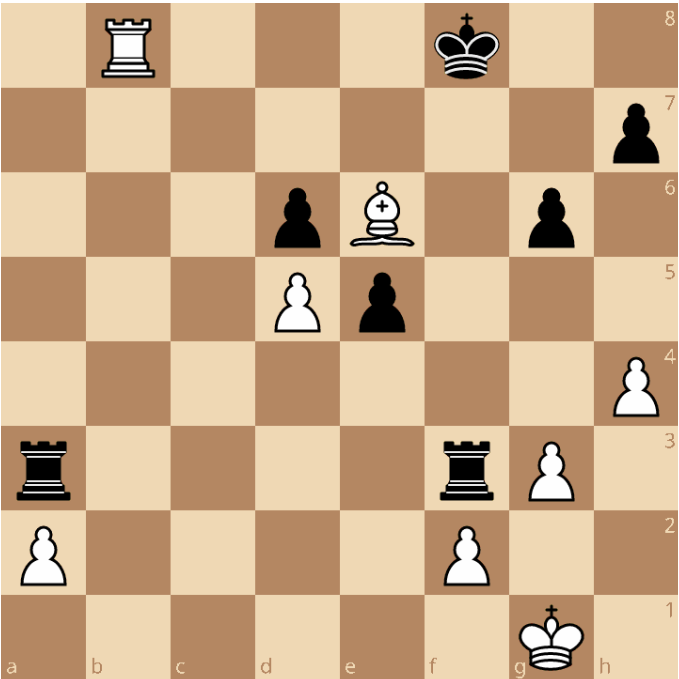
The chess puzzle is taken from the recent Late-Titled-Tuesday-Blitz-October 2024 and has Magnus Carlsen 3294 Black v MikaelyanArman 2895 White in a whirl of fast play as their game concludes. White has played 38. Rb8+, what was Black’s response and what was a trap Black needed to avoid?
The Solution
38. Rb8+, Ke7. 39. Rb7+, Kd8! Avoiding Kf6 as Rf7 is checkmate! 40. Rd7+, Ke8. 41. Rxd6, Rxa2. 42. Rb6, Rfxf2. 43. d6, Rfb2. O-1.