Traces of the Inner Tracey

Tracey Emin: A Second Life at Tate Modern | Until 31 August
Born in 1963, Tracey Emin was brought up in Margate and throughout her chaotic and rumbustious life she has always returned there, ostensibly to visit her mum but also to reacquaint herself with her rather shambolic beginnings. Now she lives in Margate, has a studio and has even started her own art school there, with an outreach programme to local schools.
Her father was Turkish Cypriot and a visiting rather than resident parent. Her mother was English, and her adult relationship with her twin brother Paul was badly strained when he tried to auction on television a work she had given him.
More Arts & Culture from EyeOnLondon
Criticism, exhibitions and reflections from London’s cultural institutions.
Turner and Constable: landscape rivalry revisited
A closer look at the competitive dialogue between two giants of British landscape painting.
Read the full reportBarry Martin obituary
A tribute to the life and influence of a distinctive voice in London’s cultural life.
Read the full reportSeurat and the Sea
Examining Georges Seurat’s engagement with coastal light and the discipline of pointillism.
Read the full reportSo you could be forgiven for imagining that Tracey Emin’s work is in some way centred on Margate where the extreme formative experiences occurred. You would be wrong: the picture is Tracey Emin, the frame only is Margate. In this exhibition she recounts her first sexual encounter on Margate Beach at the age of 11; racism; parental indifference; first rape at 13 so that she says she cannot remember being a virgin; running away from home at 15.
At 17 she got into Medway College of Art to study fashion, and at 20 studied print-making at Maidstone College of Art, a time she calls the happiest of her life, living with the poet, painter, musician and film-maker Billy Childish, in an ill-fated early relationship. In 1987 she won a scholarship to the Royal College of Art, which she hated. She says that the first work of art to bring her to tears was a Mark Rothko Horizons picture which she encountered when she wandered into the Tate, now Tate Britain. She was 20.
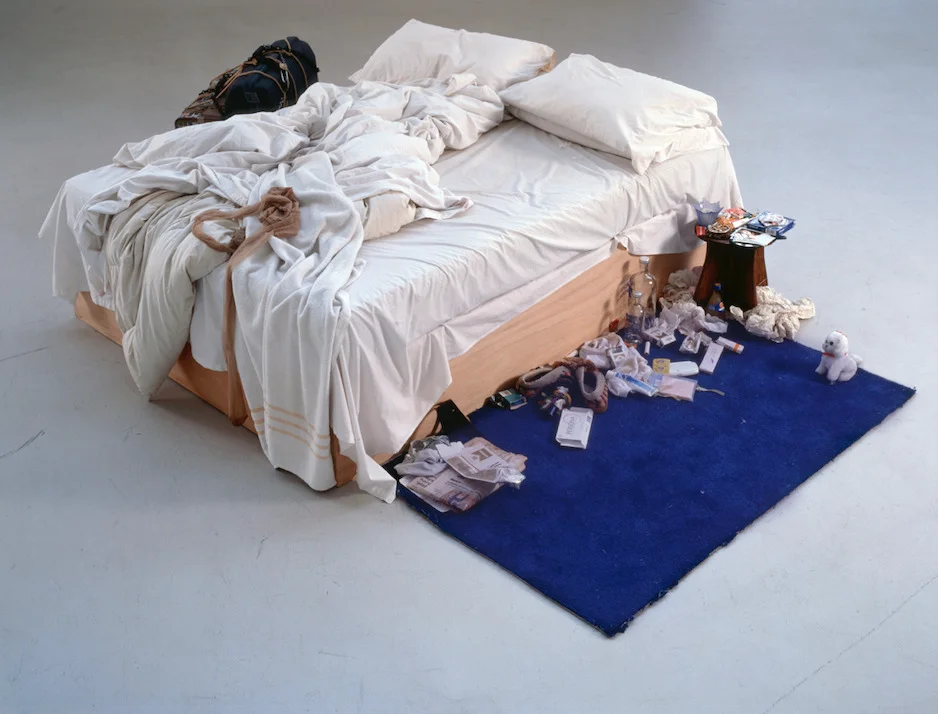
She was a natural member of the Young British Artists group along with Damien Hirst, Sarah Lucas and others, and came to fame first not through her art but through her appearance in 1997 on a Channel 4 programme discussing the Turner Prize when she appeared drunk, swore and walked off. Two years later she was shortlisted for the Turner Prize with her most famous work My Bed, which is in this show. She did not win the prize but she won the memory.
Tracey Emin is a phenomenon who brought a shocking and transforming unapologetic self-expression in which she examines her emotions, the effects on her body and the pain of ruptured relationships, a praxis that is still a powerful influence. This exhibition, the largest ever survey of her work, is a tumbling discourse on Emin in words and pictures, some of it written in blue Biro in her own neat hand, badly spelt; some of it is a series of her large paintings and embroideries of her body, all excoriatingly honest in terms of what she chooses to disclose.
The show’s subtitle, A Second Life, has a double meaning. On the face of it it is about the contrast of her life now to the one she led until her life-threatening bladder cancer in 2020. More profoundly, it is the private life of the artist and her subject that we cannot see. How someone gets from being a sex- and drink-obsessed young woman to a professor of painting at the Royal Academy and Dame of the British Empire is a tribute to personal conviction and hard work and a unique British art-loving public that seems ever open to new ideas.
Sadly, there are no works from her early life until about 1993. During and just after her RCA years Emin had two traumatic abortions, which she relates here in her careful notes with bitter condemnations of obstetricians, when she destroyed her whole portfolio, only preserving them in tiny photographs, 180 of them, hung here under the title My Major Retrospective II in 1993. But in them you can see the talent that propelled her through her training: a mastery of line, an assured grasp of composition, an ease with colour. And a sense of humour.
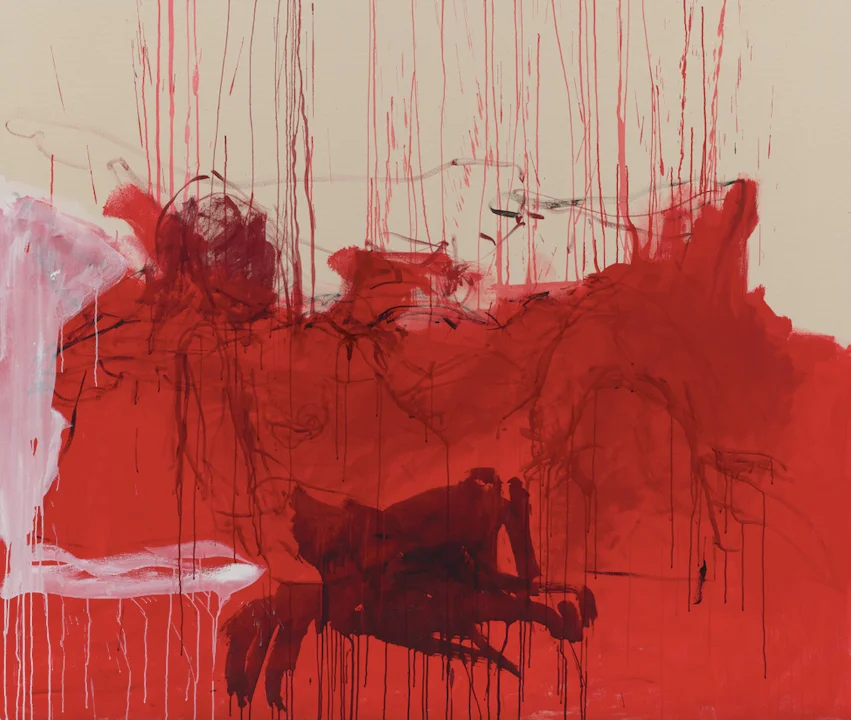
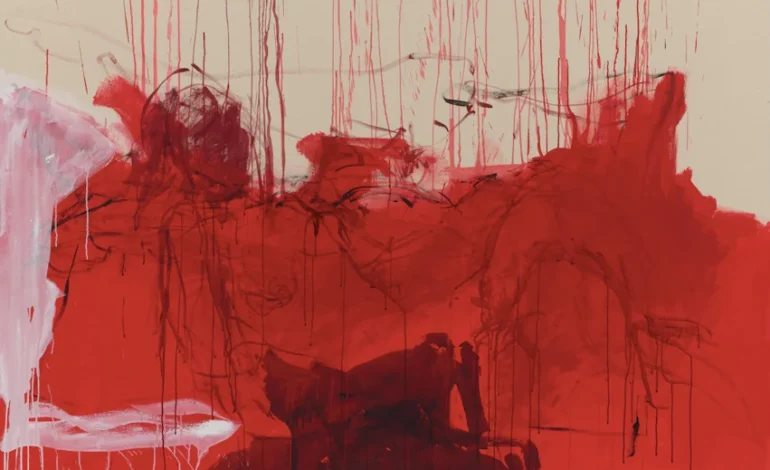
It was in 1993 that she began making her textile works, sheets embroidered with slogans, “blankets”, and the exhibition starts with one from 1997 with her stitched texts summing up her mood when she first ran away: Mad Tracey from Margate Everyone’s Been There. The first painting here, though, is a newer reflection, from 2018, with a much simpler title: Rape. This is a large canvas that is almost abstract, red paint almost creating a prone form all but obliterated with white slashes across the surface, a response to an experience she had more than once in her early adolescence. In her 20s came the abortions, and in the show another blanket which speaks of the end of her first Margate life, The Last of the Gold. “This blanket is the A–Z of abortion,” she explains. “It tells you what to do and what not to do. It is titled The Last of the Gold because the gold fabric is the last I had from my mum’s curtains.” When she was pregnant with Tracey and her brother, Pam had planned an abortion but changed her mind at the last moment, “…so I am the last of the gold in my family.”
There are bronze sculptures here, too, which she has never shown before, monstrous shapes, some very small but embodying nightmare and trauma. The principal trauma among many for her was her cancer surgery six years ago from which she almost did not recover, and which involved the removal of some organs and the reshaping of others. All of this she recorded in colour photographs, a horrid documentary of what happened to her body.
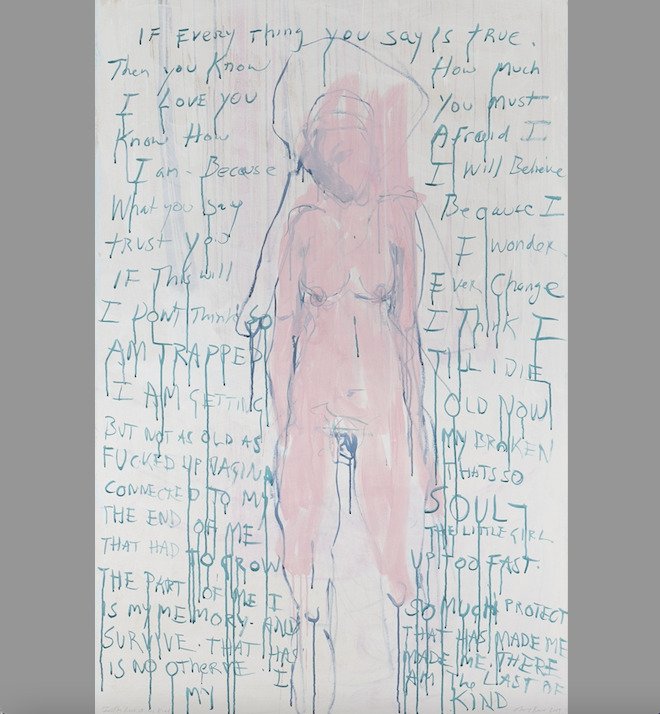
Emin works on these large canvases sometimes over years, starting and leaving, adjusting and leaving, and one might be left permanently if it never resonates for her. “If an image fails to surprise her or lacks the weight of its subject,” says Henry Weller, creative director of her studio, “it is considered unworthy and risks being disregarded or destroyed.”
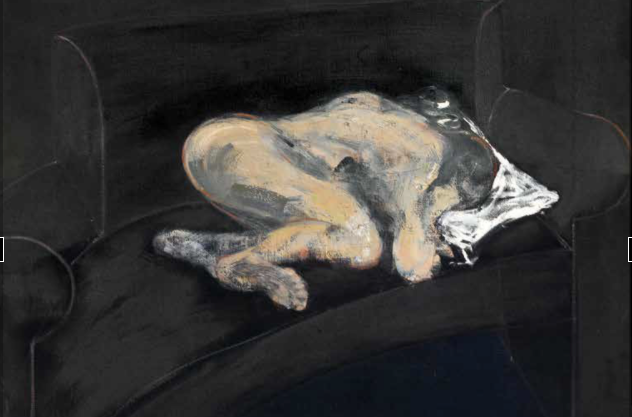
The last room has at its centre a death mask she made of herself surrounded by pictures from this last phase of her work so far, including one with her sprawled on a table in what appears to be a homely parlour that includes a small altar, with a black shrouded figure standing over her, called I Watched Myself Die and Come Alive. But much of it is turning back to her Margate childhood and her mother. A large, plain image of a young pubescent Tracey, naked and kneeling on a bed, is called You Should Have Saved Me. But there is also a spiritual, almost religious, sense to these later works as she contemplates again the death she almost succumbed to.
As expected, the work is strong, powerful, visceral and fundamentally personal, Tracey stripped at the core. One of her stitched cloth images says simply, “It’s not me that’s crying, it’s my soul.”
For independent criticism and measured reporting, subscribe to EyeOnLondon and support coverage of London’s artistic life.
Tracey Emin: A Second Life
Tate Modern , London
The largest survey of Tracey Emin’s work, spanning early textiles to recent paintings shaped by illness and survival.
27 February – 31 August
Standard gallery admission applies. Advance booking recommended.
Open daily. Check Tate Modern website for updated opening times.
Follow us on:



Subscribe to our YouTube channel for the latest videos and updates!

We value your thoughts! Share your feedback and help us make EyeOnLondon even better!