The Importance of Stephen Fry: An OTT Earnest that misses Wilde’s finesse but lands a surprise with its Lady Bracknell

The Importance of Being Earnest | Noël Coward Theatre | Until 10th January 2026
The National Theatre production transfers to the West End with an entirely new cast and, mercifully, a shorter running time.
Oscar Wilde described his play as “a trivial comedy for serious people”, and it has been a staple of stage and screen since its first production in 1895.
Set in late Victorian England, the play centres on two bachelors, Jack Worthing and Algernon Moncrieff, who both maintain fictitious identities (“Ernest”) to escape social obligations and pursue romance. The play ridicules the hypocrisy and triviality of upper-class society.
Arts & Culture — More from EyeOnLondon
Explore more reviews and features and stay with the story.
Oliver Gielgud theatre review
A clear-eyed theatre review, focused on what works on stage and what falls short.
Read the reviewMore Arts & Culture
Oliver Gielgud theatre review
A theatre piece with a direct verdict and a close look at performance and staging.
Read the reviewMore Arts & Culture
Wicked for Good film review
Our take on the latest big-screen release, with an honest view on performances and tone.
Read the reviewMore Arts & Culture
It is widely regarded as a masterpiece of English comedy, frequently revived on stage and adapted for film and television. One of the landmark productions remains the 1952 film starring Edith Evans and Michael Redgrave, and every Lady Bracknell since has been judged against Evans’ delivery of the iconic line: “A handbag!”
Given the play’s history, the challenge for any new production is clear. Either it finds something genuinely new to say, or it presents the work as close to the original style as possible, risking it being viewed as a museum piece.

Director Max Webster has attempted the former. His approach begins with Oscar Wilde’s four-act version of the play and foregrounds the subtext that, in Wilde’s time, the name “Ernest” functioned as coded language for being gay. This reading is pushed firmly to the surface.
This approach has produced mixed results, as I felt when I originally saw the production on the South Bank, starring Ncuti Gatwa and Sharon D Clarke as an imposing and hilarious Trinidadian Lady Bracknell.
This West End version leans heavily into queer culture. Everything is exaggerated and turned up to eleven, complete with ironic and contemporary music. I have no problem with plays being reinvented and reimagined. However, any new approach still needs to serve the piece and help audiences understand what is happening, rather than functioning purely as a gimmick.
Wilde’s play is fun. It is a delicate theatrical soufflé and requires a lightness of touch. Here, the approach is heavy-handed, with excessive winking and asides to the audience, crotch-grabbing and statue-fondling. It suggests a fundamental lack of faith in the original text and ultimately becomes tiresome, robbing the play of emotional connection.
When I saw the production at the National Theatre, it ran close to three hours, which was far too long. I was pleased to see that this has been trimmed to a running time of two hours and thirty-five minutes for the transfer. Unfortunately, everything else remains unchanged in both style and approach.
Unusually, the transfer does not feature a single member of the original cast, and this produces mixed results. One of the better-known performers is pop star Ollie Alexander as Algernon. He is suitably puckish and energetic but struggles to master the intricacies and rhythms of Wilde’s dialogue.

He is joined by Nathan Stewart-Jarrett as Jack, who brings enormous energy and attack but lacks clarity of diction, resulting in much of the humour being lost. One need only watch the NT Live recording of the original production to see how effectively Hugh Skinner handled the same role.
This relentless OTT approach robs the production of subtlety and emotional depth. Miss Prism, played by Shobna Gulati, and Canon Chasuble, played by Hugh Dennis, are particular casualties of this style.

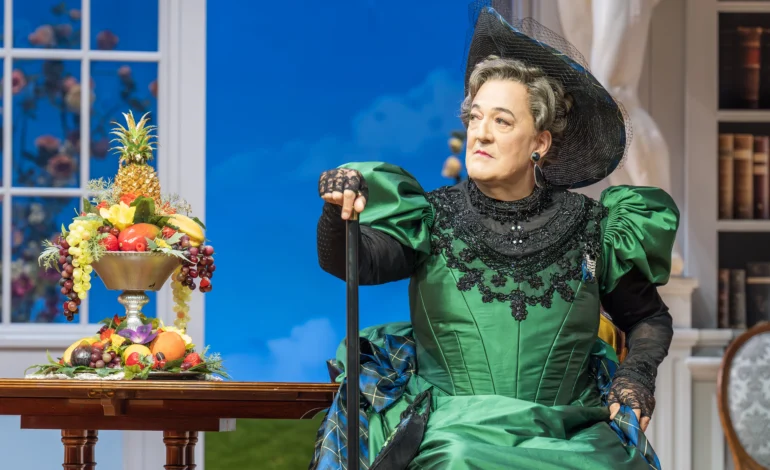
On the positive side, I approached the performance with reservations about Stephen Fry playing Lady Bracknell, feeling that it was unnecessary for a man to take on the role. I was more than pleasantly surprised. Fry delivers a nuanced, underplayed performance that works precisely because of the chaos surrounding him. He finds humour in Wilde’s text rather than imposing it, and he is consistently and genuinely funny.
Overall, this is a high-energy, OTT production that revels in its gender- and colour-blind casting. It ultimately fails to serve Wilde’s original with the delicacy it requires, but it is worth seeing for Stephen Fry’s Lady Bracknell alone.
Max Webster’s queer-camp Earnest entertains, but it is Fry’s Lady Bracknell that makes it worth seeing.
For more intelligent, honest theatre reviews and arts coverage across London, follow EyeOnLondon for a different perspective every time.
The Importance of Being Earnest
Noël Coward Theatre | Booking until 10th January 2026
A high-energy, OTT reinterpretation of Oscar Wilde’s classic. Visually bold and divisive in tone, but elevated by Stephen Fry’s sharply observed Lady Bracknell.
★ ★ ★ ☆ ☆
Visit the official production website for tickets and performance details
For more theatre reviews and arts coverage, visit our Arts & Culture section .
Follow us on:



Subscribe to our YouTube channel for the latest videos and updates!

We value your thoughts! Share your feedback and help us make EyeOnLondon even better!