Russia-Ukraine Conflict Escalates as Ukrainian Forces Advance in Kursk

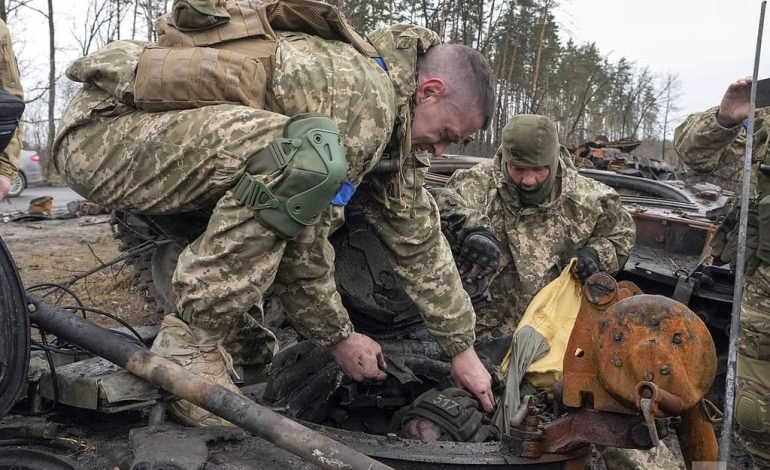
As the Russia-Ukraine conflict continues to intensify, Ukrainian forces have made significant inroads into Russia’s Kursk border region, creating a new front in the war that has stunned many observers. This incursion, which has involved as many as 10,000 Ukrainian troops, marks one of the most notable offensives by Ukraine within Russian territory since the conflict began.
On Saturday, Ukraine’s State Emergency Service reported that a Russian missile strike in the city of Sumy sparked a fire that injured two people and caused damage to cars and nearby buildings. The attack involved an Iskander-K cruise missile and an aerial bomb, underlining the ongoing intensity of the conflict. Ukraine’s air force also confirmed the downing of 14 Russian drones overnight, with several intercepted over the Kyiv region.
Meanwhile, fighting has intensified in Russia’s Kursk region, where Ukrainian troops have been deployed since 6th August. This strategy appears to be an attempt to divert the Kremlin’s military focus from the main front line within Ukraine. In a significant development on Thursday, Ukrainian forces announced the capture of Sudzha, a town located just 10 kilometres from the Russian-Ukrainian border. With a prewar population of around 5,000, Sudzha is the largest town to fall under Ukrainian control since the start of the incursion.
Reports from the scene, shared by Associated Press journalists who visited the area on Friday, described the town’s central square as being heavily scarred by artillery fire, with a statue of Soviet founder Vladimir Lenin suffering severe damage. The local administration building, once a vibrant yellow, is now marked with bullet holes and charred by fire.
Russian military sources, including Alexander Kots, a correspondent for the pro-Kremlin newspaper Komsomolskaya Pravda, noted that despite some stabilisation in certain areas, Ukrainian pressure in Kursk remains strong. Kots commented on his Telegram channel, “In the main sections of the ragged front, the situation has stabilised. But there are areas where the enemy continues to try to expand its bridgehead.”
The conflict has also seen the destruction of critical infrastructure in the region. On Friday, Russian Foreign Ministry spokeswoman Maria Zakharova claimed that Ukrainian forces used U.S.-supplied HIMARS rockets to destroy a bridge across the Seim River in the Glushkovsky district. Although this claim could not be independently verified, the Institute for the Study of War, a Washington-based think tank, released geolocated footage showing the bridge’s collapse.
Russian military bloggers have noted that while the destruction of bridges would hinder the delivery of supplies to Russian forces, it would not entirely sever their supply lines. “No one has canceled the pontoons,” said Kots, emphasising that the Seim River is smaller and less significant than major Ukrainian waterways such as the Dnieper River.
The incursion into Kursk, characterised by its size, speed, and the involvement of experienced Ukrainian brigades, has led to the evacuation of more than 120,000 civilians, according to Russian authorities. The scale of this incursion has shocked many, with Yan Furtsev, an activist and member of the local opposition party Yabloko, remarking, “No one expected that this kind of conflict was even possible in the Kursk region. That is why there is such confusion and panic.”
Russia’s Emergency Situations Ministry announced on Saturday that approximately 10,000 evacuees from the Kursk region, including 3,000 children, are currently housed in 171 temporary accommodation centres across the country.
As Ukrainian forces advance, they have also captured a number of Russian troops. On Friday, Associated Press journalists visited a Ukrainian detention centre, the location of which remains undisclosed for security reasons. There, they observed dozens of Russian POWs, some walking with their hands tied behind their backs while being escorted by guards.
Ukrainian President Volodymyr Zelenskyy expressed his gratitude towards the soldiers and commanders for capturing Russian military personnel, stating that the “exchange fund” used to bargain for the return of Ukrainian POWs is being replenished. “I thank all our soldiers and commanders who are capturing Russian military personnel, thereby advancing the release of our warriors and civilians held by Russia,” Zelenskyy said in a post on X.
For those looking to understand the complexities of the ongoing conflict, detailed analysis and updates can be found on the Institute for the Study of War.