Battle symbols from Boudica’s Britain unearthed in Norfolk dig

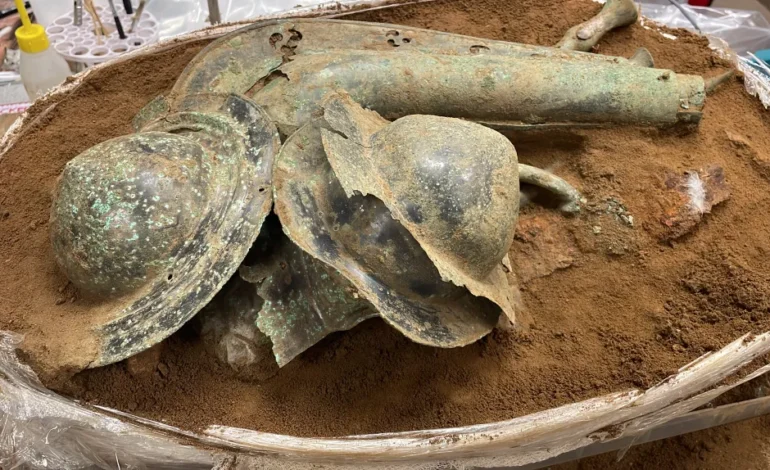
A rare Iron Age hoard discovered in Norfolk has revealed some of the most striking evidence yet of how Britain’s tribal warriors may have looked and sounded on the eve of Roman domination, in the years associated with the uprising led by Boudica.
The find, uncovered during routine archaeological work ahead of a housing development in west Norfolk, includes a near-complete carnyx, a long bronze battle trumpet once used to intimidate enemies, alongside a bronze boar’s head that formed part of a military standard. Five iron shield bosses were also recovered, suggesting a strongly martial purpose to the burial.
History & Civilisations — More from EyeOnLondon
Three recent reads to take you further into the past, one story at a time.
Secret maps at the British Library
A look at hidden cartography, what it reveals about power, and why old maps still matter.
Read the storyMore History & Civilisations
Earliest evidence of fire-making found
What the discovery suggests about early human skill, survival, and the long arc of invention.
Read the storyMore History & Civilisations
Staunton of Arabia
A sharp portrait of a life shaped by travel, diplomacy and the hard work of understanding place.
Read the storyMore History & Civilisations
Archaeologists believe the objects were placed in the ground around 2,000 years ago, in territory once occupied by the Iceni tribe. It was from this region that Boudica launched her revolt against Roman rule in AD60 or 61, attacking Camulodunum, Londinium and Verulamium before her eventual defeat.
Sound, spectacle and fear
The carnyx is among the most significant elements of the hoard. These upright trumpets, often topped with animal heads, were played to create an unnerving din on the battlefield. Roman writers described their sound as harsh and terrifying, and the instrument appears frequently in classical art as shorthand for Celtic warfare.
Only three carnyces have ever been found in Britain. The Norfolk example is one of the most complete known anywhere in Europe.
Dr Tim Pestell, senior curator of archaeology at Norfolk Museums Service, said the discovery offered a rare physical connection to a formative moment in British history.
“This find is a powerful reminder of Norfolk’s Iron Age past which, through the story of Boudica and the Iceni people, still retains its capacity to fascinate,” he said. “It gives us an unparalleled opportunity to investigate objects that are almost never recovered in such condition.”
He added that the trumpet was exactly the sort of object associated with warfare during Boudica’s campaign, though further research would be needed to establish whether it was actually used in conflict or deposited as part of a ritual act.
A boar and a banner
Equally striking is the bronze boar’s head. The boar was a potent symbol in Iron Age Europe, associated with strength, ferocity and protection. While Roman reliefs and continental finds depict similar standards carried into battle, surviving physical examples are exceptionally rare.
Dr Fraser Hunter, an Iron Age specialist at National Museums Scotland, described the hoard as internationally important.
“I’ve examined carnyces from across Europe, and this discovery will reshape how we understand sound, music and display in the Iron Age,” he said. “The style of the trumpet and the boar-headed standard shows that communities in Britain were not isolated, but deeply connected to a wider European world.”
Lifted as one, preserved for study
Because of their fragility, the objects were removed from the ground encased in a single block of soil, preserving their original arrangement. CT scanning was used to map the contents before conservators began the painstaking process of stabilising each piece.
The work is being coordinated by Historic England alongside Norfolk Museums Service, National Museums Scotland and the archaeological firm that made the discovery. Conservation is expected to take several years, and no final decision has been made on where the objects will eventually be displayed.
In a joint statement, Historic England’s leadership said the hoard would “transform our understanding of ancient British culture” and help tell the story of the Norfolk community that owned and buried these remarkable objects.
For readers interested in how Iron Age finds are protected and studied, further context on the process of conserving nationally important discoveries can be found via Historic England’s website.
The discovery will feature in an upcoming episode of Digging for Britain (14th January) on BBC Two.
For more features exploring Britain’s ancient past and the stories still emerging from the ground beneath us, follow EyeOnLondon for clear, intelligent history coverage you can trust.
[Image Credit | © BBC]
Follow us on:



Subscribe to our YouTube channel for the latest videos and updates!

We value your thoughts! Share your feedback and help us make EyeOnLondon even better!