History of the Muses: From Ancient Greece to Modern Inspiration

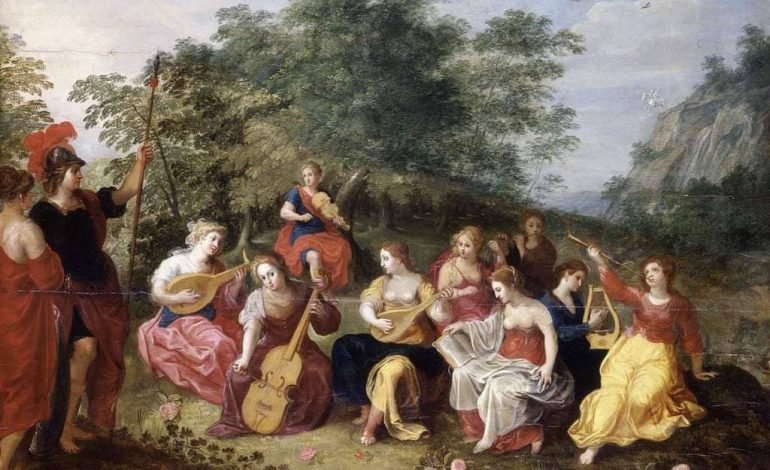
The history of the muses begins in ancient Greece, where these nine goddesses were revered as the sources of inspiration for poets, musicians, and artists. Known as the daughters of Zeus and Mnemosyne (the goddess of memory), the muses symbolised different forms of artistic and intellectual creativity. Hesiod, one of Greece’s earliest poets, described their powers in his epic Theogony, where he introduces them as divine patrons of the arts. Each muse had her own domain, from epic poetry (Calliope) to dance (Terpsichore), embodying every creative pursuit. For the Greeks, these goddesses weren’t just mythical figures—they were a vital force behind the act of creation.
The Names and Roles of the Muses
The nine muses were each associated with a different form of expression, and their names reflect their ancient Greek origins: Καλλιόπη (Calliope) for epic poetry, Ευτέρπη (Euterpe) for music, Θάλεια (Thalia) for comedy, Μελπομένη (Melpomene) for tragedy, Τερψιχόρη (Terpsichore) for dance, Ερατώ (Erato) for love poetry, Πολύμνια (Polyhymnia) for hymns, Ουρανία (Urania) for astronomy, and Κλειώ (Clio) for history. Each muse’s role extended beyond mere artistic oversight—they were seen as the givers of divine inspiration, invited to guide the hands and minds of creators.

Explore More on Arts, Culture, and History with EyeOnLondon
The San José Shipwreck: Untangling Ownership and Secrets of the Deep
Viking Age Coins on the Isle of Man: Treasures from a Storied Past
Plato and the Divine Madness of the Muses

The philosopher Plato (Πλάτων) revered the muses not just as goddesses but as symbols of a higher, almost ecstatic form of inspiration. In his dialogue Phaedrus, Plato describes the “divine madness” that artists experience when under the muses’ influence, a form of creative possession that defies logic and reason. He argued that true artistic inspiration wasn’t something one could force; it was a gift, bestowed only when one was touched by the muses’ “madness.” This idea resonates with the concept of the muses as supernatural guides who enable humans to reach artistic and intellectual heights otherwise inaccessible.
The Evolution of the Muses in Roman and Medieval Thought
As Greek culture spread, the Romans adopted the muses but adapted them to fit their own cultural context. Roman poets like Ovid invoked the muses as part of their creative process, integrating these goddesses into epic tales that reflected the values of Rome. During the medieval period, the influence of the muses evolved further, becoming more symbolic than literal. While the divine spark remained, it was gradually replaced by a focus on Christian saints and martyrs as sources of inspiration. Yet, the muses lingered in the background, symbolising the timeless mystery of creativity.

The Elizabethan Revival and Romanticism

During the Elizabethan era, writers like Shakespeare invoked the muses, combining the Greek tradition with the romanticised view of inspiration popular at the time. In his works, the muse became a symbolic lover or patron, an embodiment of both creative drive and emotional depth. This view continued into the Romantic period, where poets and artists like William Wordsworth and Samuel Taylor Coleridge drew on nature itself as a muse, seeking an unfiltered connection to the world around them. The muses thus evolved into figures that inspired not only through divine madness but also through direct encounters with the natural world.
The Muses in Modern Creativity
In the modern era, the concept of the muses has shifted once more. Today, they’re often seen as symbols of the subconscious mind, the parts of us that fuel creativity in ways we can’t entirely explain. Although we no longer call upon Calliope (Καλλιόπη) or Euterpe (Ευτέρπη) by name, the idea that inspiration is a gift—something we can’t fully control—still resonates. From the mystical to the psychological, the muses continue to be a reminder that creativity has an element of magic, something beyond mere technique or effort.

A Lasting Legacy of Inspiration
The history of the muses shows us that creativity has always been viewed as something a bit mystical, whether it comes from the divine madness Plato described or the romanticised visions of later poets. Their legacy lives on in modern art and literature, as artists continue to speak of “finding their muse” or “being inspired.” While their names may not be invoked as often, the spirit of the muses—the idea that inspiration comes from somewhere beyond ourselves—remains deeply embedded in the way we think about creativity.
An academic perspective on the history of the muses and their influence in ancient Greek culture is explored in The Journal of Hellenic Studies, available on JSTOR
For more insights on the history of creativity and inspiration, visit EyeOnLondon and discover the timeless legacy of the muses.