The British Museum will be showing this September a splendid exhibition entitled ‘Silk Roads.’ The show explores how trade routes spanning Central Asia, trading with Europe, Africa, and the Far East, influenced and serviced global cultures, creating ‘must-have’ characteristics, particularly among the wealthy and aristocratic classes entrenched in Europe.
The show focuses on the period from about 500 AD to 1000 AD and includes over 300 objects. For example, a shoulder clasp laden with Indian garnets found at an early Anglo-Saxon site at Sutton Hoo, Suffolk, to Iranian glass found in Japan. What may, the reader of this chess column opine, has this to do with chess? Well, as stated by The British Museum, the exhibition includes a group of 8th-century carved ivory figurines claimed to be from the ‘world’s oldest known chess set, shown for the very first time in the UK. The seven pieces, which include foot soldiers, an elephant rider, and other quite complex chess entities, are exciting to observe and conjure in the mind the ‘rich’ associations of players and environments these chess pieces would have travelled through. They are on loan from the city of Samarkand in Uzbekistan, among the many other items on show. Lu K Yu-Ping, a curator associated with the show, has said, ‘The aim of the exhibition is to tell a richer, more complex story of the Silk Roads beyond trade between East and West, highlighting the interconnectedness of Asia, Africa, and Europe during this period.’ Elisabeth O’Connell, curator and Byzantine historian, said, ‘This Silk Roads story comprises many journeys that span the distance from the Pacific to the Atlantic, from Empires to individuals. We’ve aimed to show the range of networks that facilitated movement, both voluntary and involuntary. It is a huge privilege for us to bring the stories of diplomats and pilgrims, scholars and students, refugees and captives, traders and traded to our BM visitors.’ I would add, ‘and our chess players.’
Although the timescale for the show begins in 500 AD, one has only to read or remind oneself of the Nabateans, a nomadic tribe referred to in the Old Testament of the Bible as the nomadic caravan leaders taking the camel trains over the very same routes from East to West and back again, and who eventually settled in Petra in Jordan, swelling their ranks to 20,000 before falling foul of the Imperial Roman army who decimated their numbers. I had the honour of being invited to Jordan in the late 1990s by King Hussein’s younger brother, Prince Mohammed bin Talal, as his guest, and explored Petra for several days, Petra’s Nabatean ‘city carved into the rose-coloured rock of this mountainous region.’ I was also transported into the middle of the Jordanian desert to play the Prince chess inside a tent, with the one chess set in the middle of the tent, with seven of the Government ministers watching us play this solitary game. No pressure there, then, I hear you say! I will just add I kept the British flag flying with honour.
Whilst chess cognoscenti can feast on the rich stimulants of the oldest known chess pieces from a chess set, come this September they will not have long to wait for the youngest contender ever to challenge for the top world chess accolade, the World Chess Championship Crown! The 18-year-old contender, Gukesh D, India, will challenge Ding Liren, China, the current World Champion, in Singapore at the ‘Resorts World Sentosa.’
In the meantime, another Indian-born prodigy, now residing in London, Shreyas Royal, aged 15 years, completed his tour of successes on the way to gaining his full Grand Master title at the British Championships recently played in Hull. Shreyas shattered the British record in becoming the youngest British player to achieve the GM title, incidentally held since 2007 by David Howell when he was 16! Shreyas’ success during the tournament included a draw with Gawain Jones, the British Champion, and successfully needing a draw in the final round against that stalwart of British chess, Michael Adams, to achieve the GM norm.
The list of young pretenders to the throne grows longer with the rise of such talents. Another world record has just been recorded with Faustino Oro achieving the International Masters title at the tender age of 10 years, 8 months, and 16 days. World records, as such, were once recorded just by the age in years; now, with such a proliferation of youthful talent, the months and days are taken into account too! Perhaps before too long, the arbiters may be kicking themselves that they should have been recording the hours too.
Oro’s success has been meteoric, defeating Magnus Carlsen, Nakamura, and others in online speed chess. This has manifested a media frenzy in his home country of Argentina and even brought the President of that country, Javier Milei, to praise Oro in adulatory style, posting his praise for him on social media. This trend is likely to continue given the results achieved from study during the Covid lockdown period. Many have mentioned it as a very formative period for the new successful aspirants to the game. For those interested in Oro’s games, some can be seen in the recent Club de Ajedrez IM Section, Barcelona 2024, Faustino Oro v Hipolito Asis Gargatagli.
In local news and on the dark side of chess, a contentious 3-day match in London’s Shoreditch that started on the 19th of August between former World Champion Vladimir Kramnik, who won and seized the title from Garry Kasparov at the Riverside Studios, Hammersmith in 2000, (I was the official artist for this championship), and GM Jose Martinez. Organised by Ilya Merenzon, a chess entrepreneur and organiser who wants his and others’ chessarena.com platform to be a competitor to chess.com, and states that one of its benefits is, ‘better cheating detection.’ Yes, on the flip side of the King of games and the Royal game, and rumbling on with increasing intensity in the electronic age that chess now occupies, cheating has become the number one ‘badass’. Kramnik himself is quoted, ‘The world of chess is in very dire straits. It is rotten,’ (The Times).
He has analysed thousands of top games on chess.com, the world’s leading platform, and concluded, ‘that there is mass cheating, and further, ‘it is being ignored’. The chess world was split when Carlsen accused Niemann of cheating when the latter won in an over-the-board contest. Yet many GMs at the time backed Niemann’s abilities, stating he didn’t need to cheat. Kramnik, in playing Martinez, hasn’t directly accused him of cheating but said, ‘…that there are many strong players, such as the Peruvian GM, who seem to have built reputations largely in the virtual world! ‘There are tons of players who are suddenly online geniuses who actually never really showed anything offline!’ Kramnik v Martinez, the 3-day Blitz tourney, has time controls of 3 minutes for each player, with a 2-second increment added after each player’s move. (Merenzon has hired the Pinkerton Detective Agency to sweep both the venue and the players to ensure there isn’t any cheating.). The Times report notes that at the end of the first day, the match was 7-5 in Martinez’s favour. Kramnik was seen throwing his Rook in irritation at losing the 12th game! C’est la vie! Is this an example of what the young aspirants written about at the beginning of this article can expect as they mature to full stature?
The Challenge
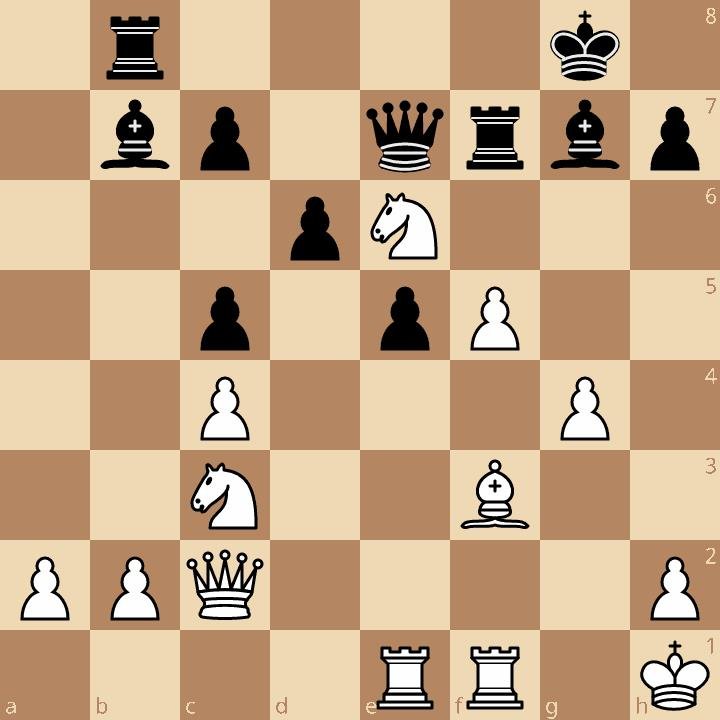
The game puzzle for this month’s chess is taken from the very exciting Late-Titled-Tuesday-Blitz – Aug. 13th, 2024 competition, where Jefferyx – Jeffery Xiong v Magnus Carlsen exploded in a very lively game! In the diagram, White has just taken back on f5. What was Carlsen’s response as Black, and how did the game go to reach its conclusion?
The Solution
21. exf5 Bxf3+ 22. Rxf3 Nxg4 23. Rg1 Qh4 24. Qg2 h5 25. Ne4 Nxh2 26. Rh3 Qg4 27. Rxh2 Rxf5 28. Qxg4 hxg4 29. Rxg4 Rf1+ 30. Kg2 Rf7 31. Nf6+ 1-0. Xiong finished top of the table with Carlsen placed 2nd.
[Image Credit:British Museum]