Three galaxies, three feeding black holes: astronomers confirm a triple radio AGN

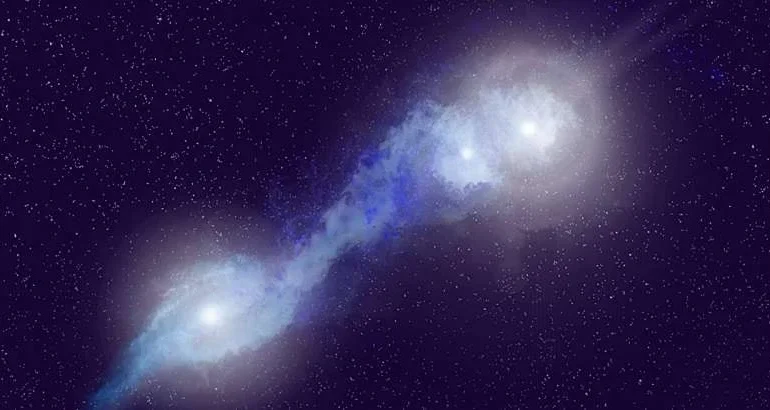
Astronomers have confirmed the first known triple radio AGN, a rare cosmic system in which three galaxies are merging while all three of their central supermassive black holes are actively feeding and emitting strong radio signals.
The system, catalogued as J1218/1219+1035, lies about 1.2 billion light-years from Earth. It contains three interacting galaxies whose cores are unusually energetic, with each black hole drawing in surrounding material and lighting up in radio observations. For researchers studying how galaxies and black holes grow together, it offers an unusually clear snapshot of a process that is thought to shape much of the Universe.
Science & Environment — More from EyeOnLondon
Three recent stories, chosen to keep you reading beyond the headline.
Subaru Telescope uncovers giant planet and dwarf star
A look at what astronomers spotted, why the find matters, and what it suggests about how systems form.
Read the storyMore Science & Environment
Dinosaur licence plates approved in North Carolina
A small change with a big public response, and what it tells us about identity, science and culture.
Read the storyMore Science & Environment
Quantum causality emerges
New work on how cause and effect may arise in quantum systems, and why it matters beyond theory.
Read the storyMore Science & Environment
High-resolution radio imaging has now confirmed that all three galaxies host active galactic nuclei, or AGN. Observations made using the Very Large Array and the Very Long Baseline Array revealed compact radio cores in each galaxy, produced by synchrotron emission that is characteristic of matter accelerating near a black hole.
This makes J1218/1219+1035 the first confirmed example of a triple radio AGN, and only the third known triple AGN system identified in the nearby Universe.
Caught mid-merger
The three galaxies appear to be in the midst of a gravitational encounter. Their central regions are separated by roughly 22,000 and 97,000 light-years, forming a dynamically bound group whose distorted shapes and tidal features trace the pull they exert on one another.
Such systems are a long-predicted but rarely observed outcome of hierarchical galaxy evolution, the process by which large galaxies grow over time by colliding and merging with smaller companions. Seeing three active black holes switched on at once provides rare observational evidence of how those encounters can funnel gas into galactic centres.
How astronomers found it
The system first drew attention through mid-infrared data from NASA’s Wide-field Infrared Survey Explorer, which hinted that at least two obscured black holes might be hidden within a pair of interacting galaxies. Optical spectroscopy later confirmed an active nucleus in one galaxy and a mixed or composite signal in another, but the nature of the third remained uncertain.
It was only through ultra-sharp radio imaging at multiple frequencies that astronomers were able to pinpoint compact radio sources aligned precisely with all three galaxies. Those observations showed that each galaxy hosts an AGN that is bright at radio wavelengths and likely driving small-scale jets or outflows.
Radio signals tell the story
The radio spectra of the three cores display features typical of AGN rather than star formation. Two show steep spectral slopes, while the third is steeper still, a sign that unresolved jet activity may be present. Follow-up observations placed limits on the brightness temperature of the central galaxy that exceed what would be expected from stellar processes alone.
Taken together, the evidence confirms that J1218/1219+1035 is not simply a triple AGN, but a uniquely radio-active one in which all three black holes are visible at once.
“Triple active galaxies like this are incredibly rare, and catching one in the middle of a merger gives us a front-row seat to how massive galaxies and their black holes grow together,”
said Dr Emma Schwartzman, lead author of the study.
“By observing that all three black holes in this system are radio-bright and actively launching jets, we have moved triple radio AGN from theory into reality.”
Only two other triple AGN systems have been confirmed nearby, making each new example valuable. Expanding this small sample will help astronomers understand how often black holes interact during galaxy mergers, and how those interactions may eventually lead to black hole pairs or even triple mergers.
Further observations are already planned, including infrared and X-ray studies to map the galaxies’ tidal structures and measure the high-energy output of each nucleus. Together, they aim to build a fuller picture of how black hole triplets influence the long-term growth of galaxies.
The findings are published in The Astrophysical Journal Letters.
For more informed coverage of science and world discoveries that shape how we understand the future, follow EyeOnLondon. We’d love to hear your thoughts in the comments.
Follow us on:



Subscribe to our YouTube channel for the latest videos and updates!

We value your thoughts! Share your feedback and help us make EyeOnLondon even better!