Bangladesh in Transition: Muhammad Yunus Leads After Sheikh Hasina’s Ouster

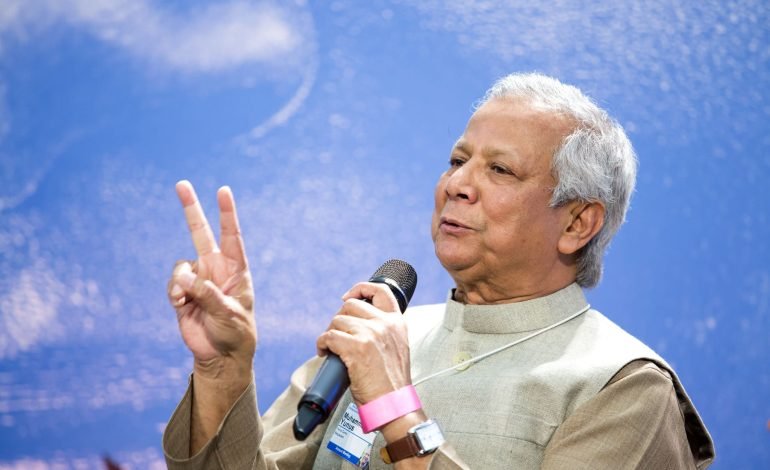
The recent ousting of Bangladesh’s Prime Minister Sheikh Hasina has plunged the country into a new political era, marked by uncertainty and cautious hope. Hasina, who had been in power for over 15 years, was forced out on August 5 following weeks of student-led protests that escalated into a nationwide revolt. The demonstrations, initially sparked by grievances over government job allocations, grew into a larger movement against Hasina’s increasingly autocratic rule, with protesters accusing her of corruption, suppressing opposition, and eroding public institutions.
Sheikh Hasina Ousted Amidst Violent Protests
The protests against Sheikh Hasina quickly spiralled into chaos, resulting in over 600 deaths and pushing the country to the brink of collapse. Amid the rising anger, Hasina, aged 76, fled to India as her government struggled to maintain control. In her absence, Bangladesh was gripped by violence, with police going on strike and mobs rampaging across cities and towns. Amid this chaos, Nobel Peace Prize laureate Muhammad Yunus, known for pioneering microcredit, was sworn in as the head of a new interim government tasked with restoring order.
Yunus, 82, took office promising to tackle corruption, reform key institutions, and prepare the nation for new elections. His Cabinet, notably including two of the student leaders who spearheaded the protests against Hasina, has focused on overhauling Bangladesh’s courts, police, and the Election Commission—institutions that were seen as deeply compromised under Hasina’s rule. Yunus has also sought international support, notably from the United Nations Development Programme, to assist with these reforms.
Interim Government Led by Muhammad Yunus Faces Major Challenges
Since assuming leadership, Yunus has emphasised the need for patience as his government works to address the deep-rooted issues facing Bangladesh. In a recent address to the nation, Yunus highlighted the interim government’s progress in curbing violence and restoring some semblance of order. “I request everyone to be patient,” Yunus said. “It is one of our objectives that public institutions regain public trust.”
However, unrest continues to simmer beneath the surface. Garment workers, a significant force in Bangladesh’s economy, have staged protests demanding higher wages, forcing about 100 factories to shut down temporarily. The garment sector, which contributes significantly to Bangladesh’s GDP, has been a flashpoint of labour unrest, particularly in times of economic strain. Despite Yunus’s efforts to stabilize the country, many Bangladeshis remain disillusioned, with lingering anger against Hasina and her party, the Awami League.
Legal Woes for Hasina and Her Allies
Hasina now finds herself in self-imposed exile, facing over 100 cases, including murder charges linked to the deaths during the protests. Several key figures associated with Hasina’s administration, from former ministers to judges, journalists, and even a prominent cricket player, are also facing legal challenges. Rights groups, however, have criticized these charges as being politically motivated, with Zillur Rahman, executive director of the Center for Governance Studies in Dhaka, describing the situation as “vigilante justice.” Rahman warns that while the faces of those targeted may have changed, the underlying issues within the system remain.
The legal persecution of Hasina’s allies has raised concerns about the potential for ongoing political vendettas, as the interim government grapples with balancing justice and stability. Many fear that the cycles of retribution could perpetuate the same abuses that plagued Hasina’s rule, undermining Yunus’s efforts to create a fair and transparent governance system.
Bangladesh’s Economy and the Road to Recovery
Bangladesh’s economy, which was already under pressure before the protests, has suffered further disruptions. The prolonged shutdown during the uprisings led to soaring prices for food and essential commodities, placing additional strain on a population grappling with the aftershocks of violence. Restoring economic stability is a top priority for the interim government, but challenges remain. Police morale is low, with many officers hesitant to engage with the public after being targeted during the protests. Meanwhile, the memories of violent crackdowns are still fresh in the minds of many Bangladeshis.
As normalcy slowly returns, signs of recovery are evident. Dhaka’s streets, once battlegrounds, are now bustling again, with shops, banks, and restaurants reopening. The internet has been restored, and a nationwide curfew has been lifted. However, Yunus’s government faces mounting pressure to ensure that the reforms promised are implemented effectively and that the groundwork is laid for free and fair elections.
When Will New Elections Be Held?
The timing of new elections remains a contentious issue. Some political experts argue that the interim government lacks the mandate to implement sweeping reforms and should instead focus on building consensus among the political parties. The Bangladesh Nationalist Party (BNP), Hasina’s chief opposition, is seen as the frontrunner in any upcoming elections and has been vocal about the need for a swift return to the polls. However, the prospect of prolonged delays raises concerns about renewed unrest.
Michael Kugelman, director of the Wilson Center’s South Asia Institute, noted that Yunus’s support base among the youth could be tested if economic and security improvements are slow to materialize. “If security continues to be a problem and economic relief is slow to come … young people could grow impatient and anxious,” Kugelman said. He also warned that if the BNP doesn’t see the elections it desires soon, it could launch its own movement, potentially destabilising the fragile political landscape further.
Outlook for Bangladesh’s Political Future
As the interim government of Muhammad Yunus looks to the complex task of steering Bangladesh towards stability, it faces enormous challenges in addressing public discontent, rebuilding institutional trust, and preparing for new elections. The road ahead is fraught with uncertainty, and much will depend on how effectively Yunus can balance the need for immediate reforms with the demands for democratic elections.
For more information and analysis on Bangladesh’s ongoing political transition, you can explore resources provided by the Center for Governance Studies, which offers in-depth insights into the current situation and the potential pathways forward for the nation.