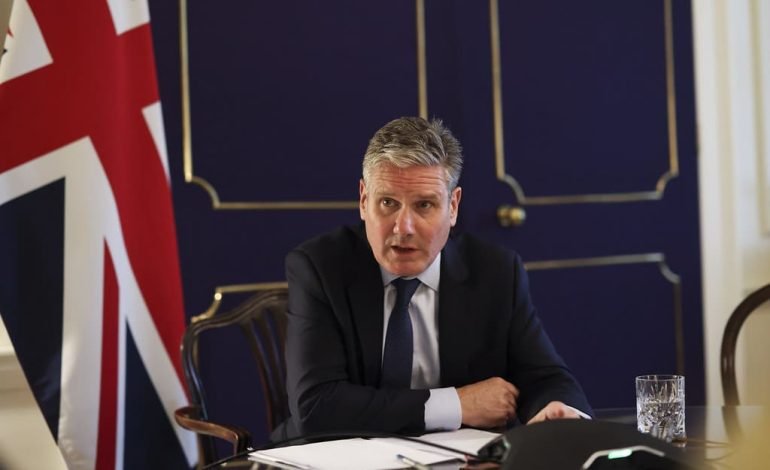
Keir Starmer power struggles have defined his first 100 days as Prime Minister, as internal conflicts and leaks reveal tensions within his team. Despite his promise to bring “stability and moderation” to Downing Street, Starmer’s administration has been marked by challenges, including the recent departure of his chief of staff, Sue Gray.
When Starmer appointed Sue Gray as his chief of staff, her reputation as a seasoned civil servant was expected to bring structure and control to his administration. Gray, known for her role in the Partygate investigation, was anticipated to help Starmer’s government navigate the complexities of Downing Street. However, in a dramatic turn of events, Gray’s exit has brought to light underlying tensions within Starmer’s team.
Power Struggles in Downing Street
Starmer’s appointment of Gray was initially met with optimism. As a civil servant with decades of experience, Gray’s knowledge of government operations was seen as an asset. However, her time in No. 10 became controversial as accusations emerged that she was too controlling. Keir Starmer power struggles soon became associated with her tenure. Gray controlled the government’s announcements, managing the internal communications grid—a move that caused frustration among those who believed she was stifling Starmer’s message. As the former head of the Partygate investigation, Gray’s role as chief of staff was expected to bring a structured approach to government operations. According to the Institute for Government, a chief of staff plays a crucial role in managing internal communications and coordinating policy.
One of the core grievances stemmed from her handling of key government announcements. For instance, when the renationalisation of the railways took place, many felt the public was not adequately informed, with minimal fanfare around what should have been a significant event. Pippa Crerar, the Guardian’s political editor, noted, “There was frustration that the government was not making the announcements that they should have been.”
The Departure of Sue Gray
The tipping point came with the leak of Gray’s £170,000 salary, which sparked resentment among senior members of Starmer’s team. The subsequent infighting led to her replacement by Morgan McSweeney, Starmer’s close political aide, who reportedly had a strained relationship with Gray. In what some described as a “power struggle,” Gray found herself sidelined, her influence diminishing as McSweeney assumed a more prominent role.
Pippa Crerar commented on Gray’s departure, noting that her role had made her a “lightning rod” for internal tensions within Starmer’s administration. According to Crerar, while Gray was simply doing her job by deciding who had access to the prime minister, others saw her as a “control freak” who interfered with the decision-making process.
Morgan McSweeney Takes Charge
Now that McSweeney is officially in charge, the dynamics within Downing Street have shifted. While Gray was valued for her civil service background, McSweeney brings a political edge as the strategist behind Starmer’s leadership campaign. Many within Labour hope that he will help the government reconnect with the public, moving away from the technocratic style that defined Gray’s tenure.
One incident highlighting their power struggle involved rumours that Gray moved McSweeney’s desk further from Starmer’s office—a claim that both parties denied. Nevertheless, it exemplifies the extent of the discord that has shaped Starmer’s first few months in office. McSweeney’s role now is to help steer Starmer’s government towards a more politically attuned approach, understanding public sentiment and prioritising decisions based on how they resonate with voters.
With McSweeney now on board, Starmer has also made other strategic appointments, including former Downing Street policy director Nin Pandit as principal private secretary and James Lyons, a former political journalist, to lead communications. These moves are intended to bring a fresh perspective and improve the coherence of Starmer’s message.
The Road Ahead
The departure of Gray and the rise of McSweeney are part of a broader reshuffling within Starmer’s top team, which could indicate a new direction for his administration. However, if infighting and leaks continue, some within Labour worry that it will reflect poorly on the party’s leadership. Crerar remarked, “If the situation does not improve, it may confirm fears that the problem lies with the strategic direction set from the top.”
As the new chief of staff, McSweeney’s challenge will be to deliver on Starmer’s promise of stability and moderation, countering perceptions of chaos and disorganisation. Whether or not this reshuffle leads to a more unified Downing Street remains to be seen.
For more updates on Keir Starmer’s government and insights into UK politics, visit EyeOnLondon.