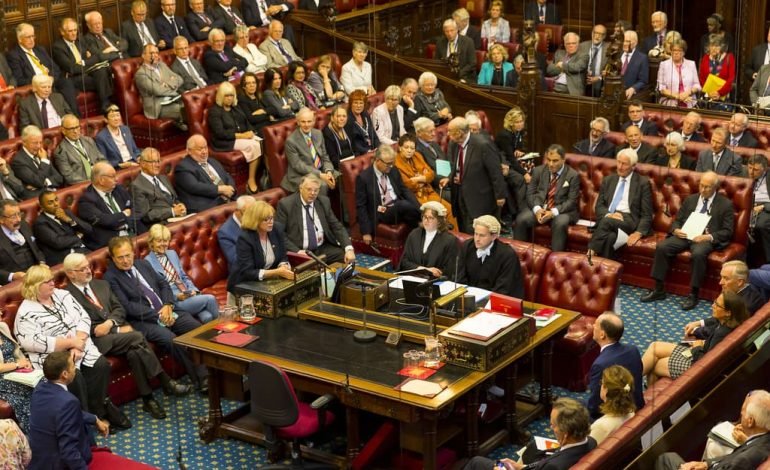
The British government has taken a decisive step to end the right of hereditary peers to sit in the House of Lords, with figures like the Earl of Devon facing the end of a centuries-old role in Parliament. This week, MPs voted in favour of a bill that would strip hereditary aristocrats of their voting rights in the House of Lords, a move that the Labour Party describes as a vital step in modernising the upper chamber.
The Earl of Devon, Charles Courtenay, is one of the few remaining hereditary peers. With a legacy dating back to 1142, Courtenay’s family has long held a seat in Parliament, a tradition that may soon come to an end. Speaking on the matter, the Earl expressed reservations about altering the UK’s unwritten constitution, stating, “The fact that I am doing a job granted by the Empress Matilda to my forebear… is a remarkable example of consistency and continuity.”
The House of Lords reform has been a gradual process. Under Tony Blair’s government in 1999, more than 750 hereditary peers were removed, although 92 were allowed to remain temporarily. Today, that number stands at 88, with peers like Courtenay continuing to represent an all-male group with an average age of nearly 70. This group includes notable Conservatives and non-aligned members who occasionally serve as a check on the more volatile policies emerging from the House of Commons.
Labour politicians have been vocal about the need for further reforms, with Constitution Minister Nick Thomas-Symonds declaring that in a 21st-century democracy, hereditary positions in Parliament are “outdated and indefensible.” Currently, only the UK and Lesotho maintain hereditary parliamentary seats, which has increasingly drawn criticism from those pushing for modernisation.
The potential removal of hereditary peers raises questions about the role of tradition in a rapidly changing political landscape. Courtenay, for example, has deep ties to the history of England, having inherited Powderham Castle and its vast Devon estate. He sees his role in the Lords as one of continuity and service to his local community, despite the sweeping changes that may be on the horizon.
Labour’s commitment to reform has been met with opposition from the Conservative Party, which views the House of Lords as a valuable body for moderating policy decisions. Conservative lawmaker Oliver Dowden commented that “the checks and balances of the Lords… work,” and urged caution before dismantling a key part of the UK’s parliamentary structure.
For now, the bill has passed its first major hurdle in the Commons and is on its way to the House of Lords for further scrutiny. While the Lords can delay and amend bills, it cannot ultimately block them, suggesting that this reform may soon become law, potentially within the next year. The Earl of Devon is philosophical about this change, reflecting on his family’s long service to the country and his future outside Parliament. “We’ve been somewhat involved in the workings of government over a long, long time,” he remarked. “And outside of those moments in the spotlight, there’s been an awful lot of plodding along, trying to support Devon and help the community.”
As the House of Lords faces this historic reform, many in the UK are left reflecting on what it means to preserve tradition in a fast-evolving world. For the Earl of Devon, this change marks the end of a long family legacy that stretches back nearly a thousand years. “We’ve been here through battles, coronations, and even the odd beheading,” he quips, recounting his family’s colourful role in British history. Yet, he remains philosophical, seeing this as simply a new chapter. “Whether inside or outside of Parliament, my family will continue to support Devon and its communities, as we always have,” he says. It’s a poignant reminder that even as traditions shift, the spirit of public service can endure.
For more captivating stories on the ever-changing landscape of British politics and the people behind it, visit EyeOnLondon. Read exclusive insights, historical perspectives, and updates that matter to Londoners. Stay connected with us as we explore the traditions that shape our nation and the reforms that redefine it.