Could a cure for menopause be closer than we think? According to Dr Kutluk Oktay of Yale School of Medicine, the possibility of not just delaying menopause but potentially staving it off altogether could be a very real future for many young women.
Each stage of life offers its own unique rollercoaster of emotions, challenges, and changes, menopause being one of the most significant. While many women celebrate the end of periods and the anxiety around unplanned pregnancies, the prospect of decreased bone density, loss of muscle strength and a gradual decline into decrepitude can be daunting. In the exciting new field of ovarian cryopreservation, Dr Oktay’s research offers a groundbreaking approach that might just rewrite the rules of ageing and fertility.
Oktay, who developed and performed the world’s first ovarian transplant procedure with cryopreserved tissue for a patient with a medical indication in 1999, sees a future in which healthy women could use this process of freezing tens of thousands of eggs within the ovarian tissue to stave off menopause for as long as several decades, or even prevent its onset altogether.
“For the first time in medical history, we have the ability to potentially delay or eliminate menopause,” said Oktay.
Ovarian cryopreservation could significantly delay the onset of menopause for most women under 40. For those under 30, the procedure might actually prevent menopause entirely. Imagine having the power to press “pause” on one of life’s most dreaded transitions. However, for women over 40, data suggest the procedure is unlikely to delay menopause where average egg reserves are concerned. Some natural questions emerge:
- Would an ovarian transplant from a younger woman also work?
- Would there be any health issues for the donating female?
- Could this lead to black market ovarian sales?
- Could cloning one’s own ovarian tissue be a future option?
Science is advancing at a rapid pace, raising a host of ethical concerns. Nonetheless, many remain hopeful about experiencing these potential health benefits. In today’s fast-paced society, with career aspirations, travel, or simply stressful and busy lives, many women are delaying motherhood. By the time circumstances align, fertility may already be in decline. For some, the intention was always to start a family “when the time was right.” Yet all too often, that time collides with the onset of peri-menopause, when reproduction is no longer a priority or possibility.
As Dr Hugh S. Taylor, Chair of Obstetrics, Gynaecology & Reproductive Sciences at YSM, points out:
“The ability to freeze and transplant ovarian tissue offers a way to extend their fertile lifespan.”
This is a game changer for anyone dreaming of parenthood but not ready just yet.
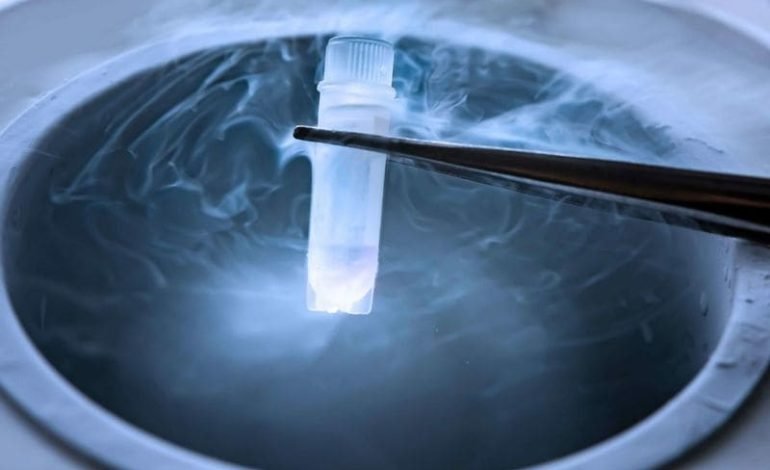
The procedure itself sounds simple, though the science behind it is anything but. During this outpatient procedure, a surgeon laparoscopically removes the whole ovary or layers of the outer portion, which contain hundreds of thousands of dormant, immature eggs (known as primordial follicles). The harvested tissue is frozen and stored at a staggering -320°F. With state-of-the-art techniques, the tissue can be reimplanted years later. After just a few days, it reconnects with surrounding blood vessels, and full ovarian function is often restored within about three months, offering another chance to maintain fertility and hormonal health.
Serious Health Benefits Beyond Baby-Making
Delaying menopause isn’t just about extending the childbearing years; it could also deliver remarkable health benefits. Research suggests that women who reach menopause later may enjoy longer lives and reduced risks of various conditions including metabolic syndrome, cardiovascular disease, dementia, bone loss, depression, and muscular-skeletal syndrome of menopause.
According to Dr Oktay, approximately 11% of women experience natural menopause after age 55. Recent findings suggest that delaying menopause could be linked with a lower risk of these conditions. While more evidence is needed to confirm that cryopreservation alone delivers these benefits, the early indications are encouraging. Oktay is optimistic, believing that many of the health risks tied to early menopause could be lessened through this approach.
Do the Risks Outweigh the Rewards?
As any Marvel fan knows: with great power comes great responsibility. While ovarian cryopreservation holds great promise, experts stress the need for further research to understand the long-term effects. Much of the existing data centres on women undergoing the procedure due to medical reasons, such as cancer treatment. The implications for healthy women are still being explored.
As this research progresses, Dr Oktay and his team are closely analysing the outcomes of women opting to delay menopause through cryopreservation. Although these findings have yet to be published, early signs suggest they are on the verge of something transformative.
Oktay and colleagues have developed a mathematical model, published in the American Journal of Obstetrics & Gynecology, to predict how long the surgery could delay menopause in healthy women under various conditions. Drawing on data from hundreds of prior procedures and molecular studies of ovarian follicle behaviour, the model takes into account key factors such as age and tissue volume. The younger the woman at the time of the procedure, the more eggs, and the higher their quality, she retains.
The model also highlights the importance of how much ovarian tissue is harvested. While removing more tissue can delay menopause for longer, excessive removal could bring menopause on earlier. This research helps identify the optimal “sweet spot” for tissue collection based on age.
Animal studies indicate that around 60% of primordial follicles may not survive transplantation. However, with improving freezing techniques, Oktay believes survival rates could soon reach 80%, with hopes of achieving full preservation in the future. Additionally, the idea of transplanting portions of the preserved tissue in multiple stages could help prolong the benefits, offering further avenues for fine-tuning the process.
The Future Is Not Set
We’re not yet at a point where menopause has a definitive “cure,” but ovarian cryopreservation brings a new vision of the future of women’s health. This research opens up broader discussions around fertility, ageing, and autonomy over reproductive timelines, and could also reduce future healthcare costs on a massive scale.
So, could this be the solution the world has been waiting for? Time will tell. However, one thing is clear: women today have more options than ever before. The horizon of reproductive health is expanding and with it, the possibility of a future free from the inevitability of menopause.
For more intelligent reporting on science, health, and innovation, follow EyeOnLondon. We bring you real stories that shape the future of healthcare and society – from breakthrough research to everyday impacts.
[Image Credit: Nabta Health]
Follow us on:



Subscribe to our YouTube channel for the latest videos and updates!

We value your thoughts! Share your feedback and help us make EyeOnLondon even better!