Cryogenic quantum sensors: the Texas lab trying to hear the universe’s faintest signals

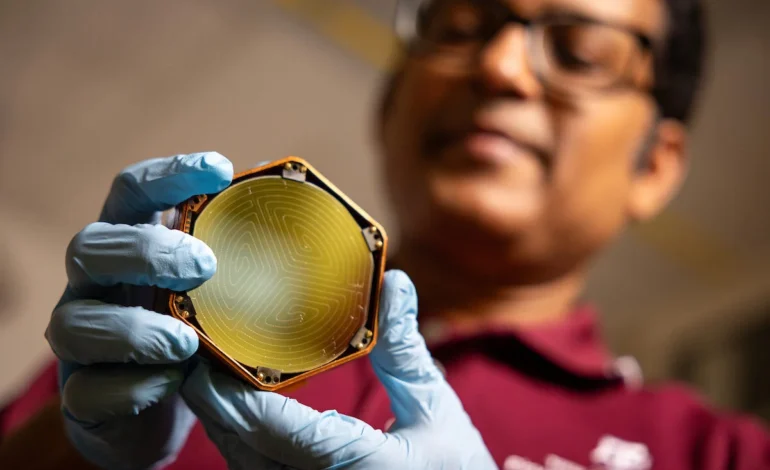
At a university reactor in Texas, cryogenic quantum sensors are being used to chase two elusive targets at once: the particles that may make up dark matter, and the low-energy neutrinos produced by nuclear fission. The work is led by Dr Rupak Mahapatra, an experimental particle physicist at Texas A&M, who says the aim is to detect interactions so rare they might appear only once in a year, or even once in a decade.
Mahapatra’s team is developing advanced semiconductor detectors paired with sensors that operate at extremely low temperatures, so that minute deposits of energy can be measured rather than lost to background noise. The same approach can be used in different settings, from underground experiments built to search for dark matter to reactor-based studies that may help verify nuclear activity.
Science & Environment — More from EyeOnLondon
Three recent stories chosen to keep you reading beyond the first discovery.
Iron Age hoard discovered in Norfolk
A find that raises fresh questions about craft, trade and everyday life in ancient Britain.
Read the storyMore Science & Environment
Microbes could be key to surviving on Mars
What the research suggests, and why the smallest organisms may matter most off-world.
Read the storyMore Science & Environment
North Atlantic right whale seeing baby boom
A rare piece of good news for a threatened species, with careful optimism among researchers.
Read the storyMore Science & Environment
In the lab, the hardware can look modest. One device pictured by the university is a sapphire detector used at the Texas A&M TRIGA reactor as part of a programme known as MINER, designed to pick up low-energy neutrinos while also offering a path into dark matter searches.
The larger purpose is to address a familiar problem in modern physics: most of the universe appears to be made of substances we cannot directly see. Dark matter, thought to shape the way galaxies and clusters hold together, has never been captured in a detector. Dark energy, used as a term for what drives cosmic expansion, remains even harder to pin down.
Mahapatra reaches for a parable to describe the gap between evidence and understanding. “It’s like trying to describe an elephant by only touching its tail,” he said. “We sense something massive and complex, but we’re only grasping a tiny part of it.”
That sense of partial knowledge shapes the way many research groups now work. Rather than betting everything on one idea, they test several possible candidates and improve the tools needed to detect them. Mahapatra has spent years contributing to SuperCDMS, an experiment known for pushing the sensitivity of cryogenic detectors, and his group is also involved in the development of detectors used in the TESSERACT programme.
One of the best-known candidate particles in this field is the WIMP, short for Weakly Interacting Massive Particle. The appeal is simple: if WIMPs exist, they could account for a significant share of the missing mass implied by astronomical observations. The problem is that a WIMP, by definition, passes through ordinary matter with almost no interaction.
What this kind of detector is trying to catch
- Signals that arrive rarely: events that might show up after long periods of quiet data.
- Energy deposits at the smallest scales: the sort that conventional detectors struggle to register.
- A clearer picture of backgrounds: separating genuine particle interactions from noise and false positives.
The researchers argue that cryogenic quantum sensors do more than serve one niche question. A detector sensitive enough to register tiny energy changes can, in principle, be useful in other contexts, including certain forms of reactor monitoring and parts of quantum technology research.
Whether the next breakthrough comes from a WIMP search, an axion-like candidate, or a surprise that does not fit current models, the immediate work remains practical and careful: refining materials, lowering thresholds, and testing how detectors behave in the real world. Further information on the detector approach used in TESSERACT is set out on the collaboration’s website.
For more reporting that explains the science shaping public debate, follow EyeOnLondon. Tell us in the comments which big research question you want unpacked next.
[Image Credit | Texas & AM Stories]
Follow us on:



Subscribe to our YouTube channel for the latest videos and updates!

We value your thoughts! Share your feedback and help us make EyeOnLondon even better!