Taklamakan Desert becomes carbon sink after major tree planting

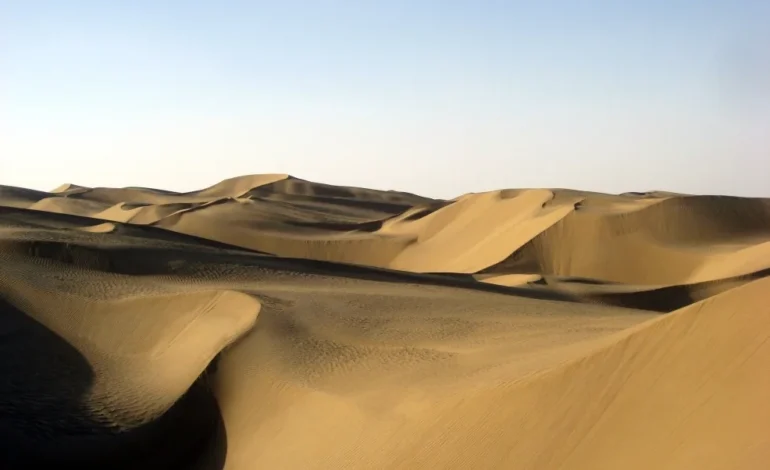
The Taklamakan Desert in northwestern China has gone from being considered a ‘biological void’ into a carbon sink after major tree planting efforts. Following major ecological engineering on the edge of the largest and driest desert, research has found that it absorbs more CO2 than it emits.
The Taklamakan Desert stretches around 130,000 square miles (337,000 square kilometres, and is surrounded by high mountains. These mountains block moist air from reaching the desert for much of the year, leading to harsh, arid conditions that are challenging for plantlife.
But over the past few decades, a forest has been planted around the edges of the Taklamakan Desert, and a new study has suggested that it has proven successful.
“We found, for the first time, that human-led intervention can effectively enhance carbon sequestration in even the most extreme arid landscapes, demonstrating the potential to transform a desert into a carbon sink and halt desertification,” study co-author and professor of planetary science at Caltech and a senior research scientist in NASA‘s Jet Propulsion Laboratory, Yuk Yang told Live Science.
Since the 1950s when China began with its massive urbanisation and farmland expansion, the desert has been growing. Nearly 95% of it is covered in shifting sand, causing it to be seen as a ‘biological void,’ the study says. The conversion of natural land created conditions which resulted in more sandstorms, causing land degradation and desertification.
But in 1978, China began with the Three-North Shelterbelt Program, a major engineering project to slow this down. The ‘Great Green wall,’ as it was nickname, aimed to plant billions of trees around the margins of both the Taklamakan and Gobi deserts by 2050. Over 66 billion trees have been planted in northern China so far, though there has been debate among experts over whether this has reduced the frequency of sandstorms.
In 2024, the Taklamakan Desert had been surrounded by vegetation, and researchers say the effort has caused sand dunes to stabilise and grown forest cover in China to go from 10% in 1949 to over 25% today.
Image: Pravit
Stay tuned to EyeOnLondon for the latest news and expert opinions.
Follow us on:



Subscribe to our YouTube channel for the latest videos and updates!

We value your thoughts! Share your feedback and help us make EyeOnLondon even better!