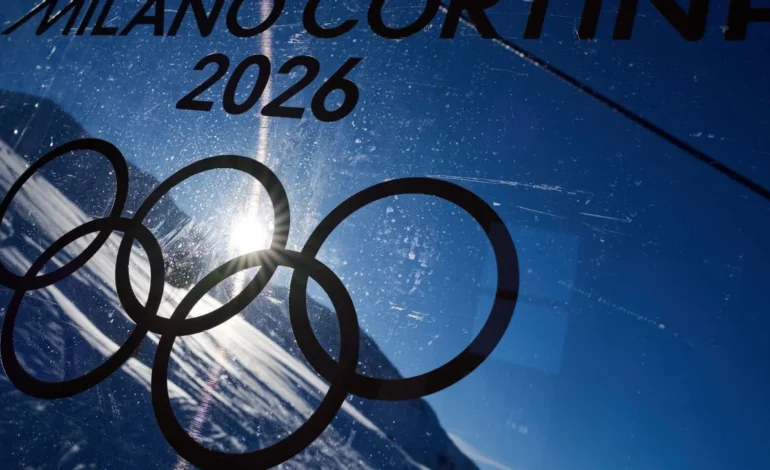
The Milano Cortina Games represent the pinnacle of a sporting life shaped by endurance, discipline, and private sacrifice, long before medals are decided. Writing from Italy ahead of competition, Britain’s most successful Winter Olympian Lizzy Yarnold reflects on the emotional realities of arriving at an Olympic Games, from the pride of joining Team GB to the quiet loneliness that can accompany it.
“There was huge pride,” she says, “but also an initial feeling of loneliness. I remember thinking, what do I do now?”
Sport — More from EyeOnLondon
Three recent stories offering context, consequence and perspective from the world of sport.
Winter Olympics competition schedule explained
A clear guide to key events, dates and formats as attention turns to the upcoming Winter Games.
Read the storyMore Sport
Facial injury after training raises safety questions
What happened during a routine session, and how elite athletes manage risk away from competition.
Read the storyMore Sport
Infantino criticised over Russia ban proposal
Ukraine responds to comments from FIFA’s president as sport and international politics collide.
Read the storyMore Sport
That emotional dislocation is rarely visible to audiences watching from home. From the outside, the Olympic Games appear seamless and celebratory. Inside the village, Yarnold discovered, identity shifts abruptly. You arrive as an individual athlete, but you are expected to subsume yourself instantly into something much larger.
What helped, unexpectedly, was routine. Each day Team GB designated a base colour for clothing. Blue one day, red and white the next. In the communal areas, that simple visual cue created a sense of belonging. “It helped me move from feeling overwhelmed into focus,” she says. “This is the Olympics. I’m here to do my job.”
That tension between vulnerability and control sits at the heart of Olympic life as a skeleton athlete, a sport that combines extraordinary speed with a constant negotiation of risk. Yarnold is now based in Cortina, where events for the Milano-Cortina Games are being staged, and although she is no longer staying in the village, she says the atmosphere is unmistakable.
In nearby Livigno, she watched the Olympic torch pass through town, blue lights flashing, people spilling into the streets to follow it. “The Games are incredibly special,” she says. “For the athletes, this is the pinnacle of their sporting lives.”
That status brings pressure as much as prestige. Distraction, Yarnold believes, is the greatest threat. Recent debate over the British team’s new aerodynamic skeleton helmets has drawn attention, but she remains unconcerned.
“I don’t think it will have a massive effect,” she says. “Team GB are already the best in the world without the new helmet. Matt Weston and Marcus Wyatt are among the favourites for gold. They won’t care too much which helmet they use.”
Innovation, she argues, is an accepted and expected part of elite sport. She recalls similar attention being paid to aerodynamic suits ahead of the 2018 Games, changes that barely registered once competition began. “The rules are loose with their wording,” she says. “There are no diagrams or measurements in the regulations. Pushing performance is normal.”
Where innovation ends and endurance begins is often far less visible. Yarnold’s own Olympic success was achieved alongside illness and injury that she kept largely to herself. Before the 2018 Games in Pyeongchang, she discovered a lump in her knee. Uncertain at the time whether it was a tumour, she chose to delay surgery until after competition, informing only the medical team.
She then developed a severe chest infection. With temperatures hovering around minus 20 degrees, she struggled to breathe. On race days, instead of warming up, she inhaled steam in a small room beside the track. “I couldn’t breathe through my nose,” she recalls. “I could barely breathe through my mouth.”
Most serious of all was a vestibular condition linked to damage in her right ear earlier in her career. At skeleton speeds, the strain on the body can reach more than five times the force of gravity. When symptoms struck, balance vanished instantly.
“Imagine being incredibly drunk, wandering sideways,” she says. “Complete physical disorientation. Not ideal when you’re travelling at 90 miles an hour.”
It happened midway through her first run in Pyeongchang. Unable to steer, she clung to the sled, arriving at the bottom unsure where she was. Her teammate helped her up and they walked away arm in arm, disguising what had just happened.
“I tried to call my husband,” she says. “I couldn’t even see my phone.”
She asked the physio a blunt question. If she went again, would it kill her? After checks, she chose to continue, with a doctor waiting at the finish. The symptoms settled. She went on to win her second Olympic gold.
That capacity to continue, Yarnold believes, defines elite sport more than raw talent. “Athletes are resilient,” she says. “That comes from responding to failure and building self-belief.”
Watching others now, she sees the same dynamic at work. She speaks with admiration of Lindsey Vonn, who is set to compete in downhill skiing despite a ruptured ACL and at the age of 41. Vonn has spoken publicly about racing with a knee brace and carrying personal grief after the death of her mother.
“She’s already won everything,” Yarnold says. “She has nothing to prove. But I can’t wait to watch her compete.”
Olympic life as a skeleton athlete, she reflects, is defined by moments of danger that are hidden behind professional calm. To the viewer, the sport may look terrifying. To those competing, it is daily work, honed through repetition and trust in preparation.
Her hope for the coming Games is simple. “Whatever the issues, whether injury, illness, doping or politics,” she says, “I just hope the athletes are safe to compete and can do so in a fair environment.”
For more first-hand reflections from athletes and writers at the world’s biggest sporting events, follow EyeOnLondon for thoughtful coverage beyond the podium.
This article is adapted from a first-person account originally published by The Guardian.
[Image Credit | ESPN]
Follow us on:



Subscribe to our YouTube channel for the latest videos and updates!

We value your thoughts! Share your feedback and help us make EyeOnLondon even better!