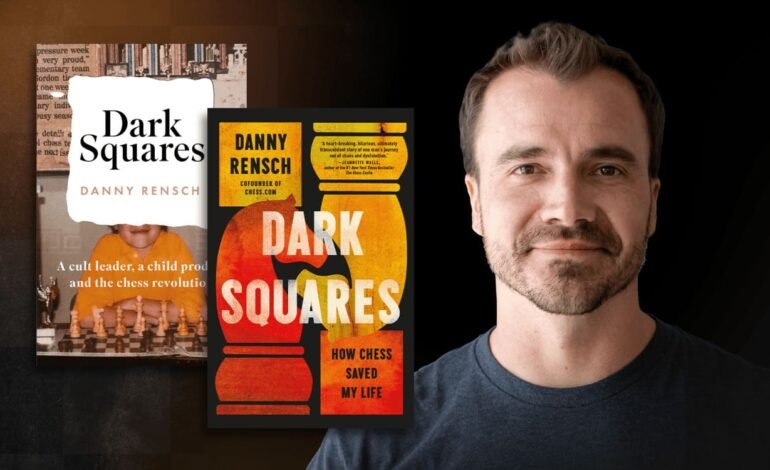
Why chess players are writers is the question at the heart of this piece, sparked by IM Danny Rensch’s memoir ‘Dark Squares’. Published by Wildfire, the book comes from the Chief Chess Officer of the world’s largest chess platform, chess.com. At 39, Rensch recounts a painful childhood in a religious cult under an abusive leader, his emergence as a child prodigy, and the chess revolution that saved his life. It is not centred on chess, but on the life of a chess player, with all its ups and downs, and it shows how the game’s habits of memory, notation and strategy can shape clear thinking and strong prose.
Dark Squares and the writer at the board
The author has risen to become one of the most influential figures in the chess world, thus ‘the memoir feels justified’. He was brought up in a religious cult, and chess provided a means of escape, with the accompanying mental health issues exacerbated by an abusive upbringing by a cult leader. He often went hungry, was passed around ‘from family to family’, his surname changing ‘with the seasons’. But, as he states, he turned the tables with his successes at chess, which the cult leader had used ‘as a prop to give him more clout’. Eventually, chess enabled him to escape the confines of the cult clan at Tonto Village in Arizona and, as we now know, led him to become a leader himself at the biggest chess company and platform the world has ever seen.
Mike Klein’s revelatory talk with the author, and long-time friend, concluded after reading the book: ‘I only knew about 10 percent of the real you. This book, in a word, is revelatory; how did chess save your life?’ Read the book. It is a must-read and reveals the author’s crusade to rise above the shackles imposed on him in his formative years by abusive, egocentric villains of the soul and abusers of the innocent.
Garry Kasparov, the 13th World Champion, states that ‘Dark Squares’ is ‘a powerful memoir and a testimony to why an ancient board game still has a place in our modern world… with his work at chess.com and with this beautiful book, he is well on the way to paying back his debt to our beloved game’.
Biographical books about chess players have proliferated over the decades, including true stories presented on film such as ‘The Queen of Katwe’, and fictional ones such as ‘The Queen’s Gambit’, although based on real life. In recent years, given the scourge of Covid, millions of people around the world took up chess and, given these life stories, even those who had no previous interest in chess have looked further and deeper into its history. Characters manifestly linked to chess, in an ever-evolving expansion through the internet and the electronic age, have shed their anoraks and become stars of popular culture.
Lessons from Kasparov, Rowson and Ashley
For monographs, Grandmaster Maurice Ashley’s ‘Move by Move: Life Lessons on and Off the Chessboard’ (2024) tells of the author’s successes, from an immigrant kid playing chess in Brooklyn’s parks, New York, to the top levels of international chess as the first African American to attain the Grandmaster title. He explains the essential lessons that chess has taught him about life. Or Jonathan Rowson’s ‘The Moves That Matter: A Chess Grandmaster on the Game of Life’, where he reveals the teachings this ancient game offers for staying present and thriving in a complex world. It includes stories on how the chess platform can be used to solve life’s problems: ‘a nuanced and witty meditation on confronting the challenges life throws at us’. Or ‘How Life Imitates Chess’ by Garry Kasparov, which contains lessons learned by the master, including daily mantras about mastering the strategic and emotional skills to navigate life’s toughest challenges and maximise success no matter how difficult the competition. ‘Unfortunately,’ he says, ‘the number of ways to do something wrong always exceeds the number of ways to do it right.’ Drawing on a wealth of revealing and instructive stories gathered in part from his wide-ranging and perceptive reading and activities, he includes quotes from many illustrious sources, including this from Winston Churchill: ‘Attitude is a little thing that makes a big difference,’ and ‘If we trust in our abilities they will repay us.’ I must admit that every time I have been in Kasparov’s company I have sensed a dynamo of controlled energy that underpins his countenance, and from him emanates a powerful, controlled sense of confidence.
Kasparov’s autobiography reveals how and why the game of chess is a fitting and powerful teacher of how to be prepared for, and how to win in, even the most competitive situations. Although I could easily go on listing and quoting from the thousands of books describing individual chess players and groups of players, the overwhelming evidence that comes to mind is that most chess players I have met are articulate, literary-minded and conversant, and able to write down their thoughts, with both the positives and negatives of life, giving due importance to their role in shaping people’s lives. This fluency is not surprising, since the game of chess requires its players to write notation, learn and store in memory opening and defensive theory, and the multiple variations that keep being added to the chess inventory in the present age of AI and electronic methodology.
Memory, notation and voice in chess writing
The literacy, memory recall, and strategic thinking behind the action keep being added to, and although this is in the mind it is expounded into real space, showing how space is ordered, used, and manipulated to fulfil the game’s requirements. In so doing it energises, trains and projects the mind’s eye to become part of the real space and real time the chess player occupies, a transformative experience in which both players assist in shaping each other’s thinking and actions.
Each player needs their adversary, their counterpart, when the call to play sounds, in order to shape themselves in the time to come. It is past, present and future at the same time, rolled into the now. Given the development and in-depth articulation that chess demands of its adherents, and has done over the centuries, it is no surprise that many books have been written by those engaged in this rich and engaging activity on so many different levels. Perhaps the bigger surprise is that there are not many thousands more.
From Simpson’s to Samarkand: culture and continuity
Recent news is that the Staunton Society is being reformed, which some may remember for, among its many triumphs, the seven successive International Howard Staunton Chess Tournaments held at Simpson’s in the Strand, the historic home of British chess, several of which were the strongest rated tournys played in Britain for over 30 years. I am once again a member of the organising committee, along with Raymond Keene GM OBE and other notables. Further news about the Society will be in the next edition of this publication.
The Challange
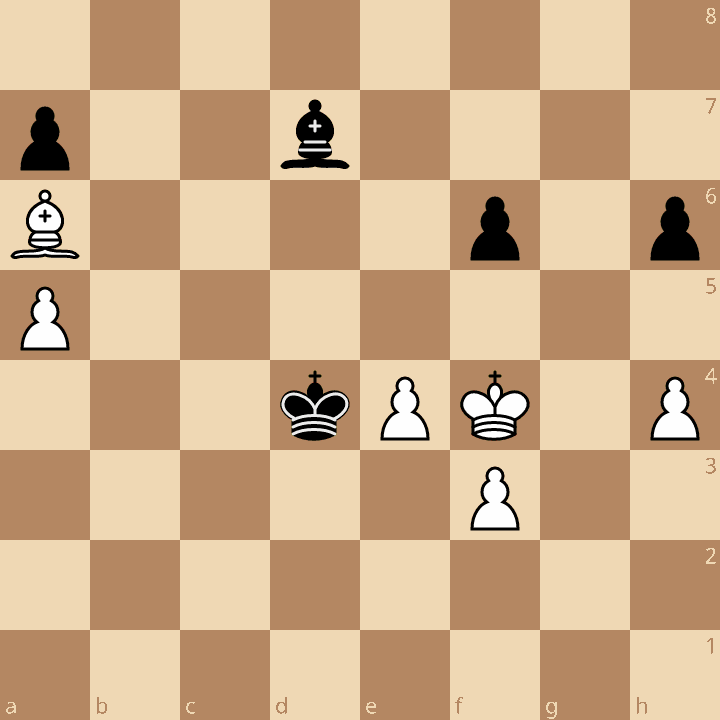
The Challange this month is taken from the FIDE Grand Swiss Tournament recently held in Samarkand, Uzbekistan, between Anish Giri and Hans Moke Niemann. Niemann, as Black, has just moved his bishop: 41…Bd7.
What was Giri’s response as White?
The Solution
42.Be2, Kc5;
43.e5, Kd5;
44.exf6, Ke6;
45.f7, Kxf7;
46.Ke5 … 1–0
Fancy more chess puzzles and stories?
If you loved this puzzle and the background on Dark Squares, why stop here? Visit our Chess section on EyeOnLondon for more game analyses, puzzles and chess-life stories. Try The Chancellor’s Craze puzzle, browse A Masterful Checkmate: Chess Through the Looking Glass, or analyse a match from the Freestyle Chess event at Grenke Festival 2025. Click the links to explore and keep playing.
[Image Credit | Chess.Com]
Follow us on:



Subscribe to our YouTube channel for the latest videos and updates!

We value your thoughts! Share your feedback and help us make EyeOnLondon even better!