London Beneath Our Feet: Why the Capital Keeps Rewriting Its Own Past

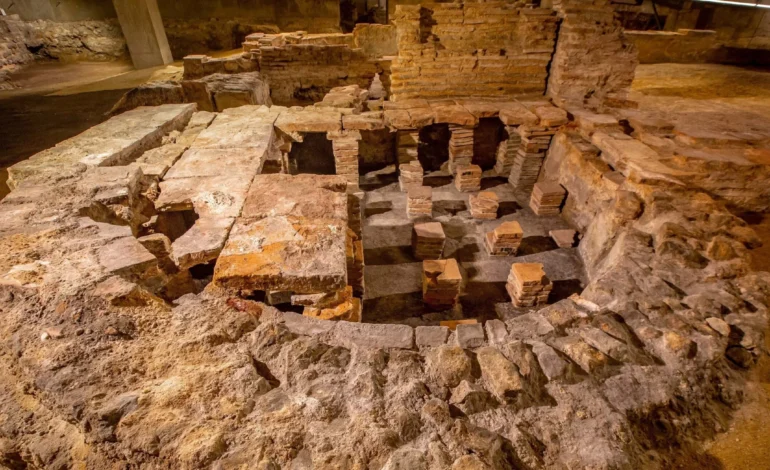
London is often described as a city that never stops changing, but recent archaeological discoveries suggest it is also a city that never stops revealing itself. From Roman frescoes shattered into thousands of fragments to everyday objects discarded by Victorian households, the capital’s building sites continue to open brief windows into nearly two millennia of life beneath its streets.
The pace and scale of London archaeology discoveries have accelerated in recent years, driven not by academic digs but by redevelopment. Each new office block, transport hub, or housing scheme brings with it a narrow opportunity to examine what lies below, before concrete once again seals the past from view.
Arts & Culture — More from EyeOnLondon
Three recent stories exploring history, discovery, and the cultural record.
Iron Age hoard uncovered in Norfolk
A rare discovery offering fresh insight into power, trade, and ritual in Iron Age Britain.
Read the storyMore Arts & Culture
Secret maps reveal Britain’s hidden past
From military intelligence to vanished landscapes, a British Library exhibition revisits mapping as power.
Read the storyMore Arts & Culture
Earliest evidence of fire-making uncovered
A groundbreaking discovery that reshapes what we know about early human innovation and survival.
Read the storyMore Arts & Culture
A city built in layers
Archaeologists working in London often describe the ground beneath the city as layered rather than linear. Prehistoric traces sit below Roman roads, which in turn are capped by medieval foundations and Victorian infrastructure. Excavation is therefore an act of careful reversal, removing history in the opposite order to which it was laid down.
Recent excavations have reinforced just how rich those layers remain. Discoveries have included what is believed to be London’s earliest theatre, the remains of the city’s first basilica, and a Roman mausoleum uncovered close to the Shard. One of the most striking finds, however, has been a set of brightly coloured Roman wall paintings, smashed into thousands of pieces and discarded in a pit nearly 2,000 years ago.
Fragments of the frescoes suggest the use of rare pigments and include what appears to be the artist’s signature, an exceptionally unusual feature for Roman Britain. Such details offer insight not only into wealth and taste, but into the individuals who once lived and worked in the city.
What rubbish tells us about Roman London
Some of the most revealing discoveries have come not from grand buildings, but from waste. At the site of Bloomberg’s European headquarters, archaeologists recovered thousands of Roman artefacts from ancient landfill along the waterfront, including what is thought to be the oldest handwritten document found in Britain.
These discarded objects have helped to reshape understanding of early London. Brooches, pottery, and personal items suggest that the city’s Roman population was drawn from across continental Europe, with distinct cultural groups settling in different areas. Evidence points to neighbourhoods shaped by origin and occupation rather than by chance, challenging older assumptions about Roman London as a homogeneous settlement.
The phenomenon is increasingly shaping academic thinking about the capital’s earliest urban identity. Research into Roman London’s development, including material now held by the Museum of London Archaeology, continues to refine how historians understand migration, trade, and daily life in the city’s formative centuries.
For readers interested in how archaeology is managed alongside modern construction, the regulatory framework governing development-led excavation in England can be found through Historic England’s guidance on archaeology and planning, which sets out why so many discoveries occur during redevelopment.
From Sailor Town to the modern city
Not all discoveries are ancient. Excavations in Wapping, on the site of a future distribution centre, revealed a densely layered community dating from Roman times through to the Victorian era. Foundations of schools, almshouses, chapels, and terraced housing were uncovered, alongside cesspits and wells filled with everyday objects.
These finds complicate long-held views of the area once known as Sailor Town. Rather than a place defined solely by overcrowding and danger, the archaeological record suggests a mixed and functioning community, home to families, tradespeople, and institutions.
Such sites underline the reality of urban archaeology today. Excavations often take place under intense time pressure, sometimes within basements while buildings above are being dismantled. Heavy machinery is as much a part of the process as fine tools, though recording and conservation remain meticulous.
Rare finds in unlikely places
Among the most remarkable recent discoveries was a Roman bed uncovered in an ancient cemetery in Holborn. Furniture of this kind is extraordinarily rare in Britain, with few parallels anywhere in the Roman world outside sites such as Pompeii and Herculaneum. Preserved in London’s damp soil for almost two thousand years, the bed is now undergoing conservation before eventual public display.
Finds like this serve as a reminder that archaeology in London is not confined to museums or textbooks. It emerges unexpectedly, shaped by the practical realities of a living city.
Why it still matters
Beyond the spectacle of discovery, archaeologists emphasise the wider significance of their work. Unearthed objects provide context, continuity, and perspective, anchoring modern London within a much longer human story.
The city’s rapid development shows no sign of slowing, but neither does its capacity to surprise. As cranes reshape the skyline, the ground below continues to yield evidence of who lived here before, how they organised their lives, and how deeply today’s London is rooted in its past.
For more features exploring London’s history and cultural heritage, follow EyeOnLondon for insightful storytelling you can trust.
[Image Credit | City of London]
Follow us on:



Subscribe to our YouTube channel for the latest videos and updates!

We value your thoughts! Share your feedback and help us make EyeOnLondon even better!