Universe slowdown challenges long-held dark energy theory

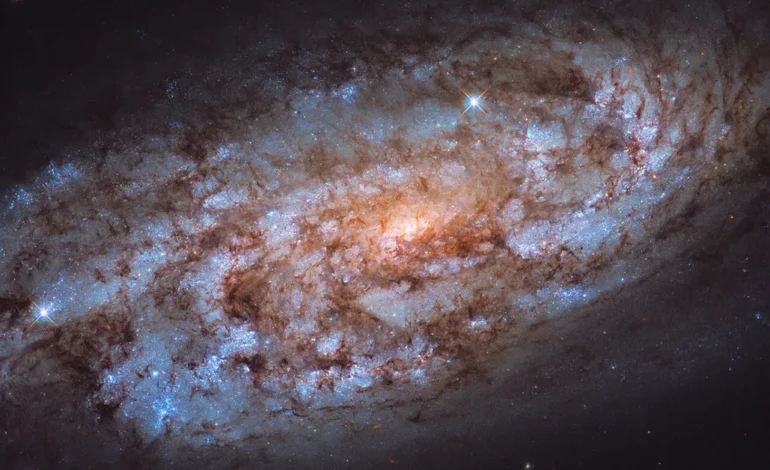
For decades, astronomers believed the universe was expanding faster and faster, driven by a mysterious force called dark energy. Now, a groundbreaking new study suggests that acceleration may already have ended, and that a universe slowdown has quietly begun.
The research, published in the Monthly Notices of the Royal Astronomical Society, could mark one of the biggest shifts in modern cosmology since the discovery of dark energy 27 years ago.
Science & Environment — EyeOnLondon
Climate, space and deep time discoveries. Click through to read the full reports.
Great Barrier Reef can recover if warming stays below 2C
Marine scientists say the world’s largest reef still has a path back, but only under tight climate limits.
Read the storyMore Science & Environment
Exoplanet temperature mapped by JWST
James Webb telescope delivers a detailed heat map of a distant world for the first time.
Read the storyMore Science & Environment
Late Cretaceous dinosaurs were thriving
New research suggests dinosaurs were still diverse and healthy before the asteroid struck.
Read the storyMore Science & Environment
Professor Young-Wook Lee of Yonsei University, who led the study, said:
“Our analysis shows that the universe has already entered a phase of decelerated expansion at the present epoch and that dark energy evolves with time much more rapidly than previously thought.”
If confirmed, the findings could reshape how scientists understand dark energy, thought to make up around 70 per cent of the universe, and could also help resolve the long-standing “Hubble tension,” the disagreement between different measurements of the universe’s rate of expansion.
Reassessing the evidence
Since the 1990s, researchers have relied on the brightness of distant supernovae to track cosmic expansion, leading to the Nobel Prize-winning discovery of accelerating growth. However, the new study, led from South Korea with contributions from UK astronomers, found that the age of the stars producing these supernovae affects their brightness, skewing earlier conclusions.
Analysing data from more than 300 host galaxies, the team discovered that supernovae from younger stars appeared fainter than those from older stars, even after standardisation. When corrected for this “age bias,” the supernova data no longer supported the standard cosmological model, which assumes a constant form of dark energy.
Instead, it aligned more closely with newer models derived from baryonic acoustic oscillations, subtle “ripples” in the distribution of matter that trace back to the early universe, and data from the cosmic microwave background. Both suggest that dark energy weakens and changes over time.
A paradigm shift in motion
Professor Lee said the implications were far-reaching.
“If these results are confirmed, it would mark a major paradigm shift in cosmology,” he said. “It shows that the universe may already have moved from an accelerating phase to a decelerating one.”
His co-lead, Research Professor Chul Chung, added that upcoming observations from the Vera C. Rubin Observatory in Chile would be critical in verifying the trend. The facility is expected to detect over 20,000 new supernova host galaxies within the next five years, offering an unprecedented opportunity to refine measurements.
The observatory, alongside the Dark Energy Spectroscopic Instrument (DESI) project in Arizona, is already transforming our view of cosmic structure. Together, these instruments could finally reveal whether dark energy, once thought to be a constant force, is instead evolving with time.
For now, the Yonsei team’s findings add weight to a growing body of evidence that the expansion of the universe may no longer be accelerating. According to the Royal Astronomical Society’s summary of the research, available via ScienceDaily, this could help explain discrepancies between different cosmological measurements that have puzzled physicists for years.
A related study published this week, New Evidence Suggests Einstein’s Cosmic Constant May Be Wrong, reinforces the same conclusion: the cosmos might be governed by evolving, rather than fixed, physical laws.
If the universe truly is slowing down, cosmologists will have to rethink not only how it began but how it will end.
For more independent coverage of science, discovery, and innovation in Britain and beyond, follow EyeOnLondon for intelligent stories that bring complex ideas down to earth.
[Image Credit | BBC Sky at Night Magazine]
Follow us on:



Subscribe to our YouTube channel for the latest videos and updates!

We value your thoughts! Share your feedback and help us make EyeOnLondon even better!