Gold Loses Its Shine as Investors Retreat from Safe Havens

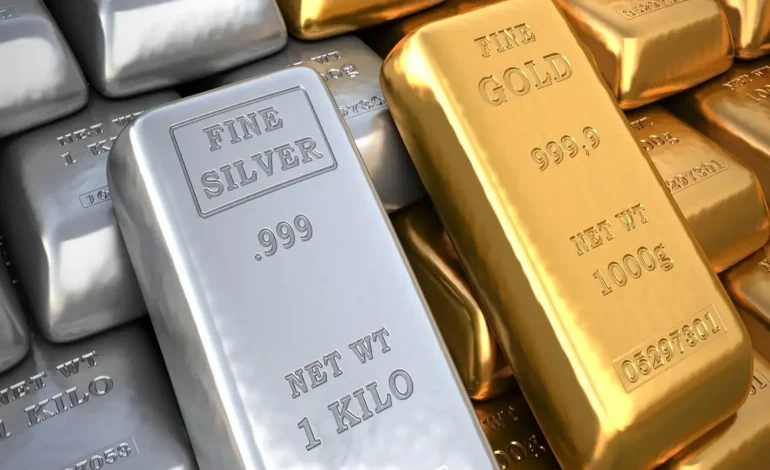
Gold and silver have suffered a sharp reversal after a rally that pushed both metals to record levels, with the gold and silver sell-off gathering pace as investors reassessed the outlook for interest rates and the US dollar.
Spot gold fell by more than nine per cent at its lowest point, marking its steepest one-day decline since 1983, before recovering some ground to trade around $4,750 an ounce. Silver fared worse, plunging as much as 27 per cent before rebounding to roughly $82 an ounce, still down more than three per cent on the day.
Business & Finance — More from EyeOnLondon
Three recent stories offering context beyond the day’s headlines.
Crypto liquidation surge rattles markets
A sharp wave of forced selling exposes leverage risks and raises questions about market stability.
Read the storyMore Business & Finance
Eurozone benefits outweigh downsides for Sweden
A new report weighs the economic case for membership against long-standing political concerns.
Read the storyMore Business & Finance
Warnings raised over AI stock valuations
Analysts caution that optimism around artificial intelligence may be running ahead of reality.
Read the storyMore Business & Finance
The retreat followed weeks of strong gains driven by demand for so-called safe-haven assets. Precious metals had surged in January as markets reacted to geopolitical tensions, concerns over US tariffs, and unease about the independence of the Federal Reserve.
That mood shifted abruptly after President Donald Trump nominated Kevin Warsh, a former Federal Reserve governor, to serve as the next chair of the central bank. Financial markets broadly welcomed the appointment, pushing the US dollar up by around one per cent and reducing the appeal of non-yielding assets such as gold.
Analysts said the nomination appeared to be the immediate trigger for Friday’s sell-off. One major bank described the move as the clear catalyst for a sudden wave of profit taking after prices had moved too far, too quickly.
Trading conditions also tightened. Changes to margin requirements on a major commodities exchange increased the cost of speculative positions, adding further pressure as leveraged investors rushed to unwind trades.
Despite the scale of the fall, gold prices remain close to levels seen just a few weeks ago and are still around 70 per cent higher than a year earlier. The metal had peaked above $5,500 an ounce at the end of January, following its strongest annual performance since 1979.
Silver’s decline was steeper, reflecting its dual role as both a precious and industrial metal. Prices had climbed above $120 an ounce earlier this year before the sharp correction exposed how stretched the rally had become.
Broader markets reflected the shift in sentiment. Asian equities fell sharply, led by a five per cent drop in South Korea’s Kospi index. Hong Kong’s Hang Seng slid three per cent, while Japan’s Nikkei 225 lost more than one per cent.
In Europe, the FTSE 100 initially moved lower as falling commodity prices weighed on mining stocks. Gold producers Fresnillo and Endeavour Mining both slipped between two and three per cent before the index recovered to trade around half a per cent higher by midday.
Energy markets also weakened. Crude oil fell by nearly five per cent amid steady output from major producers and signs of easing tensions between the United States and Iran. A stronger dollar added to the pressure, making dollar-priced commodities more expensive for overseas buyers.
Gold’s longer-term appeal has been underpinned by its scarcity. According to figures from the World Gold Council, only around 216,265 tonnes of the metal have ever been mined. Central bank buying and geopolitical uncertainty have fuelled demand in recent years, though prices have proved vulnerable when sentiment turns.
Mark Matthews, head of Asia research at Bank Julius Baer, said the recent falls reflected how far prices had already run. “Once profit taking started, it just snowballed,” he said, describing the market as having gone parabolic in the days before the reversal.
Investors are now watching closely for signals from the Federal Reserve. Wall Street analysts expect at least two interest rate cuts in 2026, a backdrop that has historically supported gold. Whether the gold and silver sell-off marks a deeper shift or a pause after an exceptional rally remains an open question.
For more stories on markets, commodities, and the forces shaping global finance, follow EyeOnLondon for informed and independent reporting. We’d welcome your thoughts in the comments.
[Image Credit | The Economic Times]
Follow us on:



Subscribe to our YouTube channel for the latest videos and updates!

We value your thoughts! Share your feedback and help us make EyeOnLondon even better!